





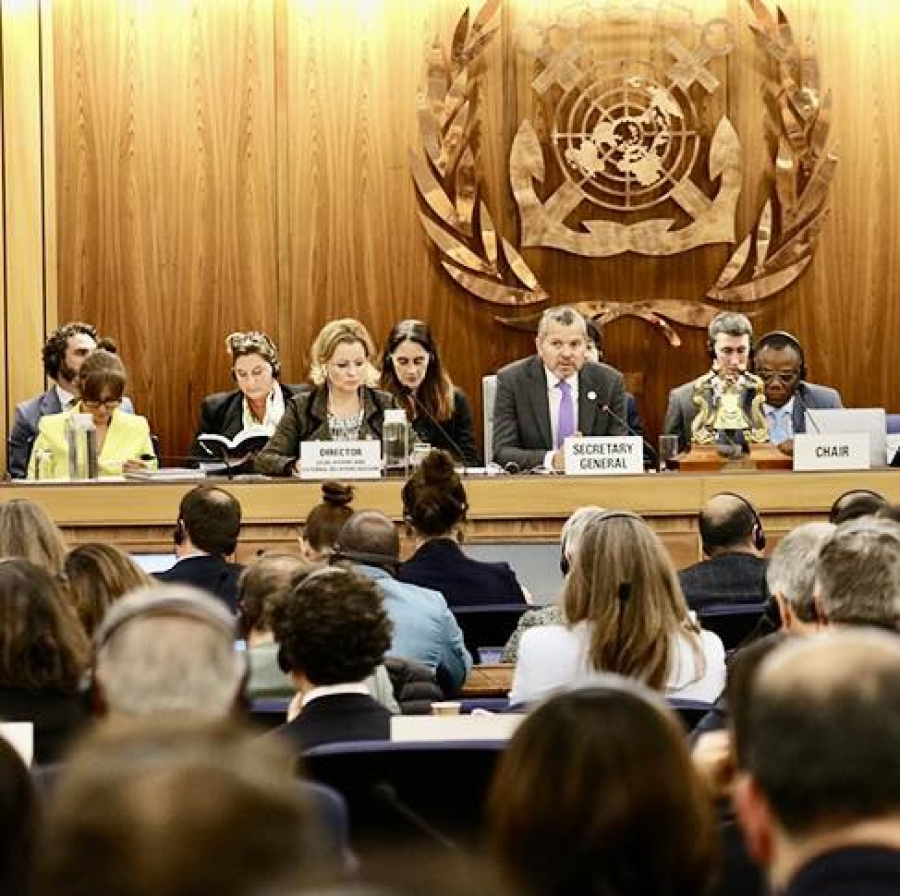
IMO’s Marine Environment Protection Committee votes to adjourn discussions on the Net-Zero Framework for one year.
The extraordinary session will be reconvened in 12 months’ time. In the interim, Member States will continue to work towards consensus on the IMO Net Zero Framework.
The International Maritime Organization (IMO) has agreed to adjourn the extraordinary session of the Marine Environment Protection Committee (MEPC), which was convened this week (14 to 17 October 2025) to consider the adoption of draft amendments to MARPOL Annex VI, including the IMO Net-Zero Framework.
The extraordinary session will be reconvened in 12 months’ time. In the interim, Member States will continue to work towards consensus on the IMO Net Zero Framework.
The Intersessional Working Group on the Reduction on Greenhouse Gas Emissions from Ships, scheduled to meet 20 to 24 October 2025, will go ahead to continue work on the guidelines for implementing the Net Zero Framework.
The IMO Net-Zero Framework was approved at the MEPC 83 session in April 2025, as a new Chapter 5 of the Draft Revised Annex VI of the International Convention for the Prevention of Pollution from Ships (MARPOL). It comprises a set of international regulations aimed at reducing greenhouse gas (GHG) emissions from ships, in line with IMO's 2023 Strategy for Reduction of GHG Emissions from Ships. It includes two key elements: a global fuel standard and global GHG emissions pricing mechanism.
Statement of the President of the Union of Greek Shipowners Melina Travlos
The decision to delay the process at the IMO presents a new opportunity to shape a sustainable and effective international framework that will guide global shipping safely and realistically through the green transition.
The lack of consensus highlighted deep rifts over the proposed Net-Zero Framework regulation, where the positions advanced by the shipping industry were not sufficiently taken into account.
Greek shipping remains firmly committed to the shared goal of decarbonisation and is ready to lead constructively, with evidence-based and unifying proposals, in a global effort to shape a fair, practical and enforceable clean plan, where all stakeholders assume their share of responsibility on the collective path toward the green transition.
Greek Shipping Co-operation Committee statement in relation to IMO MEPC Extraordinary Session outcome
Last Friday’s events at the IMO need not presage a delay in the creation of a coherent decarbonisation policy.
They simply provide an opportunity to involve those at the epicentre of the maritime world, the shipping community.
So far, they have only had side seats at this crucial time. We must include them closely to create a workable policy which selects all available low carbon and zero carbon fuels and all technologies on the way towards 2050. Furthermore, fuels that are to be mandated, explicitly or implicitly, to achieve decarbonisation must be both available and safe.
The non availability of many of the transitional fuels does not help the shipping industry move forward.
There must be a realisation that different sectors of the industry, such as tramp and liner shipping, have different paths to achieve their goals. The regulations must reflect this.
There needs to be certainty and accountability in respect of funds that are to be collected. Furthermore, if there were actual funds specifically ring fenced for the necessary maritime research and development to take place, it might be possible to achieve real solutions before it is too late.
Global shipping companies, which are represented in all major sectors of the shipping industry and which will in fact be the ones implementing the decarbonisation policy, must be closely consulted if a workable pathway to net zero is to be achieved.
ELNAVI Newsletter
More Information: ELNAVI,
19, Aristidou str., Piraeus 185 31,
Tel.: +30 210 45.22.100, e-mail: This email address is being protected from spambots. You need JavaScript enabled to view it.