





Navigating Volatility and Digital Transformation
For over 30 years, Marine Money has successfully brought together shipowners and financiers. Its 27th annual Greek Ship Finance Forum continued this tradition, featuring prominent and influential maritime experts from around the world.
Mia Jensen, Director Greece & Events Organiser for Marine Money International, opened the forum by setting the stage. She described the current shipping environment as being heavily influenced by geopolitical uncertainty and a volatile freight market.
The first session, "Navigating global trade at the cusp of a new era," was led by Apostolos Zampelas, Partner and Leader of the Shipping Practice at McKinsey & Company.
Mr. Zampelas presented the following remarks:
- Global trade remains at almost peak historical levels, with no region being self-sufficient.
- Trade is travelling further, but countries are trading more with closer political allies.
- US tariffs are at their highest level in nearly a century leading to trade rearrangement and production ramp-up in different geographies.
- Fossil fuels remain resilient until 2050, with natural gas gaining share, while alternative fuels see adoption post 2040.
In this challenging environment he advised he advised shipowners to embed global trade scenarios in business planning, Define fleet composition and deployment, Create strategic partnerships, Develop capabilities to decision making (incl. AI).
Market Turmoil, Geopolitics, and Finance
A subsequent panel, moderated by Chris Vartzis, Partner and Head of Greece Maritime Finance at Stephenson Harwood, addressed the peak of market volatility and political turmoil in 2025. Mr. Vartzis himself noted that 2025 has been a year of market volatility and geopolitical disruptions.
Key takeaways from the panel included:
Costas Delaportas, President & CEO of DryDel Shipping Inc., commented that new US port tariffs will cause transshipment and a shortage of tonnage. He advocated for a "wait and see" strategy to observe how this will evolve. He also predicted that Chinese leasing facilities will be replaced by other financing methods and expressed optimism for continued improvements in engine optimization and efficiency in the dry bulk sector.
Jerry Kalogiratos, CEO of Clean Energy Carriers Corp., agreed that geopolitics, especially U.S. government sanctions, affect various shipping segments. He highlighted the reduction of ships crossing the Suez Canal as a major disruption to trade flows. He added that the USTR policy will influence how shipowners raise capital and, while M&A and governance issues are present, there is still room for new companies.
Alex Hatzipateras, Chief Operating Officer of Dorian LPG Ltd., outlined that adaptability is crucial, as shipowners have always been resilient to market changes. He agreed that consolidation and alliances will be significant in the future, yet opportunities for new players remain.
George J. Souravlas, CEO of Load Line Marine SA, pointed out that disruptions often create more ton-miles, and shipping must seize the opportunity to deliver more efficient and sustainable services. He also viewed Chinese leasing as an issue due to the port tariffs. Regarding alternative fuels, he cautioned that the necessary technology and infrastructure are not yet in place for their widespread adoption.
The consensus among all speakers was that the industry must live with volatility, and that commercial flexibility and diversification are essential for navigating the shipping cycles.
Investments and Capital Markets
David Herman, Projects/Finance at SSY, moderated the next discussion, which focused on investments and Mergers & Acquisitions (M&A).
Constantine Nanopoulos, Deputy CFO of Star Bulk Carriers Corp., explained that the company focuses on transparency to create an attractive equity for future investors.
Hugh Eden, Managing Director, Maritime Investment Banking at Jefferies LLC, provided an update on the latest developments in the capital markets.
Evangelos Chatzis, Chief Financial Officer of Danaos Corporation, highlighted Danaos's solid balance sheet and its recent $500 million bond offering, which proved the company's clear vision and easy access to capital markets. He stressed that a competitive capital structure requires avoiding reliance on a single source of capital.
Alexis Stephanou, Chief Financial Officer of Goldenport Group of Companies, noted that his company strategically creates partnerships with financial and strategic investors to expand its business into new markets. He advised small and medium-sized owners to consider outsourcing the procurement of spares and other operations to help manage the demands of strict regulations.
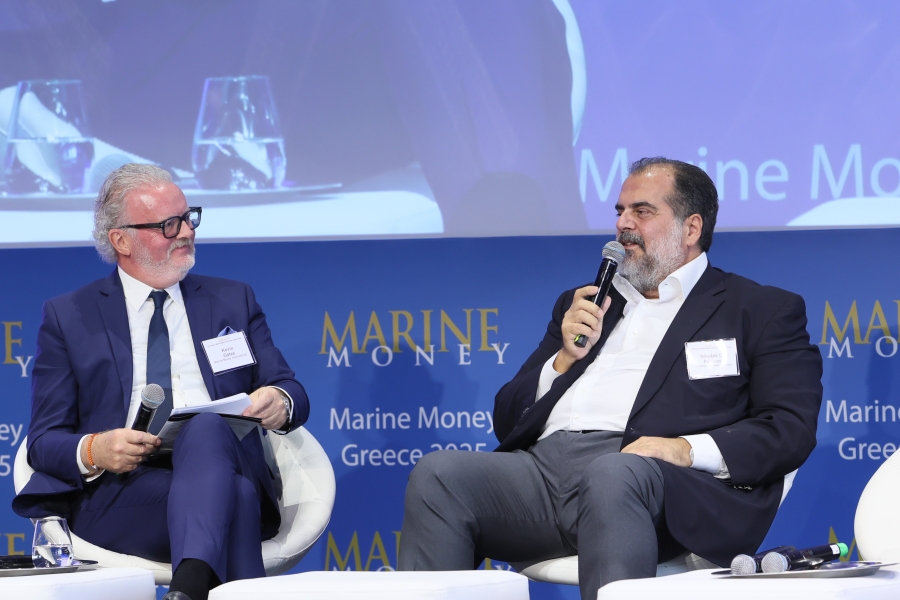
Captain of Industry: Nikolas D. Pateras
The "Captain of Industry" session featured an interview with Nikolas D. Pateras, Chairman of Contships Management Inc., conducted by Kevin Oates, Head of Asia, Marine Money International.
Mr. Pateras represents the fifth generation and 150 years of the Pateras family in shipping, with 40 years of personal industry experience, having owned and operated over 150 vessels.
Chairman of Contships, which operates 40 container feeder vessels, he shared lessons learned, the appeal of smaller container vessels, finance alternatives, a recent Nordic bond in Oslo, and the future of Contships.
Mr. Pateras recounted his start in the industry, which began with working close to his father’s office at a young age, followed by polytechnic studies in London and service in the Hellenic Navy. He formally joined the family business during the depressed shipping market of 1984, when only two of the company’s Multi-Purpose vessels (MPP) were trading and the rest of the fleet was idle. Recognizing an opportunity, he borrowed a quite limited amount of money from his father to acquire 10 ships with the financing of a Spanish bank at attractive prices, which he later sold at higher prices when the market recovered. In 1993, he established Pacific and Atlantic, acquiring different types of ships through various market conditions. Following the market recovery in 2002-2003, he liquidated the majority of his fleet just before the market collapse in 2008. He then entered the feeder sector in 2015, acquiring 60 vessels from distressed German KGs.
More recently, Contships raised $175 million bond from the Nordic market for fleet renewal, capitalizing on the continuing good performance of the feeder ship market. CONTSHIPS is now a leader in this delicate and demanding trade, carrying 1 million TEUs per year. The company has also designed a new vessel 1.300 teu, for the construction of a series of 20 new feeder ships. Mr. Pateras also mentioned his religious roots and support for the restoration of monasteries and churches, particularly the renovation of St. Nicholas church in Athens and sites on Oinousae island. His children are also involved in the company.
U.S. Maritime Policy and Geopolitical Risks
Brian Maloney, Partner at Seward & Kissel LLP, and RADM John P. Nadeau, USCG (ret.), of Nadeau Maritime/MTI Network, provided an update on U.S. Maritime Policy, covering:
- • Sanctions, Tariffs, and Port Fees.
- • U.S. Maritime Enforcement & Policy Outlook for Key Risks.
- • Strategic Implications for Shipowners, Chinese ships, and USA ports.
New Investments and Market Opportunities
A panel moderated by Eva Tzima, Head of Research & Valuations at Cass Technava Maritime S.A., discussed market opportunities for new investments and future market expectations. Speakers included Nikos Gkezepis, CFO, Neptune Lines Shipping and Managing Enterprises S.A., Yannis Kourkoulis, CEO, ARMI Ship Management, Nicholas Petrakakos, Partner & Managing Director, Maritime & Offshore Investment Banking, Alantra, Pantelis Pittas, Head of Drybulk Chartering, Eurobulk Ltd. and Wilhelm Magelssen, Partner & Fund Manager, NRO Maritime Asset Management.
The panelists agreed that owners remain financially healthy due to accumulated cash, which has kept vessel values high. They suggested that second-hand and newbuild vessel values are likely to see a correction to bring the market back to equilibrium.
Specific comments included:
Mr. Pittas expressed satisfaction with his company's new building investments, noting that the project is gaining value.
Mr. Gkezepis was confident that the RoRo carriers’ market will remain healthy but cautioned that new projects require prudence due to rising asset values.
Mr. Magelssen suggested staying away from the market for a period if tonnage oversupply is expected to continue.
Mr. Kourkoulis referred to the implementation of the Hong Kong Convention, which will cause a bottleneck effect regarding the supply of ships destined for demolition.
Mr. Petrakakos commented on ship finance and capital market trends, expressing confidence that the financial market will continue to support well-organized and high-performing shipping companies.
Afternoon Sessions
The afternoon commenced with lunch co-hosted by TEN Limited.
The subsequent sessions covered critical topics for the future of shipping:
-AI-Driven Decisions: Operational Efficiency and Financial Impact.
This session explored how artificial intelligence (AI) is transforming decision-making across the shipping value chain, covering applications from route optimization and fuel efficiency to predictive maintenance, port logistics, and risk management. The discussion highlighted how AI enables faster, data-driven decisions that reduce costs, improve safety, and enhance sustainability, using real-world case studies.
Speakers were Kimon Drakopoulos, Associate Professor Data Sciences and Operations (USC), Executive Advisor for AI and Innovation, PwC Greece, Konstantinos Kyriakopoulos, CEO & CO-Founder, DeepSea Technologies, Stella Saridou, VP Data Warehouse, The Signal Group and Moderator Alkistis Krimpeni, Director, Head of Strategic Analytics & Operations, PwC Greece.
Chinese Leasing and Asian Finance session.
Moderated by Anders H. Schau, Managing Director & Partner at Northcape Capital AS, this panel addressed the current status and future of Asian finance for Greek owners. The core questions were: Is Chinese leasing and Asian finance still a top target for Greek owners? and Are the planned USTR penalties on Chinese flagged, owned, and built ships impacting the attractiveness of Chinese lease finance?
Speakers were Christoforos Bisbikos, Partner, Watson Farley & Williams, Channing Wang, Partner, Head of European Market, Ebridge Capital, Spiros Vellas, Director & Head of Corporate Finance, Eurofin Group
Scrapping: The Only Bear Market in Shipping.
A presentation on the state of the scrapping market and its future was performed by Edward Finley-Richardson, a shipping investor.
Finance for Greek Shipping in 2025 and Beyond
Financiers discussed the best sources and structures for the current market, addressing whether traditional bank finance is back in favor, if Asian finance is still in high demand, the increasing role of non-bank finance, and whether sustainable finance is now the norm in terms of conditions.
Panelists were Vassilios Maroulis, Managing Director, Global Head of Shipping, Citi, Harris Antoniou, Founder & Managing Director, Neptune Maritime Leasing, Nick Daskalakis, Managing Director, Alpha Shipping Advisors Ltd., Hugues Calmet, Head of DNB Athens Representative Office, DNB Bank, Theofanis Moustakatos, Head of Shipping, National Bank of Greece and Moderator Alexia Hatzimichalis, Athens Office Head and Partner, Assets & Structured Finance Group, Watson Farley & Williams.
The speakers agreed that traditional bank finance will always be there and especially Greek banks are close to the decision makers that’s why don’t exit shipping during the financial crisis of 2010-20 and supported their clients restructuring their debt portfolio. Greek banks have good teams with great shipping experience and highly skilled executives.
Charting a Smart Course Forward for Greek Shipping.
The final panel, moderated by Christos Sigalas, Associate Professors, Department of Maritime Transport and Supply Chain at Deree - The American College of Greece, discussed the future strategy for Greek shipping.
Panelists were Stavros Gyftakis, Chief Financial Officer, Seanergy Maritime Holdings Corp., Symeon Pariaros, Chief Administrative Officer, Euroseas Ltd., EuroDry Ltd. and EuroHoldings Ltd., Peter Borup, Chief Executive Officer, Quadrise PLC and Emma Collier, Partner, Further & Further.
The speakers agreed that Greek shipping has performed extremely well, with bigger companies expanding through new order deliveries and smaller companies growing or upgrading their fleet quality and age. However, they recognized major macro challenges: geopolitics, softer freight markets, regulation, and decarbonization. All agreed that digitization is a game changer.
ELNAVI Newsletter
More Information: ELNAVI,
19, Aristidou str., Piraeus 185 31,
Tel.: +30 210 45.22.100, e-mail: This email address is being protected from spambots. You need JavaScript enabled to view it.