




elnavi
PPG SIGMAGLIDE 2390 marine coating delivers dramatic power savings and emissions reductions
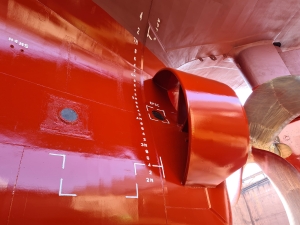
PPG announced the launch of PPG SIGMAGLIDE® 2390 marine coating, a breakthrough approach to help shipowners lower power consumption and carbon emissions and meet demands for higher performance with no adverse impact on the marine environment.
The biocide-free fouling release coating is based on revolutionary PPG HydroReset™ technology, which modifies the coating when it is immersed in water to create a super-smooth, almost friction-free surface that marine organisms do not recognize and cannot adhere to.
Based on third-party evidence following ISO 19030 and International Towing Tank Conference (ITTC) standards, this coating enables vessels to maintain a clean hull and reduce drag, achieving power savings of up to 20%, a speed loss performance of less than 1%, and up to 35% reduction in CO2 emissions in comparison to traditional antifouling coatings. Actual performance will depend on ship model and operating conditions.
PPG Sigmaglide 2390 coating can help owners and operators to meet targets for reduction of greenhouse gas emissions under the International Maritime Organization’s energy efficiency (EEXI and EEDI) and carbon intensity (CII) requirements, which went into effect this year.
“PPG Sigmaglide 2390 coating is a unique formulation that paves the way for ship owners and operators to improve efficiency and reduce CO2 emissions,” said Jan Willem Tegelaar, PPG global platform director, Marine Coatings. “The speed loss performance of less than 1% helps ships operate at an average one knot higher speed while remaining CII compliant.”
The exceptional fouling control performance of PPG Sigmaglide 2390 coating is achieved with no release of biocides into the oceans.
PPG Sigmaglide 2390 coating is also suitable for electrostatic application, which provides high transfer efficiency, leading to lower paint consumption. In service, the coating can deliver up to 150 days of idle performance and an extended lifetime of more than 10 years with minimal maintenance requirements. These benefits, combined with the power savings, provide an industry-leading return on investment for shipowners.
PPG: WE PROTECT AND BEAUTIFY THE WORLD®
At PPG (NYSE:PPG), we work every day to develop and deliver the paints, coatings and specialty materials that our customers have trusted for 140 years. Through dedication and creativity, we solve our customers’ biggest challenges, collaborating closely to find the right path forward. With headquarters in Pittsburgh, we operate and innovate in more than 70 countries and reported net sales of $17.7 billion in 2022. We serve customers in construction, consumer products, industrial and transportation markets and aftermarkets. To learn more, visit www.ppg.com.
ELNAVI Newsletter
More Information: ELNAVI,
19, Aristidou str., Piraeus 185 31,
Tel.: +30 210 45.22.100, e-mail: This email address is being protected from spambots. You need JavaScript enabled to view it.
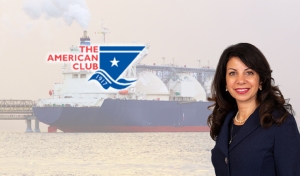
The American Club has reported encouraging year-on-year growth in premium and tonnage over the recent renewal period. Increases in both metrics were experienced across all of the Club’s insurance lines, strengthening its position for 2023 and beyond.
Premium income for the Club’s Class I (mutual P&I) entries was 17% greater than a year earlier, with concomitant tonnage growth of 25% over the period. Its Class II (mutual FD&D) portfolio also grew, while its Class III (charterers’) business is poised to increase by about 10% in 2023 by comparison with the previous twelve months.
Eagle Ocean Marine, the Club’s fixed premium facility, which serves the operators of smaller vessels in local and regional trades, also enjoyed a positive renewal season, strengthening its growing market position.
The Club’s Board had mandated an overall increase in expiring premium of 10% for the 2023 policy year, together with uplifts in certain deductibles. In the result, the cash rise on renewing business was just over 9%, with increases in deductibles over and above those generally prescribed, particularly through the application of higher annual aggregate deductibles in several sectors, providing an additional cash value of about 2% overall.
While the Club renewed about 95% of its expiring tonnage over the renewal itself, its renewing premium for 2023 was almost exactly the same as the expiring volume, implying an increase in the average rate per ton on the renewing portfolio of just under 8% by comparison with that of twelve months earlier.
Speaking in New York earlier, Tom Hamilton, the Chief Underwriting Officer of SCB, Inc., the Managers of the American Club, said: “The American Club experienced a positive 2023 renewal season. Year-on-year tonnage entered for mutual P&I risks grew by 25% to just over 25 million gross tons with an increase in annualized premium to about $108 million. With similar increases in premium and tonnage entered for FD&D and charterers’ risks, as well as a solid portfolio under its Eagle Ocean Marine banner, the American Club commences the 2023 policy year with a premium income in excess of $135 million, an encouraging result providing a sound platform for further expansion over the months and years ahead.”
Dorothea Ioannou, the Chief Executive Officer of SCB, Inc., also commented on the Club’s recent results: “The growth of the Club’s premium and tonnage over the recent renewal reflects the loyalty and commitment of its Members and their intermediaries throughout the world. None of this is taken for granted, and will continue to be earned by a dedication to excellence in service provision, supported by a strengthening financial outlook for the Club. While business conditions remain challenging in many respects, the Club and its Managers are sure that the positive results of this renewal will enable further development of the Club’s market position in the future.”
Image: Dorothea Ioannou, the Chief Executive Officer of SCB, Inc.,
ELNAVI Newsletter
More Information: ELNAVI,
19, Aristidou str., Piraeus 185 31,
Tel.: +30 210 45.22.100, e-mail: This email address is being protected from spambots. You need JavaScript enabled to view it.
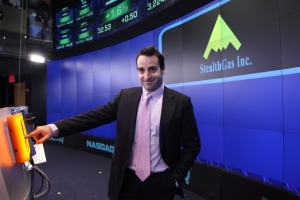
Focusing on the expansion of its fleet and the provision of eco-efficient transportation services to its charterers Nasdaq NYSE StealthGas Inc. has reported excellent revenues at $42.7 million for Q4 22’ and $152.8 million for FY 22’ despite having reduced the number of vessels in the fleet from 37 vessels at the end of Q4 2021 to 34 vessels at the end of Q4 2022. The highest quarterly revenue number in the last five years.
The company has also entered into a number of medium to long term charters increasing forward coverage. About 55% of fleet days are secured on period charters for 2023, with total fleet employment days for all subsequent periods generating approximately $105 million (excl. JV vessels) in contracted revenues.
It must also be noted that the net Income stands at $7.7 million for Q4 22’ corresponding to an EPS of $0.20 and $34.3 million for FY 22’ corresponding to an EPS of $0.90, setting a new record in annual profits.
Total cash, including short-term investments and restricted cash stands at of $100 million as of December 31, 2022 compared to $45.7 million as of December 31, 2021, an increase of 109.4%.
StealthGas Inc. has entered into sale agreements for three of the oldest vessels in the fleet, the Gas Prodigy, the Gas Spirit and the Gas Galaxy. All vessels were unencumbered and the sale proceeds will be reflected in the first quarter 2023.
CEO Harry Vafias Commented: “I am very pleased to report best ever annual profit for Stealthgas. In a difficult environment with rising interest rates and a smaller fleet, we managed to earn total net income of $34.3 million or $0.90 per share. Our adjusted EPS for Q4 22’ was 4 times higher than the adjusted EPS for Q4 21’, our total cash doubled from $45.7 million at prior year end to $100 million at December 31, 2022, while our total assets were $900 million at December 31, 2022 with only $303.6 million in total liabilities! These results give us the energy we all need to continue to push for more noteworthy results and to strengthen the Company and our balance sheet even further!”.
SteatlhGas Inc. has a fleet of 38 LPG carriers, including six Joint Venture vessels in the water, and three 40,000 cbm newbuilding Medium Gas Carriers (one owned through Joint Venture) to be delivered by the end of Q12024. These LPG vessels have a total capacity of 456,367 cubic meters (cbm).
ELNAVI Newsletter
More Information: ELNAVI,
19, Aristidou str., Piraeus 185 31,
Tel.: +30 210 45.22.100, e-mail: This email address is being protected from spambots. You need JavaScript enabled to view it.
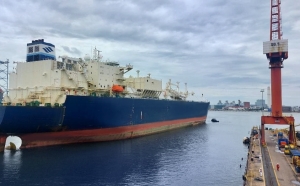
The work to develop Greece’s first Floating Storage Regasification Unit (FSRU) commenced recently at the Keppel shipyard in Singapore with the conversion of GasLog’s DNV classed LNGC Gaslog Chelsea, recently renamed as Alexandroupoli. Following conversion, the FSRU Alexandroupoli will serve as an offshore storage and regasification facility and will be part of the Alexandroupolis Independent Natural Gas System (INGS).
The 155,000-cbm LNG carrier, recently reflagged to the Greek flag, is the first FSRU conversion under the Greek Flag for operation in the Aegean Sea. The project’s owner, Gastrade, is a consortium of key players in the wider region’s energy market: Mrs. Elmina Copelouzou, GasLog, DEPA Commercial, the Public Gas Company of Greece, DESFA, the Hellenic Natural Gas Transmission System Operator, and Bulgartransgaz, the Bulgarian natural gas transmission and storage system operator.
“GasLog believed in the FSRU Alexandroupolis endeavor from the very beginning, and at a time when energy security in Europe was taken for granted,” said Kostas Karathanos GasLog’s COO. “We worked patiently and diligently to reach this stage and we are extremely proud to soon offer the first ever FSRU in Greek waters. Through GasLog’s renowned high standards of safety and reliability, the FSRU Alexandroupolis will offer energy diversification and security to the wider region and establish GasLog as an integrated provider of natural gas solutions. We are thankful to DNV for their support and partner-mindset throughout the project,” he concluded.
This is an exciting milestone in a project that is the result of an exceptional collaborative effort,” said Martin Cartwright, Business Director - Gas Carriers & FSRUs, DNV Maritime. “This will be our record 9th FSRU conversion project as a classification society, and we take great pride in being entrusted with supporting this initiative. By choosing DNV and our pioneering REGAS (ES) and ASP notations, the consortium demonstrates that they are focused on delivering an installation that meets the most innovative and rigorous standards in the industry,” he added.
The FSRU Alexandroupolis is designed to add a new gateway for natural gas in the Greek and wider Balkan region, improving the region's energy mix and diversifying energy sources to enhance energy security. It is expected to have a regasification capacity of around 8 billion cubic meters annually.
“We are extremely proud to be part of a project with such a significant role in the improvement of energy security and autonomy in Greece and the entire southeastern Europe,” said Leonidas Karystios, Regional Business Development & Gas Segment Director, DNV Maritime. “In DNV we have been providing technical support and risk management consultancy in all phases throughout the project’s development, and we are honoured to be the classification partner of this game-changing project,” he concluded.
The existing LNGC is currently in DNV class. As an offshore-classed FSRU, the vessel will have the following notations: OI Ship-shaped LNG Storage Installation, Field (Alexandroupolis), REGAS(ES), POSMOOR, UWILD, BIS, TMON, Clean, NAUT(OC), NAUTICUS(Newbuilding), ASP(MRU).
The vessel is expected to be delivered at the end of 2023 and will be connected to the National Natural Gas Transmission System (NNGΤS) of Greece via a 28km long pipeline.
Image caption: FSRU Alexandroupoli
ELNAVI Newsletter
More Information: ELNAVI,
19, Aristidou str., Piraeus 185 31,
Tel.: +30 210 45.22.100, e-mail: This email address is being protected from spambots. You need JavaScript enabled to view it.
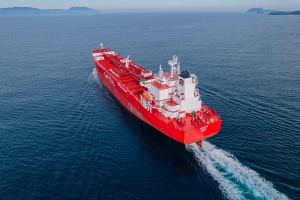
A tanker with Wind-Assisted Ready and HVSC-Ready ABS notations, one of six LNG fuel ready sister ships with eco-friendly design delivered to Capital in 2023.
Executing an ambitious program of newbuilding ships Capital Ship Management Corp. ('Capital') took delivery of the newbuilding vessel M/T ‘Agisilaos’, a 50,000 dwt, eco-type Chemical/Product MR tanker, built by Hyundai Vietnam Shipyard Co Ltd, Vietnam. It is assigned with Wind-Assisted Ready and HVSC-Ready notations by ABS, while it is the second of six LNG Fuel Ready sister ships with eco-friendly design delivered to Capital in 2023.
The HVSC-Ready notation is for vessels equipped with High Voltage Shore Connection systems to be installed in the future, and the Wind-Assist Ready notation refers to vessels equipped with wind-assist equipment to be installed on board. M/T ‘Agisilaos’ has future proof design compliant with EEDI Phase 3 and is annotated with ABS SUSTAIN-1 (2020) that demonstrates adherence to the United Nations' (UN) Sustainable Development Goals (SDG).
Being Tier III compliant for reduced NOx emissions, assigned ABS ENVIRO notation, as well as ABS Wind-Assisted Ready, HVSC-Ready and LNG Fuel Ready notations, and equipped with IHM notation for safe recycling, M/T ‘Agisilaos’ becomes one of the most environmentally friendly, technologically advanced and efficient vessels in the global MR fleet.
ELNAVI Newsletter
More Information: ELNAVI,
19, Aristidou str., Piraeus 185 31,
Tel.: +30 210 45.22.100, e-mail: This email address is being protected from spambots. You need JavaScript enabled to view it.
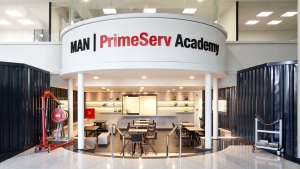
The data cleansing department for 2-stroke and 4-stroke MAN engines is located in Piraeus in Greek office of MAN Energy Solutions. It creates and maintains data for the 2-stroke and 4-stroke components of the MAN products in use worldwide. In the context of decentralization policy of the group, the department started operating in Greece in 2013, working on 2-stroke propulsion engines. In 2016, the scope expanded to 4-stroke engines used as generators and propulsion engines in marine and power applications. The department was initially composed by mechanical engineers. The team grew over the years and was strengthened with other specialists. Now the team also includes Software Engineers, Data Analysts and Technical Coordinators.
The Data cleansing department operates in a decentralized mode from Piraeus in cooperation with Headquarters. The objective of data cleansing is to create and maintain the spare parts catalogues in a database for all 2-stroke and 4-stroke MAN engines running worldwide, to be used internally or directly by the customer. The creation and the maintenance of the catalogues is a complex procedure, combining data from different sources: engine’s documentation, feedback from the sales, technical messages, retrofit solutions etc. When an offer is being created, these catalogues are used for the part identification.
Having these catalogues in a database, the time needed for the offer to be processed is greatly reduced, improving the response time to the customer and leading to higher customer satisfaction. On the other hand, customers can directly use our Portals, such as our web shop PrimeServ, MyPlace, to gain easy access to technical documentation, to effortlessly place an order and to track down the shipment.
Back in 2013 the process included manual handling. The catalogues were being created one by one. Even the documentation used was not stored in a database to be massively accessible. As the years went by and as digitalization became more and more important globally, in 2018 MAN Energy Solutions, known to be an innovative company, made digitalization a cornerstone of its strategy. To follow this strategy, the department developed software to improve its processes and turn from manual identification to automatic identification during the last two years. This was done with algorithms that mimic the steps the colleagues were doing manually.
In order to make this development work, the department’s technical coordinators offer valuable assistance by digitalizing info and data received from customers to be used for the catalogues creation and also help to keep these catalogues up to date. In the meanwhile, the department has spread its activities, by creating RPAs (Robotic Process Automation) that mimics human procedures and make highly automated, fully automated and autonomous operation possible.
With the mentioned functionalities, we now turn to a customer-oriented approach. We can offer customized solutions using the latest digital and technological developments to meet customer specific needs and requirements. We have now moved from working strictly as a back office team that creates catalogues, to working with the sales organization on large customer projects, providing our expertise in data analysis. The success story of these projects proves that the team’s increasing brand name goes in close collaboration with a remarkable customer service.
ELNAVI Newsletter
More Information: ELNAVI,
19, Aristidou str., Piraeus 185 31,
Tel.: +30 210 45.22.100, e-mail: This email address is being protected from spambots. You need JavaScript enabled to view it.
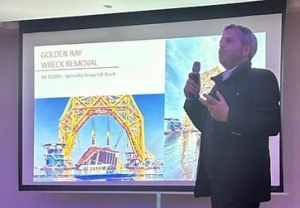
In the afternoon of 9th February 2023, Global Emergency Response Company T&T Salvage LLC presented in the Cyprus Shipping Chamber during the February Monthly Members’ meeting, the : Golden Ray - The Largest wreck recovery recorded in US history.
The vessel was a roll on roll off Car Carrier built in 2016 with over 4,200 Cars onboard.
These types of car carriers are notorious for their stability concerns. The GOLDEN RAY was a 7,700-unit pure vehicle carrier designed with 13 cargo decks in total, with 4 movable decks and 9 fixed decks. She came to rest at Saint Simons Sound, Brunswick, Georgia, USA. More than two COVID-19 pandemic struck years after it wrecked, the car carrier was removed from the Georgia coast under the supervision of the IG P&I Club – North of England. T&T Salvage presented the methodology that was quite innovative. Delivering the VB 10,000 a crane barge with 7,500 tons lifting capacity, utilized before only in the Oil & Gas Industry, and cutting the ship into eight parts, lifting each part with the cargo (4,200 cars) in them was far cleaner and economic method than the moving the ship up into small sections and having to remove the cars individually.
The presentation at the Amathus Beach Resort Hotel was followed by a cocktail reception where members had the opportunity to share views and impressions with the company representatives and members of the Chamber, Ms. Anna Shipilli – Commercial Manager EMEA and Mr. Elias Psyllos – Vice President who presented the innovative project.
ELNAVI Newsletter
More Information: ELNAVI,
19, Aristidou str., Piraeus 185 31,
Tel.: +30 210 45.22.100, e-mail: This email address is being protected from spambots. You need JavaScript enabled to view it.
Celestyal Cruises acquires a new 1260 passenger cruise ship to be renamed "Celestyal Journey"
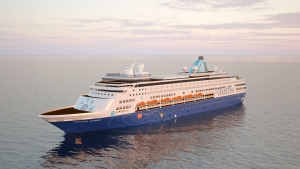
Celestyal, the award-winning, number one choice for travelers to the Greek Islands and the Eastern Mediterranean, is delighted to confirm the acquisition of a new vessel.
Originally built as the Ryndam for Holland America Line and more recently operating for P&O Australia, the 1,260-guest Celestyal Journey will undergo an extensive, €20 million, refurbishment and technical maintenance overhaul before entering service.
“While the global events of the past few years have placed our growth plans on pause, the positive industry outlook along with strong bookings for the coming season, provides Celestyal with the opportunity to recommence the process of renewing our fleet with new vessels,” said Chris Theophilides, CEO. “In addition to her expansive open decks, numerous bar & dining options as well as spacious public areas and staterooms, the Celestyal Journey provides our guests with a significant increase in premium and balcony staterooms, which continue to be in high demand on all of our voyages. We look forward to welcoming her to the Celestyal fleet!’’
The Celestyal Journey will undergo its capital expenditure program in the wider Piraeus ship repair zone area. Details regarding the onboard experience and itineraries will be forthcoming.
ELNAVI Newsletter
More Information: ELNAVI,
19, Aristidou str., Piraeus 185 31,
Tel.: +30 210 45.22.100, e-mail: This email address is being protected from spambots. You need JavaScript enabled to view it.
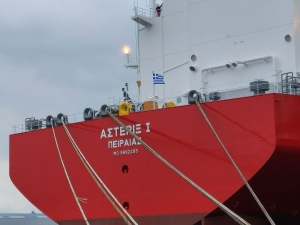
The ship was christened by CapitalGas’ technical director Alexandra Xystra
South Korean shipbuilding major Hyundai Heavy Industries (HHI) has delivered the 7th LNG carrier to Greece-based shipowner Capital Product Partners (CPLP).
The 174,000 cbm LNG carrier Asterix I has already secured a long-term time charter with Hartree Partners for a firm period of five years.
The dual-fuel vessel was named and delivered at a ceremony held at the yard on 16 February 2023.
The godmother of the vessel was Alexandra Xystra, Technical Director of Capital Gas Ship Management Corp.
In his message the CEO of the Capital Product Partners, Jerry Kalogiratos said: “an exceptional job in supervising this vessel incorporating the latest technological advances in energy efficiency and greenhouse gases emissions abatement.”
The LNG carrier is classed by ABS. It features two Hyundai-WinGD 5X72DF dual-fuel main engines enabling it to sail on marine diesel and gas. The ship comes equipped with HHI’s self-developed Hi-ALS air lubrication system, which can cut fuel consumption by up to eight percent. The LNG carrier is fitted with energy-saving fin and rudder, also developed by Hyundai. It has been outfitted with GTT’s Mark III Flex tank containment systems which offer a guaranteed boil-off rate of 0.07% V/day, according to GTT.
The vessel is 299 meters long overall, has a breadth of 46.4 meters, and a depth of 26.5 meters.
The company’s previous six LNG carriers of the same size, Aristos I, Aristidis I, Aristarchos, Attalos, Adamastos,and Asklipios were delivered in 2020 and 2021. All six LNG carriers have been chartered out to energy majors such as BP, Hartree, Cheniere, and Engie.
Overall, the CPLP fleet currently consists of 20 vessels, which also include ten Neo-Panamax container vessels, three Panamax container vessels, and one Capesize bulk carrier vessel.
ELNAVI Newsletter
More Information: ELNAVI
19, Aristidou str., Piraeus 185 31,
Tel.: +30 210 45.22.100, e-mail: This email address is being protected from spambots. You need JavaScript enabled to view it.
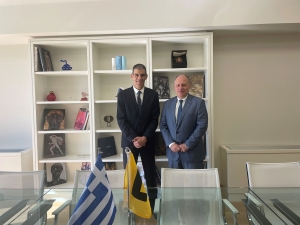
Latsco Marine Management Inc received the Preventative Maintenance Program for Condition Based Maintenance (PMP-CBM) notation from ABS for a pioneering project that adopts predictive maintenance principles for equipment onboard vessels.
Latsco’s LPG carrier “Hellas Sparta” will constitute a pilot vessel for the gradual transition of the fleet’s maintenance schedules to a new era of condition-based programs.
The key element in the project is a Preventative Maintenance Program (PMP) based on a Condition Based Maintenance (CBM) approach. Equipment maintenance under CBM is conducted on a more frequent or real-time based measurement of operational parameters rather than on rigid time intervals in traditional Planned Maintenance programs.
ABS reviewed and awarded the PMP-CBM notation for selected critical equipment on the “Hellas Sparta” including vibration analysis components and high-end infrared thermographic cameras. These systems complement monitoring techniques already onboard the Hellas Sparta including direct current (DC) insulation resistance measurements for polarization index calculations, air circuit breaker (ACB) tripping protection device inspections and health status/internal resistance measurements for selected critical batteries.
“We are excited and welcome the LPG “Hellas Sparta” into this new era of optimum maintenance that increases safety, reliability and efficiency. We look forward to working with ABS along the way in our journey. Eventually, with the big data generated by these pieces of equipment, Latsco will be able to further improve operations with the use of artificial intelligence, especially with main engine and cargo plant systems. We are taking this journey one step at a time,” said Antonios Georgantzis, Latsco Chief Operating Officer.
“The PMP-CBM notation offers vessel owners an avenue to potentially reduce unexpected maintenance-related costs and downtime, optimizing operations in the process,” said Patrick Ryan, ABS Senior Vice President, Global Engineering and Technology. “Like Latsco, we are committed to more efficient, safer and sustainable operations, and we are excited to support their entrance into this new chapter.”
Image: Antonios Georgantzis, Latsco Chief Operating Officer & Elias Kariambas ABS Director, Regional Business Development
ELNAVI Newsletter
More Information: ELNAVI
19, Aristidou str., Piraeus 185 31,
Tel.: +30 210 45.22.100, e-mail: This email address is being protected from spambots. You need JavaScript enabled to view it.