



-
Home

-
About Elnavi
- elnavi

elnavi

Created & produced by PROJECT CONNECT, the 3D virtual office tour is a first of a kind! Made for the entire international shipping industry and free to use.
Now every shipping and business student, teachers and families can enter a shipping company and learn about the various departments and roles, without having to get an appointment.
Project Connect chose to place the office building in the heart of the international shipping scene, Piraeus, and narrators are real time shipping executives.
It is a two-year project, envisioned by Irene Notias and inspired by the pandemic’s impact on education and training of youth.
During Covid when entry in shipping offices was prohibited, Irene, the director of Project Connect, decided to provide an office visit online so students wouldn’t miss out on an integral part of their education – vocations in shipping.
Remembering her office work in shipping companies and the thousands of office visits she made as a marine fuel broker visiting clients, she began writing a script and shared her idea with her team and some interested founder members.
One such member, Mr. Nikos Tsalamanios, Co-CEO of Seaven Group and Chairman of Project Connect sponsored the project in full.
Irene had her script read/edited by several principals such as John Xylas, Nicholas Notias, Anna Polemis, Shipping HR Panos Sotiropoulos and shipping professionals, Mary Arvaniti and Nikos Marmatsouris before she gave it to a professional script writer for final proof reading.
All together, graphic, architect, montage, narrators, script writers, shipping and HR professionals, they made an idea materialize by contributing their expertise.
Mary Arvaniti, Executive Assistant to George Tsavliris, is the female narrator, Nikos Marmatsouris, GAC Sr Group Marketing Manager, is the male narrator, Maria Yiassa, Swedish Club Sr Marketing Manager, is the Executive Assistant voice and Symeon Tsalikoglou plays the CEO while Irene Notias gives the prologue.
It is worth taking the entire tour.
Watch the 30.25 minute tour now: 1st Virtual Shipping Company Tour
Watch the 50 seconds short trailer: https://vimeo.com//700251622
By accessing the virtual tour, the aspiring shipping graduate immerses her / himself in the door of an actual Greek shipping firm and via a knowledgeable and experienced virtual narrator / tour guide, is taken through its every department in an exciting 3D setting ! The young graduate has the opportunity to view the professionals heading each department whilst learning of the day to day activities, practices and procedures required of their respective roles. In other words, Project Connect’s first virtual shipping office tour, is an added powerful tool for aspiring shipping candidates, giving them unique insider knowledge of the fast-paced challenging work environment of a Greek shipping company.
This innovative shipping office environment is freely available to Colleges and Universities, making it possible for shipping students to gain a clearer picture of the shipping firm beyond the pages of a Business / managerial text book. This two-fold success is what anyone who is a member of Project Connect aspires to : the success of our youth means success and the tangible added value to our shipping companies.
Marianna Terzidaki, BlueGeneration Project Coordinator of Militos S.A. a consulting firm says: “I am positive that young people, who pursue a career in shipping, will find it very motivating to watch the 3D Virtual Tour at Evdokia Maritime Corporation, that provides a clear and realistic view of the organizational structure, the activities and the roles and responsibilities in a shipping company. “
Established in Greece since 2015, the NPO, Project Connect has been Greek Shipping’s main advocate, connecting educational institutions and graduates with the local job market with its online CV Platform of students and grads.
It helped hundreds of striving shipping students and grads get a placement or internship after the financial crisis hit hard in Greece.
“During this period of crisis, pandemics and war in our neighboring Ukraine, we pray for peace to prevail and we strive to continue our mission to enhance Greece’s youth with strength, hope and the tools they need to develop themselves for their future. Afterall they will be our leaders, as we age”, says Mary Arvaniti, member of the NPO and one of the two main narrators of the tour.
Individuals who are part of the Shipping industry have a special quality – a passion- unique to Shipping ; one cannot be a part of this industry without loving every second of it.
Shipping IS its people : comprised of Dedicated men and women, with the appropriate education, a rare sense of responsibility and a willingness to go ‘beyond the call of duty’ on a daily basis – this is all depicted in the tour, to show to younger people the secret to shipping’s success.
PROJECT CONNECT is an initiative of hope and tangibles which actively promote change for a better future for our youth and our country.
Defined by its commitment to excellence, PROJECT CONNECT is removing obstacles in the path of our youth. In the words of Honorary Chairman George Tsavliris, “Project Connect is daring to surpass the complacencies and sometimes even defy logic.”
The result is the strengthening of Greek Shipping competitiveness.
This production is in memory of the young shipping people who left too soon : Nikos Tsiamis, Rena H. Notias, Maria E. Tsakos, John D. Pateras, Cpt George Boulas, Helen Panagos & Patrick Hawkins
& in memory of Eva Divari who happily permitted the use of her paintings on the virtual company’s walls but didn’t live to see the final production.
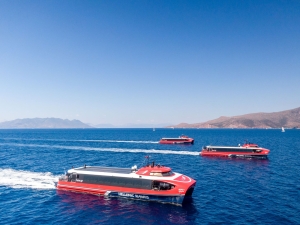
The Athens Exchange listed company Attica Holdings reported excellent financial figures for the 3rd quarter of the fiscal year 2022.
- Consolidated revenue stood at Euro 220.17mln for the third quarter of 2022 and Euro 421.61mln for the period 01.01.2022-30.09.2022 compared to Euro 148.31mln and Euro 270.5mln in the corresponding 2021 periods, an increase of 48.45% and 55.86% respectively.
- Consolidated earnings before interest, taxes, investing and financial results, depreciation and amortisation (EBITDA) stood at Euro 62.33mln for the third quarter 2022 and Euro 52.73mln for the period 01.01.2022-30.09.2022 against Euro 47.11mln and Euro 42.74mln in the corresponding 2021 periods.
- Consolidated earnings before interest and tax (EBIT) stood at Euro 49.09mln for the third quarter of 2022 and Euro 14.62mln for the period 01.01.2022-30.09.2022 against Euro 33.34mln and Euro 4.31mln in the corresponding 2021 periods.
- Consolidated Profit after taxes stood at Euro 60.70mln for the third quarter 2022 and profit after taxes of Euro 30.16mln for the period 01.01.2022-30.09.2022 against Profit after taxes of Euro 32.74mln and loss after taxes of Euro 1.31mln in the corresponding 2021 periods.
For the forthcoming months of 2022, which constitute months of low traffic, the Group’s traffic volumes are expected to be at pre Covid-19 levels.
The Group holds adequate liquidity with its cash and cash equivalents standing at Euro 75.67mln on 30.09.2022 compared to Euro 97.36mln as at 31.12.2021. Moreover, on 30.09.2022 the Group maintains undrawn credit lines amounting to Euro 15mln.
In October 2022, the Company has entered into bilateral credit facilities with three Greek credit institutions for a total amount of Euro 210mln and tenors from five to seven years, successfully concluding the long-term refinancing of all Group's credit facilities maturing in 2022- 2023. The above agreements result in the reduction of the average interest rate margin of the Group.
Moreover, ICAP S.A., pursuant to its regular reassessment of the Company, upgraded its credit rating by one (1) notch by assigning it a ΑΑ credit rating (low credit risk zone).
Further to the agreement signed on 23.9.2022 between the Company and the largest shareholders and creditors of "ANEK S.A.”, concerning the merger through absorption of ANEK by the Company, the Board of Directors of ATTICA decided the commencement of the process of merger through absorption of ANEK by ATTICA. The 31st of December 2021 was set as transformation date.
ELNAVI Newsletter
More information: ELNAVI,
19, Aristidou str., Piraeus 185 31,
Tel.: +30 210 45.22.100, e-mail: This email address is being protected from spambots. You need JavaScript enabled to view it.

Columbia Shipmanagement (CSM) and Marine Capabilities (MARCAP LLC) have signed a Memorandum of Understanding in Abu Dhabi that will lead innovation and shape the technological future of the maritime sector in the Middle East Gulf region.
The two organisations, who place quality performance, targets and goals at the heart of what they do, will initially focus their partnership on ship management, crewing, IT and Performance Optimisation and will work to identify new opportunities to challenge the existing status quo by generating vessel performance optimisation models that will shape the future of the maritime sector in the Gulf.
serving the largest oilfield and construction companies across the Arabian Gulf (including both United Arab Emirates and the Kingdom of Saudi Arabia), the Arabian Sea, and across the Red Sea.
CSM is a leading integrated maritime and logistics services platform with a focus on performance optimisation and using advanced digital technologies to deliver its services. It is already focusing heavily on delivering digitised solutions to the region via its office in Saudi Arabia and sees its partnership with Marcap as an opportunity to strengthen the digital credentials of the Gulf.
CSM and Marcap are operating in a region that is forward-looking and future-oriented and have a mutual understanding that the future will be driven by technological advances in key areas like crew welfare and cost-competitiveness together with vessel performance optimisation. The confidence that the resulting sizeable value of this partnership will lead to massive benefits is undisputable, they feel.
Commenting on this partnership during the signing ceremony, Mark O'Neil, President and CEO of CSM, said: “We are very excited to be partnering and cooperating with Marcap. I think from the first meeting we had with Mr. Qiblawi and all of Marcap’s team, we realised they are a company that mirrored our culture and corporate values. We are very excited to be working together, to seize the opportunities and face the challenges of the region which are obvious to everyone. We are very keen on developing the market in Saudi Arabia and the wider Gulf region, where the opportunities are immense. With friends like Marcap, I think everything is possible.”
On the same level, Marcap President & CEO Samer Qiblawi, added: “We met in Cyprus two weeks ago, with a very warm-hearted welcome. We look forward to this cooperation with a lot of hope and enthusiasm, trusting it to be a very fruitful cooperation, to expand in terms of skills and capacities in the markets we work in. CSM also shares this outlook and we are proud to be in partnership with one of the key players in the maritime industry. We certainly welcome this partnership with all our friends at Columbia Shipmanagement.”
Image: CSM President and CEO, Mark O'Neil, and Marcap President & CEO Samer Qiblawi, (L-R)
ELNAVI Newsletter
More information: ELNAVI,
19, Aristidou str., Piraeus 185 31,
Tel.: +30 210 45.22.100, e-mail: This email address is being protected from spambots. You need JavaScript enabled to view it.
AHEPA celebrated its 100 years in Athens
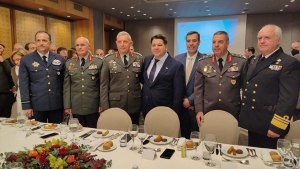
The members of AHEPA in Greece and the AHEPA Maritime "St' Nicholas" celebrated its 100 years of service in Athens in Divani Caravel Hotel.
The event was honored by the presence of the following distinguished personalities: Honoring the US ambassador in Greece Mr. George James Tsunis, the Hellenic National Defence General Mr. Konstantinos Floros and the leadership of Hellenic Army, Navy and Airforce. During the event, speeches addressed by Minister of Health Mr. Θάνος Πλεύρης and the State Secretary of Defence Mr. Nikos Hardalias, Mr. Dimitris Mattheou president of the Chapter AHEPA Maritime "St' Nicholas" HJ-45and the Vice President Mr. Dionisis Politis.
Order of AHEPA Supreme President Mr. Jimmy Kokotas, among other distinguished speakers presented the 100 years history of AHEPA and the role for defending the Hellenism, Education, Philanthropia, Civic responsibility and its values to excellence for every individual and family.
ELNAVI Newsletter
More information: ELNAVI,
19, Aristidou str., Piraeus 185 31,
Tel.: +30 210 45.22.100, e-mail: This email address is being protected from spambots. You need JavaScript enabled to view it.

By Marina Aliferopoulou, Lawyer, LL.M. Mediator. Member of Wista Hellas, PhD candidate, University of the Aegean, Department of Shipping, Trade and Transport
I. Introduction.
Meaning of Sanctions.
Sanctions are an essential tool in the EU’s common foreign and security policy (CFSP), through which the EU can intervene where necessary to prevent conflict or respond to emerging crisis;
EU restrictive measures are not punitive, they are intended to bring about a change in policy or activity by targeting non-EU countries, as well as entities and individuals, responsible for the malign behaviour at stake 1 , 2 .
Implementation. The EU applies sanctions in order to:
Promote international peace and security.
Prevent conflicts.
Support human rights.
Defend international law.
The sanctions may target governments of non-EU countries, as well as companies, groups, individuals through:
Travel Bans.
Embargoes.
Asset freeze.
Restrictions on imports/exports.
(Competent Directorate).
1 Overview of sanctions and related tools (europa.eu).
2 Sanctions tools, EU Sanctions Tool (europa.eu): EU sanctions map, Financial Sanctions Consolidated List, Due Diligence Help Desk-Iran, EU sanctions tool-Iran.
The proposals for Regulations on sanctions for adoption by the Council of the European Union are prepared by the Directorate General for Financial Stability, Financial Services and Capital Markets Union (DG FISMA).
II. The applicable regime.
(Regulation).
The European Council’s Regulation (EU) no. 833/2014 concerning restrictive measures in view of Russia’s actions destabilizing the situation in Ukraine 3 is in force, as it is amended 4 , 5 and is currently (10 October 2022) consolidated (“the Sanctions Regulation”):
The Regulation provides, among others, that:
(Article 3ea):
It shall be prohibited to provide access, after 16 April 2022, to ports and, after 29 July 2022, to locks in the territory of the Union, to any vessel registered under the flag of Russia, with the exception of access to locks for the purpose of leaving the territory of the Union.
The prohibition shall also apply, after 8 April 2023, to any vessel certified by the Russian Maritime Register of Shipping. Also, it shall apply to vessels that have changed their Russian flag or their registration. 6
The above prohibitions shall not apply in the case of a vessel in need of assistance seeking a place of refuge, of an emergency port call for reasons of maritime safety, or for saving life at sea.
However, by way of derogation from the above, the competent authorities may authorize a vessel to access a port or lock, under such conditions as they deem appropriate, after having determined that the access is necessary for: (a) import or transport into the Union of natural gas and oil, including refined petroleum products, titanium, aluminium, copper, nickel, palladium and iron.
3 EUR-Lex - 32014R0833 - EN - EUR-Lex (europa.eu)
4 The amendments and implementing regulations are the following: Council Regulation (EU) no 960/2014 of 8 September 2014, Council Regulation (EU) no 1290/2014 of 4 December 2014, Council Regulation (EU) 2015/1797 of 7 October 2015, Council Regulation (EU) no 2017/2212 of 30 November 2017, Commission Implementing Regulation (EU) 2019/1163 of July 2019, Council Regulation (EU) no 2022/262 of 23 February 2022, Council Regulation (EU) no 2022/328 of 25 February 2022, Council Regulation (EU) 2022/334 of 28 February 2022,
Council Regulation (EU) 2022/345 of March 2022, Council Regulation (EU) 2022/394 of March 2022, Council Regulation (EU) 2022/428 of 15 March 2022, Commission Implementing Regulation (EU) 2022/595 of 11 April 2022, Council Regulation, Council Regulation (EU) 2022/879 of 3 June 2022, Council Regulation (EU) 2022/1269 of 21 July 2022, Council Regulation (EU) 2022/1904 of 6 October 2022.
5 See also, the presentation of Bruce Paulsen, Seward & Kissel, Sanctio ns Related to the Russian Oil Price Cap, at the Marine Money event, 13 October 2022, at Stavros Niarchos Lighthouse. Timeline of events: “June 3, 2022, EU passes its sixth sanctions package which includes a prohibition for EU operators to insure or finance the transport of crude oil or petroleum products from Russia to third countries, going into effect Dec. 5 2022 for crude oil and February 5, 2023 for petroleum products. September 2, 2022, G7 issues a statement announcing the price cap and maritime services exception. September 9, 2022: OFAC issues a Preliminary Guidance on the implementation of the maritime services ban and price cap exception. September 29, 2022, EU proposes 8 th sanctions package against
Russia which includes a Russian oil price cap. October 6, 2022, EU approves 8 th sanctions package which marks the beginning of the implementation of the price cap within the EU”.
6 A ‘vessel’ means: (a) a ship falling within the scope of the relevant international conventions; (b) a yacht, of 15 meters in length or more, which does not carry cargo and carrying no more than 12 passengers; or (c) recreational craft or personal watercraft as defined in Directive 2013/53/EU of the European Parliament and of the Council.
ore, as well as certain chemical and iron products as listed in Annex XXIV 7 ; (b) the purchase, import or transport of pharmaceutical, medical, agricultural and food products, including wheat and fertilizers, whose import, purchase and transport is allowed under the Regulation;
(c) humanitarian purposes; (d) transport of nuclear fuel and other goods strictly necessary for the functioning of civil nuclear capabilities; or (e) the purchase, import or transport into the Union of coal and other solid fossil fuels, as listed in Annex XXII 8 , until 10 August 2022.
Also, by way of derogation from the above, the competent authorities may authorize vessels that have changed their Russian flag or their registration to the flag or register of any other State prior to 16 April 2022, to access a port or a lock, under such conditions as they deem appropriate, after having determined that: (a) a Russian flag or registration was required by contract; and (b) the access is necessary for the unloading of goods strictly necessary for the completion of renewable energy projects in the Union, provided that the import of such goods is not otherwise prohibited under the Regulation 9 .
(Article 3i):
It shall be prohibited to purchase, import, or transfer, directly or indirectly, goods, which generate significant revenues for Russia thereby enabling its actions destabilizing the situation in Ukraine, as listed in Annex XXI 10 of the Regulation, into the Union, if they originate in Russia,
or are exported from Russia· also, it is forbidden to provide relevant to the above technical assistance, or brokering services 11 , 12 .
7 Article XXIV-List of Goods as referred to in article 3ea(5)(a).
8 Article XXII-List of coal and other products as referred to in Article 3j.
9 Also, by way of derogation from the above, the competent authorities may authorize, under such conditions as they deem appropriate, a vessel to access a port or lock provided that the vessel: (a) has flown the Russian Federation flag under a bareboat charter registration initially effected prior to 24 February 2022, (b) has resumed its right to fly the flag of the underlying Member State registry before 31 January 2023, and (c) is not owned, chartered, operated or otherwise controlled by a Russian national or any legal person, entity or body incorporated or constituted under the law of the Russian Federation.
10 Annex XXI-List of Goods and Technology referred to in Article 3i.
11 However, by way of derogation from the above, the competent authorities may authorize the purchase, import or transfer of the goods listed in Annex XXI of the Regulation, or the provision of related technical and financial assistance, under such conditions as they deem appropriate, after having determined that this is necessary for the establishment, operation, maintenance, fuel supply and retreatment and safety of civil nuclear capabilities, and the continuation of design, construction and commissioning required for the completion of civil nuclear facilities, the supply of precursor material for the production of medical radioisotopes and similar medical applications, or critical technology for environmental radiation monitoring, as well as for civil nuclear cooperation, in particular in the field of research and development.
12 As of 10 July 2022, the above prohibitions shall not apply to the import, purchase or transport, or the related technical or financial assistance, necessary for the import into the Union, of: (a) 837 570 metric tonnes of potassium chloride of CN 3104 20 between 10 July of a given year and 9 July of the following year; (b) 1 577 807 metric tonnes combined of the other products listed in Annex XXI under CN 3105 20, 3105 60 and 3105 90 between 10 July of a given year and 9 July of the following year. The import volume quotas set out shall be managed by the Commission and the Member States in accordance with the management system for tariff-rate quotas provided for in Articles 49 to 54 of Commission Implementing Regulation (EU) 2015/2447. The Member State concerned shall inform the other Member States and the Commission of any authorization granted under paragraph 3c within two weeks of the authorization.
(Article 3j):
It shall be prohibited to purchase, import or transfer, directly or indirectly, coal and other products, as listed in Annex XXII of the Regulation into the Union, if they originate in Russia, or are exported from Russia. It shall be prohibited to: (a) provide technical assistance, brokering
services or other services related to the goods and technology referred to above and to the provision, manufacture, maintenance and use of those goods and technology, directly or indirectly in relation to the prohibition referred to above; (b) provide financing or financial
assistance related to the goods and technology referred to above for any purchase, import or transfer of those goods and technology, or for the provision of related technical assistance, brokering services or other services, directly or indirectly in relation to the prohibition referred to above. The above prohibitions in shall not apply to the execution until 10 August 2022 of contracts concluded before 9 April 2022, or ancillary contracts necessary for the execution of such contracts 13 .
(Article 3m):
It shall be prohibited to purchase, import or transfer, directly or indirectly, crude oil or petroleum products, as listed in Annex XXV 14 , if they originate in Russia or are exported from Russia. It shall be prohibited to provide, directly or indirectly, technical assistance, brokering services, financing or financial assistance or any other services related to the above prohibition. The prohibitions shall not apply: (a) until 5 December 2022, to one-off transactions for near-term delivery, concluded and executed before that date, or to the execution of contracts for the purchase, import or transfer of goods falling under CN 15 2709 00 concluded before 4 June 2022, or of ancillary contracts necessary for the execution of such contracts, provided that those contracts have been notified by the relevant Member States to the Commission by 24 June 2022 and that the one-off transactions for near-term delivery are notified by the relevant Member States to the Commission within 10 days of their completion; (b) until 5 February 2023, to one-off transactions for near-term delivery, concluded and executed before this date, or to the execution of contracts for the purchase, import or transfer of goods falling under CN 2710 concluded before 4 June 2022, or of ancillary contracts necessary for the execution of such contracts, provided that those contracts have been notified by the relevant Member States to the Commission by 24 June 2022 and that the one-off transactions for near-term delivery are notified by the relevant Member States to the Commission within 10 days of their completion; (c) to the purchase, import or transfer of seaborne crude oil and of petroleum products listed in Annex XXV of the Regulation, where those goods originate in a third country and are only being loaded in, departing from or transiting through Russia, provided that both the origin and the owner of those goods are non-Russian; (d) to crude oil falling under CN 2709 00 which is delivered by
13 See also, The London p&i club, “Ukraine-EU Sanctions-EU adopts Eight Package of Sanctions against Russia”, 12 October 2022; Britannia p&i club, “EU sanctions-updated FAQs published by the EU on the carriage of certain Russian cargoes including coal and fertilizers”, 31 October 2022; West of England, Tony Paulson, “Ukraine Conflict-EU adopts eighth sanctions package against Russia; North p&i club, “EU Sanctions-clarification Published on the Carriage of Certain Russian Cargoes”, 21/09/2022; Gard p&i, “EU sanctions-updated FAQs published by the EU on the carriage of certain Russian cargoes including coal and fertilisers”, member circular n.8/2022, September 2022.
14 Annex XXV-List of crude oil and petroleum products referred to in articles 3m and 3n of the Sanctions Regulation.
15 CN=Combined Nomenclature.
pipeline from Russia into Member States, until the Council decides that the prohibitions in paragraphs 1 and 2 shall apply. If the supply of crude oil by pipeline from Russia to a landlocked Member State is interrupted for reasons outside the control of that Member State, seaborne crude oil from Russia falling under CN 2709 00 may be imported into that Member State, by way of an exceptional temporary derogation from paragraphs 1 and 2, until the supply is resumed or until the Council decision referred to in paragraph 3(d) applies with regard to that member State, whichever is the earliest. As of 5 December 2022, and by way of derogation from paragraphs 1 and 2, the competent authorities of Bulgaria may authorize the execution until 31 December 2024 of contracts concluded before 4 June 2022, or of ancillary contracts
necessary for the execution of such contracts, for the purchase, import or transfer of seaborne crude oil and of petroleum products listed in Annex XXV of the Regulation originating in Russia or exported from Russia. As of 5 February 2023, and by way of derogation from paragraphs 1 and 2, the competent authorities of Croatia may authorize until 31 December 2023 the purchase, import or transfer of vacuum gas oil falling under CN 2710 19 71 originating in Russia or exported from Russia, provided that the following conditions are fulfilled: (a) no alternative supply of vacuum gas oil is available; and (b) Croatia has notified the Commission, at least two weeks prior to the authorization, of the grounds on which it considers that a specific authorization should be granted, and the Commission has not objected within that period. The goods imported following a derogation granted by a competent authority under paragraph 5 or 6 shall not be sold on to buyers located in another Member State or in a third country. The transfer or transport of crude oil delivered by pipeline into Member States as referred to in paragraph 3(d) to other Member States or to third countries, or its sale to purchasers in other Member States or in third countries, shall be prohibited 16 , 17 , 18 .
(Article 12).
16 All consignments and containers of such crude oil shall be clearly marked as 'REBCO: export prohibited'. As from 5 February 2023, where crude oil has been delivered by pipeline into a Member State, it shall be prohibited to transfer or transport petroleum products falling under CN 2710 which are obtained from such crude oil to other Member States or to third countries, or to sell such petroleum products to purchasers in other Member States or in third countries
17 By way of temporary derogation, the prohibitions referred to in the third subparagraph shall apply as from 5 December 2023 to the import and transfer into Czechia, and to the sale to purchasers in Czechia, of petroleum products obtained from crude oil which has been delivered by pipeline into another Member State as referred to in paragraph 3(d). If alternative supplies for such petroleum products are made available to Czechia before that date, the Council shall terminate that temporary derogation. During the period until 5 December 2023, the volumes of such petroleum products imported into Czechia from other Member States shall not exceed the average volumes imported into Czechia from those other Member States over the same period during the previous five years.
18 The prohibitions shall not apply to purchases in Russia of goods listed in Annex XXV of the Regulation, which are required in order to meet the essential needs of the purchaser in Russia or of humanitarian projects in Russia. Member States shall report to the Commission by no later than 8 June 2022 and every three months thereafter on the amounts of crude oil falling under CN 2709 00 imported by pipeline, as referred to in paragraph 3(d). Such import figures shall be broken down per pipeline. In the event that the exceptional temporary derogation referred to in paragraph 4 applies with regard to a landlocked Member State, that Member State shall report to the Commission every three months on the amounts of seaborne crude oil falling under CN 2709 00 which it imports from Russia, for as long as that derogation applies. During the period until 5 December 2023, Member States shall report to the Commission every three months on the amounts which they export to Czechia of petroleum products falling under CN 2710 obtained from crude oil which has been delivered by pipeline as referred to in paragraph 3(d).
It shall be prohibited to participate, knowingly and intentionally, in activities the object or effect of which is to circumvent prohibitions in this Regulation.
(Article 13).
This Regulation shall apply:(a) within the territory of the Union; (b) on board any aircraft or any vessel under the jurisdiction of a Member State; (c) to any person inside or outside the territory of the Union who is a national of a Member State; (d) to any legal person, entity or body, inside or outside the territory of the Union, which is incorporated or constituted under the law of a Member State; (e) to any legal person, entity or body in respect of any business done in whole or in part within the Union.
III. Impact on Ports- Trade & Insurance.
Access to Ports.
The access to ports is monitored via the Union Maritime Information and Exchange System 19 , which also links to EQUASIS 20 . All EU Member States have access to this system. Any attempt to circumvent the sanctions by the change of the flag of the vessel could be identified by the port authorities through a check of the IMO number of the vessel· in addition, under SOLAS, the ships are also obliged to keep on board the synopsis report with the history of change of flags. Also, port authorities have access to the above monitoring system. Furthermore, ship-to-ship operation can occur between a Russian flagged vessel and a third country flagged vessel in international waters, a ship-to-ship operation between Russian and EU-flagged vessels, and a Russian flagged vessel and third-country flagged vessel in territorial waters of a Member State.
If a ship-to-ship operation takes place with the objective to circumvent the prohibition of article 3ae of the Regulation, such an operation is caught by the non-circumvention clause of Article 12. The determining element is that such ship-to-ship operation is orchestrated in order for a vessel that is not subject to the port access ban to call in an EU port, where otherwise a Russian flagged vessel could not call in. Where a vessel has been authorized to call on a port in order to unload goods subject to derogation, it must obtain a separate authorization. Russian flagged recreational ships that were berthed in the port of a Member State before 16 April 2022 do not fall under the scope of the prohibition since their sole presence does not amount to access into a Union port; however, leaving a Union port, any request to return would result in calling into a Union port and be prohibited under Article 3ea 21 .
Oil imports-Reporting obligations under the oil import restrictions-Export restrictions on maritime navigation goods and technology-Export related restrictions.
Article 3m of the Regulation prohibits, subject to certain exceptions and derogations, imports of goods set out in Annex XXV, if such goods originate from Russia 22 . It is therefore necessary to determine, if the product originates from Russia. EU operators and national authorities must conduct appropriate due diligence before purchasing goods listed in Annex XXV from other
19 UMIES, was established under Directive 2002/59/EC.
20 Electronic Quality Shipping Information System.
21 Access to EU ports (europa.eu), Frequently Asked Questions-as of October 2022.
22 Oil imports (europa.eu), Frequently Asked Questions- as of 8 November 2022.
Member States, which benefit from the exceptions laid down in Article 3m(3)(d) (crude imports by pipeline), or from specific derogations (for Bulgaria and Croatia). When purchasing such goods, they should do the necessary checks to ensure that such goods do not originate from
Russia, are not exported from Russia or are not petroleum products (CN 2709 10), which are obtained from crude oil originated or exported from Russia. However, the purchase of Russian seaborne crude oil by an EU company is allowed, when the goods are exported from Russia towards a third country and are not transiting Union territory. Furthermore, the aim of the reporting obligation included in Art. 3m(3) is to monitor the flows of oil still entering the EU after the ban on seaborne oil established with the 6 th sanctions package adopted on 3 June 2022 23 .
The data provided by Member States will remain confidential except for some high level aggregated numbers referring to the total EU level of oil imports. It is prohibited to sell, supply, transfer or export certain maritime navigation goods and technology (paragraph 1 of Article 3f of
the Sanctions Regulation), related technical assistance, brokering services or other services related to those above, directly or indirectly, to any natural or legal person, entity or body in Russia, or for use in Russia (paragraph 2(a) of article 3f of the Sanctions Regulation)·however, if the intended end-use of the marine navigation and radio communication equipment falls under the scope of maritime safety, the exporter may apply for an authorization and a case-by case assessment is made by the competent authority of the Member State in which the exporter is resident or established· this is also applicable for the related technical or financial assistance. As far as Export-related restrictions are concerned, it shall be prohibited to sell, supply, transfer or export, directly or indirectly, dual-use goods and technology, whether or not originating in the Union, to any natural or legal person, entity or body in Russia or for use in Russia 24 , 25
The Sanctions Regulation has expanded the scope of the export restrictions (since 2014, the restrictions applied to the military sector and now to civilians end-users or uses, with very limited exceptions and derogations). The Sanctions Regulation also prohibits the export of
additional “Advanced Technology” items to limit the enhancement of Russia’s military and technological capacity in sectors and lasers marine, chemicals that could be used in the process of manufacture of chemical weapons, special materials and related equipment, manufacturing equipment and other sensitive items, such as those used by law enforcement bodies. Finally, the Sanctions Regulation identifies entities connected to Russia’s defence and industrial base, on whom even tighter export restrictions are imposed.
Insurance & Reinsurance.
It shall be prohibited to provide insurance and reinsurance, directly or indirectly, in relation to goods and technology listed in Annex XI of the Sanctions Regulation to any person, entity or body in Russia or for use in Russia 26 . After a wind down period of 6 months, during which
contracts signed before 4 June 2022 can still be executed until December 5, EU operators will be prohibited from insuring and financing the maritime transport of goods set out in Annex XXV to third countries 27 , 28
23 Oil reporting obligation (europa.eu), Frequently Asked Questions-as of 26 August 2022.
24 In particular, see articles 2, 2a, 2aa, 2c, 2d, 2b, 3 of the Sanctions Regulation 833/2014, as it is in force.
25 Export restrictions on maritime navigation goods and technology (europa.eu), Frequently Asked Questions-as of
26 April 2022. Export Related restrictions (Europa.eu), Frequently Asked Questions-as of 10 October 2022.
26 See Article 3c (2) of the Sanctions Regulation.
Execution of Contracts & Claims.
No claims in connection with any contract or transaction the performance of which has been affected, directly or indirectly, in whole or in part, by the measures imposed under the Sanctions Regulation, including claims for indemnity or any other claim of this type, such as a claim for compensation or a claim under a guarantee, notably a claim for extension or payment of a bond, guarantee or indemnity, particularly a financial guarantee or financial indemnity, of whatever form, shall be satisfied, if they are made by: (a) legal persons, entities or bodies listed in the Annexes to this Regulation or legal persons, entities or bodies established outside the Union whose proprietary rights are directly or indirectly owned for more than 50 % by them; (b) any other Russian person, entity or body; (c) any person, entity or body acting through or on behalf of one of the persons, entities or bodies referred to in points. In any proceedings for the enforcement of a claim, the onus of proving that satisfying the claim is not prohibited, shall be on the person seeking the enforcement of that claim 29 , 30 .
27 Insurance and reinsurance (europa.eu), Frequently Asked Questions-as of 26 August 2022.
28 Skuld, Insight Russia sanctions, 10 October 2022: «Insurance Cover. The Association’s Rules contain a standard exclusion for liability for liabilities, costs or expenses where payment by the Association or the provision of cover may expose the Association to the risk of being subject to a sanction, prohibition or any adverse action (Rule 30.4.6). Liability is also excluded when there is a shortfall due to an inability to recover reinsurance or pool contributions from other insurers or P&I Clubs which are themselves unable to pay due to sanctions legislation
(Rule 32.6). the Association is also able to terminate cover where a Member has exposed or may expose the Association to the risk of being or becoming subject to a sanction, prohibition, restriction or other adverse action by a state or international organization or competent authority (Rule 3.3.2a). Similar provisions exist in the Terms & conditions for non-mutual covers…».
29 See article 12 of the Sanctions Regulation.
30 The term “contract” refers to a binding commitment between the parties. An “ancillary contract” is a contract necessary for the execution of another (principal) contract, that is, a contract without which the main contract cannot be executed, such as insurance, financing etc. Execution of contracts and claims (europa.eu), Frequently Asked Questions-as of 26 August 2022.
ELNAVI Newsletter
More information: ELNAVI,
19, Aristidou str., Piraeus 185 31,
Tel.: +30 210 45.22.100, e-mail: This email address is being protected from spambots. You need JavaScript enabled to view it.
The first LNG cargo by MYTILINEOS arrived in the FSU gas storage unit of DESFA in Revithoussa
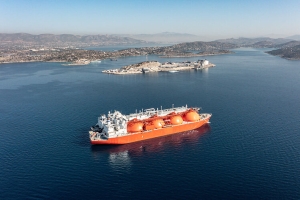
The start of the operation of the floating natural gas storage unit (FSU) installed by DESFA in Revithoussa is marked by the unloading of the first LNG cargo by MYTILINEOS.
The transshipment of the over 140,000 m3 LNG cargo at the FSU “GASLOG ATHENS” that DESFA has leased by GASLOG is being completed within the next days with a Ship-to-Ship (STS) unloading process from the vessel ARCTIC PRINCESS, which arrived in the gulf of Megara for this purpose. This is the first time that the specific procedure is being carried out in Greek territorial waters, while the specific cargo is intended to cover part of the strategic reserve that must be kept by power generation units that are not able operate with an alternative fuel. This obligation concerns the period from 1 November 2022 to 31 March 2023, according to the provisions of the Preventive Action Plan approved by the Greek Regulatory Authority for Energy (RAE).
The addition of the new floating tank was implemented in a record time following close cooperation between DESFA and the Ministry of Environment and Energy, the Ministry of Maritime Affairs and Insular Policy, as well as RAE, with the aim of strengthening the energy security of the country in view of the winter and in light of international developments. The operation of the FSU, moored 700 meters from the terminal, increases the storage capacity of the LNG Terminal of Revithoussa from 225,000 m3 to approx. 370,000 m3 LNG in total, an increase of around 70%.
In addition, it offers the LNG facility extended flexibility in terms of receiving and unloading LNG cargoes, since it is now possible to simultaneously unload two LNG carriers (at the Revithoussa jetty and the floating unit), thus optimizing the country's LNG supply chain and ensuring the required reserves for the smooth supply of the market during the coming winter.
The CEO of DESFA, Maria Rita Galli, stated: “The start of the FSU’s operation in Revithoussa with the unloading of the first cargo by MYTILINEOS is a very important milestone that comes as a result of an exemplary cooperation, under pressure, with the relevant market players whom we would like to thank. We are satisfied that through our high technical expertise and our network, we are contributing significantly with yet another infrastructure to ensuring the country's security of natural gas supply for the coming winter, while, at the same time, we are further strengthening the strategic role that the LNG Terminal of Revithoussa plays in the wider region of Southeast Europe".
ELNAVI Newsletter
More information: ELNAVI,
19, Aristidou str., Piraeus 185 31,
Tel.: +30 210 45.22.100, e-mail: This email address is being protected from spambots. You need JavaScript enabled to view it.
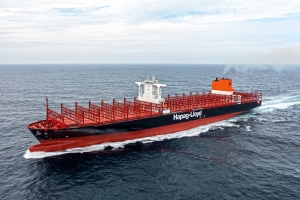
Implementing an ambitious new building program Capital-Executive Ship Management Corp. has added to its fleet the newbuilding C/V Manzanillo Express, a 13,300 TEU container vessel. This vessel is the largest reefer ship ever built by Hyundai Samho Heavy Industries, with a carrying capacity of 2,220 reefers, and an overall capacity of 65,000 tons of reefer goods.
Applying cutting edge technologies aimed at reducing the vessel’s environmental footprint, “Manzanillo Express” combines enhanced ‘green’ features, which result into more than 35% lower energy consumption and reduced carbon emissions and more than 85% reduction of certain harmful emissions (NOx & SOx), compared to older container vessels of similar capacity. The vessel will operate to the highest operational environmental standards, including full compliance with IMOs EEDI Phase 3, with the ability to run on Tier III mode together with the hybrid scrubber that is installed. The vessel is also dual fuel LNG ready and has a full alternative maritime power system installed (AMP), also known as “cold ironing.
About Capital-Executive Ship Management Corp.
Capital-Executive Ship Management Corp. currently operates a fleet of 40 vessels including 36 container carriers and 4 modern bulk carriers with a total dwt of 2,915,834 tons and total teu of 180,363 approx.
The fleet under management includes vessels of Nasdaq-listed Capital Product Partners L.P.
ELNAVI Newsletter
More information: ELNAVI,
19, Aristidou str., Piraeus 185 31,
Tel.: +30 210 45.22.100, e-mail: This email address is being protected from spambots. You need JavaScript enabled to view it.
IRI Remains Focused on Client Services in Japan

International Registries, Inc. and its affiliates (IRI) continue to expand resources to provide strong support to the Republic of the Marshall Islands (RMI) fleet throughout Asia and the world. With 11 offices in the Far East, including Busan, Dalian, Hong Kong, Imabari, Manila, Qingdao, Seoul, Shanghai, Singapore, Taipei, Tokyo, and bridge support from Vancouver and Long Beach, IRI provides comprehensive administrative and technical support to the RMI Registry throughout Asia and beyond.
Since 2007, IRI’s Tokyo office has provided marine safety, technical, and operational services to shipowners and operators in Japan. As of 30 September 2022, the RMI fleet stood at 193.8 million gross tons, and 7.4% of that tonnage is Japanese owned or operated. Japan is recognized as one of the largest ship owning and shipbuilding nations in the world.
“Our long-term presence in Japan supports one of the largest and most dynamic shipping industries in the world,” said IRI President Bill Gallagher.
“We have long-term relationships built upon decades of trust and respect, and as Japan has made a significant commitment and investment to a sustainable shipping future, we have strategically placed our resources to provide technical, administrative, and operational support to our owners and operators as they invest in decarbonization technology,” he continued.
Mr. Masaharu Okamoto became IRI’s chief representative in Tokyo in 2007, providing local representation and services to Japanese owners and operators flying the RMI flag.
“Confidence in the RMI flag grew significantly once the office opened and the local market recognized the high-quality services and support the Registry provides,” noted Mr. Okamoto.
“The RMI Registry was the first foreign flag to open full technical and administrative services in Japan and it quickly expanded in 2011 opening a second office in Imabari,” he continued.
Mr. Okamoto works closely with other regional offices as a broad and strong network of services throughout Asia.
“Our offices in Asia offer support to a large amount of RMI flagged vessels trading in the region,” noted Annie Ng, Head of Asia.
“Hong Kong and Manila handle almost a third of the global seafarers’ documentation production for the fleet,” she continued.
This level of production is supported by more than 100 IRI employees across the Far East who provide not only seafarer documentation, but also technical and fleet operation support, business development and client services, and more. Recent renovations to the Manila office and newly established offices in Qingdao and Vancouver demonstrate the Registry’s commitment to the region. Hong Kong, with 28 team members, is the largest office in Asia, followed closely by Manila and Singapore.
After 20 years based in Hong Kong, Ms. Ng opened the Registry’s Vancouver office earlier this year as a bridge between business hours in Asia and IRI’s headquarters in Reston, Virginia.
“Several decades ago, we made a significant commitment to our owners and operators in Asia,” noted Annie Ng. “We continue to enhance our local resources and services to help them best position for the future,” she concluded.
ELNAVI Newsletter
More information: ELNAVI,
19, Aristidou str., Piraeus 185 31,
Tel.: +30 210 45.22.100, e-mail: This email address is being protected from spambots. You need JavaScript enabled to view it.
Spotlight on energy efficiency and EU regulations at LR's Hellenic Advisory Committee (HAC) meeting

Leading Greek shipping executives gathered at the unique FONDAZIONE Spyros Loverdos Library for the annual meeting of the Lloyd's Register (LR) Hellenic Advisory Committee have called for further collaboration among supply chain stakeholders to address energy transition challenges, while raising awareness on marine and offshore industry efforts to reach net zero, with many in the room stressing that delivering on these ambitions relied on enhancing the efficiency of ships already on the water.
“As we strive towards reducing the longer term emissions from shipping and the move to low and zero carbon fuels we must not lose focus on what can be practically implemented today on the world’s existing fleet. Greece, as the home of the largest fleet and the dominant supplier of tramp trade, is perfectly placed to lead on this focus and scale the practical steps that can be taken to further improve the energy efficiency of existing ships. Lloyd’s Register has heard the call from the Greek Prime Minister and intends to work with Greek Shipping to establish Athens as an implementation centre for the energy efficiency of existing ships” LR Chief Executive Officer Nick Brown told Committee members attending the meeting.
HAC members were joined by the Member of European Parliament, Maria Spyraki, who spoke on the role of policy makers and regulatory certainty in shipping’s energy transition. Referring to EU proposed measures, she also underlined the importance of security of the energy supply chain and the need to foster investments.
Sharing charterer’s perspective, Nicholas Logan, Cargill’s Asset Deal Originator talked about his organisation’s proactive and agile approach towards decarbonisation, focusing on existing technologies applications to deliver immediate reductions in emissions, working to scale up wind and biodiesel in the mid-term, and collaborating to explore the long-term solutions that can get the shipping industry to net zero.
During the meeting, LR experts shared updates on new construction trends, how the drive for alternative fuels is impacting ship design as well as the current projects of LR’s Maritime Decarbonisation Hub in addressing energy transition challenges. There was a lively debate among the Committee members around the role and uptake of carbon capture. There was also much emphasis on digital solutions and the importance of data in helping meet decarbonisation targets and transform operations.
“LR Greece is reaching new heights, focusing on clients’ needs, investing in people and technologies, transforming inclusivity. This is an important part of LR’s transformation in Greece, as it provides the implementing steps to position the organisation for the future challenges,” said Theodosis Stamatellos, LR’s South Europe Regional Manager. “This meeting sent a clear message that collaboration with stakeholders across ocean economy comes on top of everything we do towards the energy transition,” he concluded.
ELNAVI Newsletter
More information: ELNAVI,
19, Aristidou str., Piraeus 185 31,
Tel.: +30 210 45.22.100, e-mail: This email address is being protected from spambots. You need JavaScript enabled to view it.
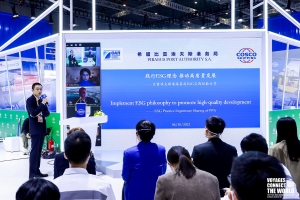
Online presentation of PPA S.A. for its activities in issues of the environment, corporate governance and society, was held in the framework of the China International Import Expo - CIIE in Shanghai, where PPA participates with an exhibition booth. In addition to the executives of the Company, market professionals as well as the Sustainability Officer - Project Manager of TAIPED, Mrs. Maria Christantoni, participated in the event.
At the beginning of the presentation, an extensive report was made of the very good financial results of the Company in 2022 as well as of the investments that have been made.
However, as mentioned, the Company's goals are not limited to improving financial indicators, but also include:
– The development of business activities with respect to the environment
– The welfare of the employees
– The concern for dealing with climate change
– The reduction of CO2 emissions
– Energy efficiency and its energy transition according to the new energy production and storage data and also the protection of water, the waste management and other.
All the above issues are adequately analyzed and presented thoroughly in the ESG Report published for fourth consecutive year by the Piraeus Port Authority S.A. It includes detailed information and a systematic presentation of the Company’s efforts, developments and achievements in the fields of environment, society and corporate governance and is available on the Company’s website www.olp.gr
About PPA S.A.
Piraeus Port Authority S.A. is an Athens Stock Exchange listed company engaged in the management and operation of Piraeus port, Greece’s largest port and one of the largest integrated harbours in Europe, providing a complete range of services. Some of the company’s activities involve cruise, coastal (ferry/passenger), container and car terminal services, as well as general cargo, ship repair, logistic and free zone services. The main shareholder of Piraeus Port Authority S.A., with a stake of 67 percent, is COSCO SHIPPING, one of the largest maritime companies in the world.
Over the last decade the company has experienced a remarkable growth in all port activities, which is still underway, largely contributing to the country’s economy, while driven by green development and increased digitalization, alongside a people-first approach and a spirit of giving back to the society.
PPA holds the "ECO PORT" PERS status, is included in the Athens Stock Exchange ESG index and is one of the “Most Sustainable Companies in Greece 2022”.
For more information please visit: https://olp.gr
ELNAVI Newsletter
More information: ELNAVI,
19, Aristidou str., Piraeus 185 31,
Tel.: +30 210 45.22.100, e-mail: This email address is being protected from spambots. You need JavaScript enabled to view it.