



-
Home

-
Special Reports 2023
- elnavi

elnavi
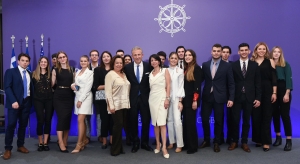
The dinner in honor of the Supporters of The Propeller Club, Port of Piraeus, was held on Friday, October 21 at the Grand Hyatt Athens Hotel and was attended by 220 guests including 20 new members of our newly established Student Port.
During the event all the Supporters of the Amver Awards 2021 as well as those of the 96th International Convention & Conference, 125 in total, were honored.
The distinguished guests were initially welcomed by Governor, Mrs. Dorothea Ioannou, followed by a greeting by the President, Mr. Costis Frangoulis.
“Without you, we would not be able to implement our vision and goals, which are constantly getting bigger and better”, Mr. Frangoulis said, among other things, in his speech, addressing the supporters of the Club and added: “A big warm and heartfelt “Thank you” for your valuable – essential to our existence – support. I am sure you feel satisfied and happy that your support is utilized in the best possible way”.
Our Club proves its qualitative and quantitative renewal, with well over 750 active members, a figure that represents an increase of active members by 80%. At the same time, it is worth noting that our Donations and Scholarships program, which is one of the main founding purposes of the Club, had a 20% growth this year.
The evening ended with a music program by the Odin’s House Project band.
ELNAVI Newsletter
More information: ELNAVI,
19, Aristidou str., Piraeus 185 31,
Tel.: +30 210 45.22.100, e-mail: This email address is being protected from spambots. You need JavaScript enabled to view it.
The Issue of Extensive Carbon Emissions in Shipping
It is clear that excessive carbon emissions are a global issue affecting all countries, industries and people. While shipping may not be a leading contributor, it is still predicted to generate roughly 940 million tons of CO2 per year and is responsible for about 2.5% of global greenhouse gas (GHG) emissions (3rd IMO GHG study). This is projected to rise at a rate of 50%-250% by 2050 unless measures are implemented.
As the shipping industry continues to grow, so do carbon emissions – unless changes are made now. Keeping in mind that, with a lifespan of 20 years for the average ship, it is the current fleet that will produce over 50% of the total emissions by 2050. New technologies and ship designs may solve the issue for the future, but today’s vessels need their own approach – and it is in data that the answers will be found.
GHG Regulations & the CII rating
In 2018, the International Maritime Organization (IMO) developed an initial strategy for reducing Green House Gases (GHG) emissions from ships.
One of the goals of this strategy is to reduce CO2 emissions per transport work, as an average across international shipping, by 40% minimum by 2030 compared to 2008.
A key tool that will be used to achieve these targets is the Carbon Intensity Indicator (CII). Using data from 2023 onwards, ships will report their Annual Efficiency Ratio (AER) at the end of the year. This value and the ship type will result in a CII rating given from A (the best) to E (the worst). The CII rating will have serious consequences on the commercial attractiveness of the ship, not to mention time limits for how long you can remain in the lower bands.
Optimizing Vessel CO 2 Output and Fuel Consumption
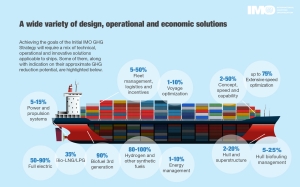
According to IMO’s initial strategy, there are multiple ways to reduce the carbon footprint of a vessel. These ways include voyage optimization, energy management, speed optimization and many others (see the figure below).
Squeezed between the pressures of the economic crisis, an oversupply of ships in certain sectors, and an onslaught of regional and international regulations aimed at reducing shipping’s impact on climate change, many ship owners and managers have been looking for innovative solutions that will help them comply with regulations and at the same time increase their influence in the industry.
Oriani Partners with VesOPS to Help Greek Shipping Companies Reduce their GHG Emissions
VesOPS has developed a software focused on the detailed performance analysis of the ship. Designed to work with anything from one daily noon-report to huge volumes of high frequency sensor data – the software compares live performance against a calculated baseline to provide the owner/operator a clear understanding of how the vessel is performing and what factors may be affecting it.
With this methodology the program provides accurate proven fuel consumption tables for multiple different conditions. This in turn supports operational decision making, including when to perform hull cleaning and propellor polishing, as well as commercial aspects, such as achieving best charter party terms for your fleet with a balance between daily hire rate and CII rating impact.
The key takeaway – use VesOPS to understand your vessel and fleet’s current CII rating and predict how that rating will be affected by future voyages. Take control of your operations from now to ensure that from 2023 onwards you will not be impacted by the ratings scheme and subsequent penalties.
VesOPS has trusted Oriani Hellas to officially represent them in Greece.
Oriani Hellas is a trusted partner that helps shipping companies in Greece and the EMEA acquire competitive advantage by supporting their digital transformation journey.
Today Oriani Hellas provides 12 selective innovative solutions that all have one common purpose: the digital transformation of the maritime industry by bringing together seamanship and big data.
ELNAVI Newsletter
More information: ELNAVI,
19, Aristidou str., Piraeus 185 31,
Tel.: +30 210 45.22.100, e-mail: This email address is being protected from spambots. You need JavaScript enabled to view it.
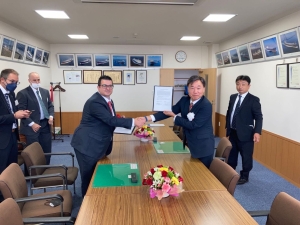
Despite the recent downward market corrections Erasmus Shipinvest Group (ESI) has spared no effort to get the 1st ever Feeder containership Newbuilding delivered from the top-class Japanese shipyard.
c/v Feeder Ace (Kyokuyo Shipyard-1096 TEU) joined the company’s dynamic and state-of-the-art management fleet, dedicatedly serving one of the world’s largest and most respectful liner-major companies for the next multiple years. The vessel is the newest eco-designed with EEDI Phase-3 compliance with long-term sustainable operations and good trading performance for the company’s premier customers.
The vessel has Vietnamese and Filipino crews onboard.
In the LPG carriers sector Erasmus has recently acquired M/V “Bougainville” which is the 2nd LPG Gas Carrier (2014 built by Murakami Hide, 5.000cbm fully-pressurized type).
It is just about half year time after Erasmus Shipinvest Group’s takeover of the 1st-ever LPG gas ship “Astrid” and the company hopes to see more LPG gas vessels to come under Erasmus Gas fleet in the sustainable future.
“Bougainville” just freshly passed drydock surveys in Papua New Guinea and will serve her Switzerland & France based Time Charterers customer, being one of the world’s largest gas-trading companies, trading mainly Australia and New Zealand areas. The ship will be commercially managed by Erasmus group’s offices out of Greece & Japan, China and Vietnam, with Indian crews onboard.
Erasmus Shipinvest Group (ESI) has been set up by Zhongyi John Su, started trading since 2010, with focus on oceangoing dry-bulk segments in the maritime transport sector, as well as container feeder and LPG gas carrier domains, on assets owning/management and chartering operations.
With over 500 seafarers and more than 40 staffs ashore, the company serves global commodity-trading and industrial customers from various offices in the shipping centers of Greece, Singapore, China, the Netherlands, Japan and Switzerland.
Erasmus currently manages and operates a “state-of-art” fleet of modern Panamax/Kamsarmax/Ultramax/Handysize bulkers, feeder containerships and LPG Gas Carriers in the pipeline.
ESI takes full advantage of the management’s broad shipping and financial knowledge as well as their business network ranging from Europe to the Far East.
ELNAVI Newsletter
More information: ELNAVI,
19, Aristidou str., Piraeus 185 31,
Tel.: +30 210 45.22.100, e-mail: This email address is being protected from spambots. You need JavaScript enabled to view it.
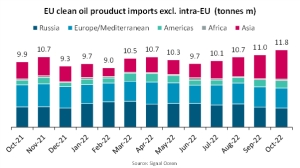
Excluding intra-EU trade, the European Union’s average monthly clean oil product imports amounted to 10.0 million tonnes in 2019 but declined to 9.3 million tonnes in 2020 and 2021. Due to the high import volumes in July to October, the 2022 year-to-date average monthly volumes have reached 10.3 million tonnes, exceeding 2019 volumes.
“Latest early February 2023, the EU will need to have found new suppliers for nearly 35% of its clean oil product import volumes as the bloc’s sanctions against Russian oil take effect. Russia, on the other hand, must attempt to find new buyers for approximately 60% of their exports,” says Niels Rasmussen, Chief Shipping Analyst at BIMCO.
Despite the upcoming sanctions, the EU’s average monthly imports from Russia have year-to-date reached 3.5 million tonnes and increased 10.3% over last year. However, during September and October, the average monthly Russia to EU volumes reduced to 3.0 million tonnes although total EU import volumes increased to 11.0 and 11.8 million tonnes in September and October respectively.
“The increase in clean oil product imports from Asia to the EU have more than replaced lost volumes from Russia. The volumes from Asia to the EU have increased since July and in October hit 4.4 million tonnes, up from the recent monthly average of 2.1 million tonnes. Asia has therefore been the main supplier of the EU’s clean oil product imports since September, overtaking Russia,” says Rasmussen.
While Russia remains the single largest supplier of clean oil products to the EU, it appears that buyers in the EU have already begun the process of finding new suppliers. So far, Saudi Arabia has delivered most of the increase in Asian volumes, but India, China, and South Korea are also contributing.
As mentioned in our Shipping Number of the Week in week 40, the newly increased export quota for Chinese refineries should increase availability of clean oil products in Asia. Reacting to the new export quotas, China’s crude oil imports rose 30% m/m and 24% y/y in October, hitting the highest level since July 2020.
“As the remaining clean oil product volumes from Russia to the EU are replaced, average haul for product tankers into the EU will continue to increase. The muted 2023 growth prospects for the global economy, and particularly the EU, will weigh on demand but as effective capacity supply growth will be very minimal (and possibly negative), we still expect further improvement in trading conditions for product tankers,” says Rasmussen.
ELNAVI Newsletter
More information: ELNAVI,
19, Aristidou str., Piraeus 185 31,
Tel.: +30 210 45.22.100, e-mail: This email address is being protected from spambots. You need JavaScript enabled to view it.
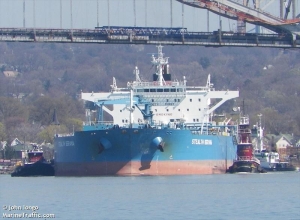
The smallest of the 4 shipping companies of Vafias Group, Imperial Petroleum reported its financial results for the nine months of 2022.
The company took delivery of its second dry bulk handysize carrier the “Eco Angelbay” and reported the Revenues of $42.6 million - up $ 31.3 million or 277% up from Q2 22’.
The Net income is $15.5 million - up $15.4 million or 15,400% from Q2 22’ and equivalent to approximately 23% of our current market capitalization.
The EBITDA1 of $18.7 million in Q3 22’ is up $15.7 million or 523% from Q2 22’ and the cash and time deposits of $92.4 million as of September 30, 2022 is 1.3 times higher than the current market cap.
CEO Harry Vafias commented: “This quarter’s unprecedented profitability growth is solid proof that our company’s strategy is paying off. With the capital recently raised we have managed to grow our fleet, maximize our profitability, substantially increase our cash flow and create value to our investors. As a result of having acquired six vessels in a course of ten months, we generated net income of $15.5 million in a single quarter which is 15,400% higher than our profit in Q2 22’ and is equivalent to 23% of our current market capitalization; We incurred moderate debt during the quarter, maintaining a healthy capital structure with $42.4 million of debt while preserving a free cash balance available for further fleet expansion of about $92 million. Given the strong market fundamentals and the promising charter rate environment and by taking advantage of our efficient management of our expanded fleet, we believe that we will achieve strong results and generate significant cash flow going forward. However, the valuation of our shares of common stock does not reflect our strong financial performance and capital available to fund our growth prospects”.
Image 1: dry bulk handysize carrier “Eco Angelbay”, 33.000dwt, built 2009
ELNAVI Newsletter
More information: ELNAVI,
19, Aristidou str., Piraeus 185 31,
Tel.: +30 210 45.22.100, e-mail: This email address is being protected from spambots. You need JavaScript enabled to view it.
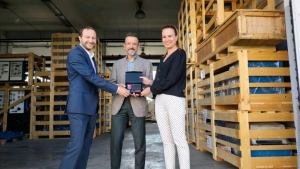
ERMA FIRST and EPE have been voted as a ‘Great Place to Work’ in Greece!
Through employee survey assessments, deep data was provided which offered a unique insight into ERMA FIRST and EPE workplace cultures.
Over 85 per cent of ERMA FIRST and EPE employees responded positively to questions about their personal role, integrity in the organisation and the leadership within the business.
ERMA FIRST and EPE are incredibly proud to have a highly talented, passionate and diverse team that excels in an extremely competitive environment.
We achieve remarkable results through teamwork, innovation and trust. With worldwide operations and mixed nationalities, both ERMA FIRST and EPE are at the forefront of serving the global shipping industry.
“This is a remarkable achievement for ERMA FIRST,” said Konstantinos Stampedakis, ERMA FIRST Managing Director.
“Our employees are the heartbeat of our business and being recognised as a Great Place to Work in Greece is testament to the commitment and diligence of our hard-working team.
“Workplace culture is deeply important as we go from strength to strength as a business and continue or expansion plans.”
ERMA FIRST and EPE invest in long-term co-operation, as well as providing a stable work environment and challenging roles with diversified responsibilities.
ELNAVI Newsletter
More information: ELNAVI,
19, Aristidou str., Piraeus 185 31,
Tel.: +30 210 45.22.100, e-mail: This email address is being protected from spambots. You need JavaScript enabled to view it.
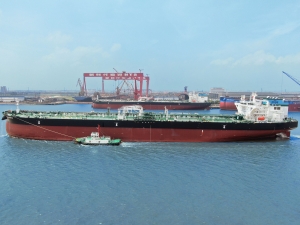
The two tankers are the first vessels delivered in Greece built with the DNV notations Fuel Ready for Ammonia and LNG fuel (Fuel ready (Ammonia[D], LNG[D; MEc]) notation). In addition, both vessels are equipped with arrangements for controlling and limiting operational emissions and discharges (Clean notation), installations for the removal of SOx and reduction of NOx emissions, and certified in compliance with the MARPOL Tier III NOx emission requirements (ER(EGCS Open, SCR, TIER III notation).
“Environmental protection is a priority of Pantheon Tankers' management as well as the decarbonization process of our fleets”, said Mr. Frangiskos Kanellakis, one of the Principals of Pantheon Tankers Management Ltd. “The suezmax tankers constructed at New Times Shipbuilding are classed with eco-friendly notations which exceed IMO requirements. Throughout the construction of these vessels, DNV's input and extensive experience on such notations were of critical importance, especially in terms of the alternative fuel solutions.”
“Pantheon’s recent deliveries again show how Greek shipowners are front-runners in the global decarbonization marathon,” said Mr. Ioannis Chiotopoulos, Senior Vice President – Regional Manager SE Europe, Middle East & Africa, DNV Maritime. “We are very grateful for Pantheon’s continued trust in DNV and extremely pleased to welcome Sea Onyx and Sea Sapphire to the DNV class family. We wish them smooth sailing. With their investment in these modern tankers and embrace of DNV’s innovative notations, Pantheon is clearly demonstrating their intention to get out in front of environmental regulations. At DNV, we are always ready to put our expertise and experience to work, as our customers drive the sustainability of the maritime industry forward.”
About Pantheon Tankers Management Ltd.
Founded in 2012, Pantheon Tankers Management (PTM) is a leading tanker manager with a modern and eco-friendly fleet of 40 ships. The company is continuously expanding through high-spec new building vessels but also selected, young second-hand ships. The fleet consists of tankers ranging in size from MR to VLCC. PTM is fully committed to achieving zero accidents, no harm to the environment, zero losses and zero lapses in security. This company is the tanker arm of the Group which is further engaged in dry bulk shipping through Alpha Bulkers Shipmanagement having a fleet of 34 vessels and in the LNG space through Alpha Gas, managing a fleet of 5 vessels with a further 3 under construction.
About DNV
We are the independent expert in risk management and quality assurance. Driven by our purpose, to safeguard life, property and the environment, we empower our customers and their stakeholders with facts and reliable insights so that critical decisions can be made with confidence. As a trusted voice for many of the world’s most successful organizations, we use our knowledge to advance safety and performance, set industry benchmarks, and inspire and invent solutions to tackle global transformations.
DNV in the maritime industry
DNV is the world’s leading classification society and a recognized advisor for the maritime industry. We enhance safety, quality, energy efficiency and environmental performance of the global shipping industry – across all vessel types and offshore structures. We invest heavily in research and development to find solutions, together with the industry, that address strategic, operational or regulatory challenges. For more information visit: www.dnv.com/maritime
Images: Sea Onyx and Sea Sapphire
ELNAVI Newsletter
More information: ELNAVI,
19, Aristidou str., Piraeus 185 31,
Tel.: +30 210 45.22.100, e-mail: This email address is being protected from spambots. You need JavaScript enabled to view it.
Survitec’s revolutionary Seahaven, world’s largest inflatable lifeboat wins technology award
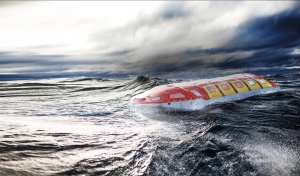
Survitec’s revolutionary Seahaven, the world’s largest inflatable lifeboat, has won the technology category of this year’s Safety4Sea awards.
The self-propelled inflatable lifeboat surpassed Safety4Sea’s judging criteria of providing a “significant technological achievement or significant contribution to maritime safety”.
Seahaven, officially introduced to the market in April, is already redefining how passengers and crew evacuate ships in an emergency, with Norwegian Cruise Line Holdings Ltd. (NCLH), Independent Maritime Advisors Ltd, and a major shipbuilder looking at incorporating the system into new designs.
Typically, a 4,000-passenger capacity cruise ship would require at least 12 to 16 lifeboats and up to four MES with liferafts. Just four Seahavens would be required to evacuate the same number of passengers in the same amount of time, freeing up 85% of cruiseship space for new passenger experiences.
Claude Sada, Managing Director, Survival Craft at Survitec, said: “We are delighted Seahaven won this important award so soon after its official market launch earlier this year.
At Survitec, we continue to push boundaries and look for new, innovative ways to protect lives at sea. This award indicates the important contribution Seahaven will make to cruiseship safety.”
Commenting on the accolade during yesterday’s virtual awards ceremony, Stew Gregory, who led the Survitec design team, said: “On behalf of our Seahaven team, I am thrilled to receive the 2022 Safety4Sea Technology Award. I would like to pay particular tribute to my colleagues at Survitec for their vision, insight, innovation and dedication in bringing this idea to life and to market.
“With Seahaven, we have provided a safe alternative to conventional lifeboats. We have optimised our revolutionary helical slide technology to achieve a rapid four-minute deployment time and minimise crew actions and the margin for operator error. We have also solved the significant challenge of being able to evacuate a growing number of cruise passengers quickly, safely and comfortably.”
ELNAVI Newsletter
More information: ELNAVI,
19, Aristidou str., Piraeus 185 31,
Tel.: +30 210 45.22.100, e-mail: This email address is being protected from spambots. You need JavaScript enabled to view it.
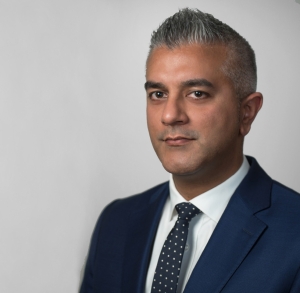
International law firm and maritime specialist Hill Dickinson has appointed partner Jasel Chauhan to its board.
In addition to heading the Piraeus office since 2020, Jasel also heads the international finance team at the firm. He has more than 16 years' experience in banking and finance legal services, 14 years of which have been focused in the marine sector.
Jasel’s appointment represents the first international partner to join the board and he brings a fresh perspective as the firm looks to deepen ties with its current international platform and global client base.
Jonathan Brown, Hill Dickinson chair, commented: “Jasel’s appointment recognises the immense contribution he brings to Hill Dickinson. He took over the helm in Piraeus in very difficult circumstances and despite those challenges has steadily grown our presence in Greece to double in size over the past three years.”
He added: “Jasel’s appointment reflects the wealth of talent developing at the firm and the importance of our younger partners taking on roles within senior management as the legal sector modernises for a new generation of clients and colleagues.”
Jasel said: “I’m delighted to join the board at this exciting time, when all law firms are looking to adapt to new challenges and demands, and I’m very much looking forward to contributing to Hill Dickinson’s future growth and development.”
Hill Dickinson employs more than 950 people, including over 200 partners and legal directors, across offices in Liverpool, Manchester, London, Leeds, Newcastle, Monaco, Piraeus, Singapore and Hong Kong.
Image: New Hill Dickinson board member Jasel Chauhan.
ELNAVI Newsletter
More information: ELNAVI,
19, Aristidou str., Piraeus 185 31,
Tel.: +30 210 45.22.100, e-mail: This email address is being protected from spambots. You need JavaScript enabled to view it.
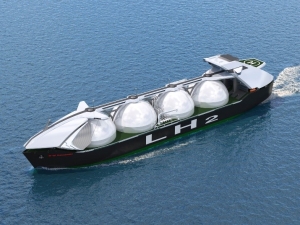
Liquefied hydrogen and liquefied carbon dioxide – and the ships designed for their transportation – can make a significant contribution to realizing a carbon-neutral society, says ClassNK.
As climate concerns continue to grow and the need to develop new energy sources becomes more urgent, the maritime sector’s environmental challenges include not only ship emissions but the safe carriage of alternative fuels.
As a clean fuel which does not emit carbon dioxide (CO 2 ) when burned, hydrogen (H 2 ) offers significant ‘green’ potential and, in Japan, work is already under way to establish a supply chain to facilitate a ‘Hydrogen Society’. Land-based CO 2 capture, utilization and storage (CCUS), meanwhile, has been attracting global attention for its ability to capture carbon generated by thermal power plants and factories and either use it as a resource or store it in a stable underground geological formation.
In their gaseous forms, both hydrogen and carbon dioxide can be transported over short distances via pipeline. However, in the liquid states which offer greater energy density per cubic meter and facilitates storage, both H 2 and CO 2 must be transported in tanks, either in trucks or aboard ships.
Over long distances, the most efficient means of transporting liquefied H 2 (LH 2 ) and liquefied CO 2 (LCO 2 ) is by sea. The development of LH 2 and LCO 2 carrier vessels has therefore emerged as one of the most promising areas for innovation in the maritime sector.
As an active contributor to advanced initiatives targeting decarbonization both within and beyond the shipping industry, ClassNK is supporting the development and safe operation of LH 2 and LCO 2 carriers.
Since H 2 is liquefied at the extremely low temperature of -253 degrees Celsius and presents hazards including flammability and permeability, handling the substance requires the observance of intensive safety procedures. In 2017, to contribute to the safe seaborne transportation of LH 2, ClassNK published its “Guidelines for Liquefied Hydrogen Carriers”, which are based on the International Maritime Organization’s (IMO) Interim Recommendations for Carriage of Liquefied Hydrogen in Bulk.
The leading classification society has since applied its guidelines in surveying, at the construction phase, the hull structure, machinery, onboard equipment and other components of the world’s first LH 2 carrier ship. Built by Kawasaki Heavy Industries, Ltd. (KHI), a member of the CO 2 -free Hydrogen Energy Supply-chain Technology Research Association (HySTRA), Suiso Frontier was added to ClassNK’s register on 3 December 2021. The Society continues to support the vessel’s safe operation through in-service surveys, utilizing the knowledge gained through these surveys to keep its guidelines up to date.
Earlier this year, ClassNK issued an approval in principle (AiP) for a large LH 2 carrier from KHI. The Society had previously granted the company an AiP for the design of the cargo containment system, at 40,000 m 3 class per tank. Four such tanks will feature on board KHI’s forthcoming large LH 2 carrier, giving the vessel a total LH 2 -carrying capacity of 160,000 m 3 . For the same ship, ClassNK granted AiPs for cargo-handling systems, which are key design elements of the vessel, and dual-fuel main boilers that use H 2 boil-off gas as fuel.
As well as helping to establish the Hydrogen Society, ClassNK has been active in its support of the CO 2 economy, recently issuing an AiP for LCO 2 carriers developed by Mitsubishi Shipbuilding and Nippon Yusen Kabushiki Kaisha (NYK Line). The Society executed the design review based on Part N of its Rules for the Survey and Construction of Steel Ships, which incorporate the IMO’s International Code for the Construction and Equipment of Ships Carrying Liquefied Gases in Bulk (IGC Code). The AiP confirms adherence to the rules regarding the design of each cargo tank system, hull form and other components, accounting for different tank-pressure settings for medium- and large-scale vessels.
Applying the same set of rules incorporating the IGC Code, ClassNK in August granted an AiP for the design of a large-scale LCO 2 carrier by Mitsui O.S.K. Lines, Ltd. (MOL). MOL had launched research and development (R&D) on the adoption of a large-scale LCO 2 carrier in response to a call for proposals by Japan’s New Energy and Industrial Technology Development Organization (NEDO) to complete the conceptual design, under a project entrusted by NEDO to Japan CCS Co., Ltd (JCCS).
The vessel design is one element of NEDO’s initiative “CCUS R&D and Demonstration Related Project/Large-scale CCUS Demonstration Project in Tomakomai/Demonstration Project on CO2 Transportation”. The MOL ship is intended as a practical solution to the need for the long-distance transportation of 1 million tons of CO 2 a year, based on NEDO’s vision to implement CCUS technology by 2030.
ClassNK has been directly supporting advancements in CCUS since 2020, when the Society joined the “Carbon Capture on the Ocean” (CC-Ocean) project to test a small-scale ship-based CO 2 –capture demonstration plant. Conducted in collaboration with Kawasaki Kisen Kaisha, Ltd. (“K” Line) and Mitsubishi Shipbuilding Co., Ltd. – part of the Mitsubishi Heavy Industries (MHI) group – the world- first demonstration resulted in the successful separation and capture of CO 2 from the test ship’s engines. Earlier this year, the project received the “Marine Engineering of the Year” award from the Japan Institute of Marine Engineering.
Through its active role in the verification of LH 2 and LCO 2 carriers and related technologies, ClassNK is facilitating the development of two fast-growing markets that promise to make a significant contribution to realizing a carbon-neutral society.
ELNAVI Newsletter
More information: ELNAVI,
19, Aristidou str., Piraeus 185 31,
Tel.: +30 210 45.22.100, e-mail: This email address is being protected from spambots. You need JavaScript enabled to view it.