



-
Home

-
Special Reports 2023
- elnavi

elnavi
Air France–KLM and Aspida Travel sign Sustainable Aviation Fuel (SAF) agreement in Greece

Aspida Travel has become the first travel agency in Greece to join the Corporate Program of Air France–KLM for Sustainable Aviation Fuel (SAF), increasing the number of the airline group’s contracts worldwide.
The Corporate Program of Air France-KLM for SAF aims for the creation of a sustainable aviation fuel industry that guarantees the future of increasingly eco-responsible air transport.
Under the agreement, signed in Athens on Thursday, Aspida Travel will play an active role in reducing CO₂ emissions by supporting the efforts and actions of the Air France-KLM Group and contributing to the ecological transition of air transport globally.
Following the signing of the agreement, Air France-KLM Regional Manager Yiannis Pantazopoulos highlighted that both Air France and KLM have been working for many years to reduce their environmental impact. Their first actions were to work together with all stakeholders and policymakers to achieve the climate objective to reach zero CO2 emissions by 2050.
“One of our most important initiatives, however, is the effort to raise awareness within our industry, by stimulating airlines, travel agencies and corporate companies alike, that control a large percentage of air travel worldwide,” Pantazopoulos said.
Launched in 2021, Air France-KLM’s innovative SAF corporate program enables corporate clients to play an active role after an estimate of the CO₂ emissions associated with their travel, and determine an annual contribution they wish to devote to the program. All contributions are then invested in the sourcing and consuming of SAF.
“We are very excited to have the support of Aspida Travel, an important partner and pioneer in this effort, coming from the travel agencies industry and based in Greece. I hope that this collaboration will inspire even more travel agencies in our country to participate, tracing a more sustainable journey for the sector,” he added.
On his part, Aspida Travel Managing Director Dimitris Matthaios underlined the importance of sustainable fuel production in the airline industry.
“The efforts of Air France–KLM Group prove that if the airline and travel industries work together, we will manage to make our activities more sustainable for the environment and much sooner,” Matthaios said.
He went on to add that Aspida Travel is constantly in a development phase and have developed its activities in ESG (Environmental, Social, and Governance) the recent years.
“We try to contribute to the protection of the environment and we believe that this important agreement we signed with such a strategic partner as the Air France-KLM group will significantly enhance this effort,” Mattheos added.
Image: Chara Papalambrou, Key Account Manager Air France-KLM; Dimitris Matthaios, Managing Director Aspida Travel; Milli Zafeiratou, Marketing Manager Aspida Travel; Yiannis Pantazopoulos, Regional Manager Air France-KLM; and Maria Mavrikaki, Marketing Manager Greece & Cyprus.
ELNAVI Newsletter
More information: ELNAVI,
19, Aristidou str., Piraeus 185 31,
Tel.: +30 210 45.22.100, e-mail: This email address is being protected from spambots. You need JavaScript enabled to view it.
Environmental Defense Fund, LR and Ricardo launch report examining ecological impact of ammonia
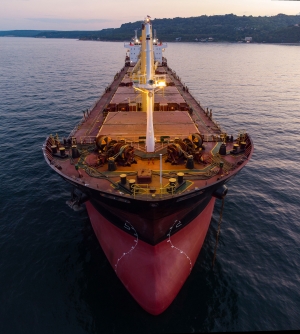
Study finds that spills of ammonia as a shipping fuel could negatively impact certain habitats and species more than others, and that the likelihood and gravity of such spills are highly dependent on ship type, hole size, temperature or even time of the day.
A joint study released by Environmental Defense Fund (EDF), Lloyd’s Register (LR) and Ricardo PLC, examines the potential marine environmental impacts of ammonia spills during its use as a shipping fuel.
Ammonia generated from renewable energy is considered a sustainable alternative to fossil fuels as the shipping industry decarbonises. The study, which used extensive modelling due to the scarcity of real-world data, focuses specifically on the impacts of large ammonia fuel spill scenarios on marine habitats.
Potential effects on aquatic environments and associated ecological receptors were assessed in scenarios if a spill were to occur during bunkering, or in the case of a ship’s collision and sinking. In addition, possible mitigation measures and specific spill management practices for these scenarios were modelled and studied.
“The shipping industry must make a rapid energy transition to address the climate emergency. But it is also clear that we must proceed with caution. We owe it to future generations to ensure we are championing true climate solutions that will not negatively impact our rivers, our oceans or our health,” said Marie Hubatova, Director of Global Shipping for EDF's Global Transport team.
The study examined potential ammonia fuel spills during bunkering and collision scenarios, under a variety of conditions, including time of day, temperature, humidity and solar radiation. The outputs were tested across eight habitats (rivers, estuaries, wetlands, coastal waters, coral reefs, mangroves, polar regions and the deep sea) using multiple ecological receptors (bacteria, plankton, macrophytes, invertebrates, fish, birds, reptiles, and marine mammals).
The study found that estuaries, mangroves and wetlands are particularly sensitive to potential ammonia fuel spills compared to the polar regions and the deep sea. Within these habitats, it is typically fish which are most sensitive to an ammonia spill, with birds and mammals to a lesser degree.
Lauren Dawson, Senior Consultant, Water and Environment Practice, Ricardo, said: “Examining the impact of ammonia is a challenge because of the vast conditions a ship might face while at sea or even when bunkered. Critical factors to consider include the various ship and storage types, the underlying principles which determine the fate of ammonia in the environment, and the diversity of aquatic habitats and species that could be affected. Ultimately, what we found is that ammonia is more threatening to fish species, and particularly to ecosystems with less saline water and higher temperatures. It is therefore important to study the impact of ammonia carefully for particular regions where these habitats intersect with major shipping channels and ports, such as the Strait of Malacca. The findings of the report provide an excellent step forward to delivering a baseline upon which future assessments can be refined.”
The results were then compared to previously studied habitat and species sensitivity to conventional oil-based fuels. Overall, an ammonia spill has a relatively smaller dispersion distance and lower persistence within the environment when compared to heavy fuel oil (HFO) and marine gas oil (MGO).
Existing reports show that oil-based fuels have higher impacts on invertebrates and birds, compared with ammonia. Ammonia has a medium impact on all other ecological receptors, except bacteria, whereas oil-based fuels have medium impacts on plankton, fish, macrophytes, reptiles and marine mammals (see the Table summarizing the environmental impact level in page 5 of our summary report).
While the maritime industry has prior experience with ammonia transported in gas carriers and used as refrigerant, the introduction of ammonia as a shipping fuel creates new challenges related to safe bunkering, storage, supply and consumption for different ship types. The potential toxicity of ammonia cannot be ignored; without mitigation measures and solid spill management practices, an ammonia fuel spill could have negative impacts on aquatic environments. Therefore, a robust regulatory framework must be developed for ammonia to be a viable, low carbon alternative for shipping.
“There are many questions around the use of ammonia as a shipping fuel. Studies like this support the industry’s understanding of the environmental impacts as well as the operational and safety challenges. Greater clarity about the risks posed to marine ecosystems will allow industry stakeholders to make better informed decisions on the multiple transition pathways under consideration,” said Andy Franks, Senior Risk Specialist, LR Maritime Decarbonisation Hub.
This study presents a first look at ammonia's potential ecological impacts as a fuel. Further research is needed to evaluate the full range of ecological and health implications (especially to a ship’s crew) of ammonia, including the increased nitrogen deposition from chronic ammonia leakage and combustion by-products to determine its safety.
“All future fuels come with specific challenges. We have been using oil to power ships for almost a century now and we had to learn how to do so in a safe way. We can't go through the same process with ammonia,” said Ricardo’s Hubatova. “We have to make sure we get it right from the very beginning. A robust regulatory framework and good management practices are essential for the safe use of ammonia.”
Depending upon its safety, ammonia produced with renewable energy is already projected as one of the possible main future fuels of shipping. It is estimated that maritime shipping emits approximately 1,056 million tons of carbon dioxide (CO2) per annum and is responsible for nearly 3% of global greenhouse gas emissions.
ELNAVI Newsletter
More information: ELNAVI,
19, Aristidou str., Piraeus 185 31,
Tel.: +30 210 45.22.100, e-mail: This email address is being protected from spambots. You need JavaScript enabled to view it.
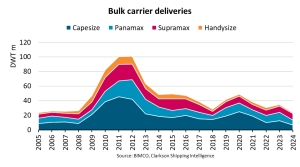
According to BIMCO estimates from the upcoming Dry Bulk Shipping Market Overview and Outlook report, deliveries of bulk carriers should drop to 23.8 million DWT in 2024. The sector’s orderbook currently adds up to 66.7 million DWT, a mere 6.9% of the bulker fleet, the lowest ratio since at least 1996.
Contracting of bulk carriers spiked in 2021 and reached 48.4 million DWT, driven by a positive congestion driven cycle which brought an opportunity for investment. However, in the first ten months of 2022 only 11.7 million DWT were contracted as concerns about economic growth and alternative fuels dominated the sector.
“In terms of size, upcoming bulk carrier deliveries are increasingly skewed towards panamax and supramax ships. Capesizes will account for around 27.8% of deliveries in 2024, significantly lower than their 40.9% ten-year average. Weaker and volatile rates and a 0.6 ratio between prices for newbuildings and 5-year-old ships are hindering contracting in the segment,” says Filipe Gouveia, Shipping Analyst at BIMCO.
The sector’s response to fuel transition and emissions reduction has thus far been slow, as demonstrated by the orderbook. Measured in deadweight, only 13.3% and 6.0% of deliveries until the end of 2024 are LNG and ammonia ready, respectively, while only two panamax ships are LNG ready.
“The continued economic downturn will likely affect investment decisions and keep the orderbook small. However, the average bulk carrier age has risen by six months each year since 2018 and the average bulker is now eleven years and six months old. Amid stricter environmental regulations and an aging fleet, renewal of the fleet will be required, and we can expect contracting to pick up across all segments towards the end of 2023,” says Gouveia.
Alternative fuel adoption among bulk carriers will likely continue to lag behind other sectors. However, by the next contracting cycle, a clearer roadmap for the adoption of alternative fuels will hopefully have emerged.
ELNAVI Newsletter
More information: ELNAVI,
19, Aristidou str., Piraeus 185 31,
Tel.: +30 210 45.22.100, e-mail: This email address is being protected from spambots. You need JavaScript enabled to view it.
Melina Travlou and Dorothea Ioannou were honored at the 33rd Seatrade Maritime Awards in London

The president of the Hellenic Shipowners Association, Melina Travlou, was honored with the "Global Personality Award" for 2022, from the international Seatrade Maritime Awards, as part of the 33rd award held in London. Dorothea Ioannou, Managing Director – American Club, was also awarded the Diversity & Inclusion Award.
"I am honored to receive this award which reflects faith and vision, especially in this period of great geopolitical, economic and technological challenges that are contained in one word: UNITY. Uniting strengths, expertise and faith, we can move forward. Our responsibility as leading members of our industry is to stand together to lead shipping into a new era. And that must happen, without any compromise on safety. For our people, our ships and the environment. Together, we can overcome the challenges. United, we can lead this new game-changing era," said Melina Travlou in her message to the audience.
Welcoming the guests, Seatrade Maritime chairman Chris Hayman said: "It's hard to believe that more than three years have passed since we were last able to gather here for the final Seatrade Awards dinner. Tonight we will have the opportunity to see and hear how much the industry, working practices have changed since 1989 when the Seatrade Award was established".
During the evening, 15 winners were announced, winning one of the most important awards in shipping.
Dorothea Ioannou, managing director of the P&I American Club, was honored with the Seatrade Maritime Diversity and Inclusion Award, as the first woman to assume this important management position in the history of Marine Insurance Organizations, worldwide. "I want to thank the Seartrade Maritime Awards Committee for honoring me and the American P&I Club for everything we have achieved to date. The real value of the club is that it always shows sensitivity and responsibility to Individuality-Diversity" she said while receiving her award.
ELNAVI Newsletter
More information: ELNAVI,
19, Aristidou str., Piraeus 185 31,
Tel.: +30 210 45.22.100, e-mail: This email address is being protected from spambots. You need JavaScript enabled to view it.
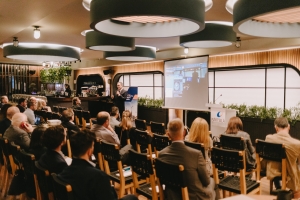
The shipping industry has entered an era of digital transformation and sustainable operations. To weather the above challenges Wartsila has merged its Marine Voyage and Marine Power Divisions to head up the future of fleet operations.
In view of these developments Wartsila Greece organised a seminar with the title “Sustainability Strategies: The future of fleet operations” to inform its clients of the new environmental and digital challenges in shipping.
Mrs. Helena Athoussaki, head of ESG Motor Oil Group, emphasized the pressure from regulators, investors and clients concerning decarbonization along with the challenges and the available solutions. She highlighted that decarbonisation is a part of a wider sustainability strategy whereby a company must develop a short-medium and long-term plan with specific targets, goals and performance analysis. As she said there are several ways to measure the performance and the reduction of emissions in ships in the effort to follow an efficient environmental strategy.She also presented the ESG criteria, the importance of the ESG risk evaluation and ESG reporting that has to be auditable and transparent. Last, Mrs. Athoussaki, underlined that digitalization plays a significant role to decarbonization but it requires commitment and change management.
Next speaker was Mr. Grant Hunter, Director for Standards, Innovation and Research, BIMCO who presented the issue “Accelerated digital transformation is the pathway to decarbonisation”.
He outlined that some of the potential speed reductions solutions are Hull Coating, Waste Heat Recovery, LNG/LPG as fuel, CCS, etc. Digital technologies have also significant impact on decarbonization.
In conclusion digitalization and decarbonisation will be the most important powers of change in shipping and shipping companies must not wait from IMO or a similar body such as EU in order to proceed with the adoption of smart solutions for a sustainable development.
Mr. Pankaj Khanna, CEO, Heidmar referred to “Environmental Regulations – Threat or Opportunity? Untangling the Mess”.
He spoke about the commercial impact of the EEXI /CII regulations on the tanker industry. The use of EPL to meet the EEXI regulations may hinder some older ships from meeting charter party speeds, however, overall the reduction of speed will be good for tanker demand as the market will need more ships. The CII regulations, in particular, will make non eco vessels less attractive commercially from 2024 onwards and also lead to some unusual trading patterns. He highlighted the potential problems with the CII regulations with regards to time spent in port and on short-haul voyages. He also referred to the inclusion of shipping in the EU Trading system and its financial impact. In conclusion he pointed out that the coming decarbonization regulations are a threat if one is not proactive particularly for owners of non-eco ships.
Christos Matsikoudis, Area Sales Manager Eastmed, Wärtsilä Voyage presented Wartsila’s Fleet decarbonization Strategies and introduced the concept of Smart Marine Eco system which is all about smart vessels, smart ports, green fuels, ship modelling, digitalization, autonomous shipping and Just in time arrivals at ports.
Mr. Matsikoudis pointed out that if we do not act immediately the 80% of the fleet in 2030 will be non CII compliant.
Then he presented how Wartsila’s Fleet Optimisation Solution platform embodies the smart marine ecosystem and constitutes a great inventory and visualization tool supporting Wartsila’s individual ship modelling and retrofit options for CII compliance. Wartsila is not a mere manufacturer of marine engines but has been transformed to an end to end provider with integration form “propeller to bridge.”
The digitalization in maritime will happen only if all stakeholders collaborate. Having data doesn’t mean being digital, concluded Mr. Matsikoudis.
ELNAVI Newsletter
More information: ELNAVI,
19, Aristidou str., Piraeus 185 31,
Tel.: +30 210 45.22.100, e-mail: This email address is being protected from spambots. You need JavaScript enabled to view it.

Created & produced by PROJECT CONNECT, the 3D virtual office tour is a first of a kind! Made for the entire international shipping industry and free to use.
Now every shipping and business student, teachers and families can enter a shipping company and learn about the various departments and roles, without having to get an appointment.
Project Connect chose to place the office building in the heart of the international shipping scene, Piraeus, and narrators are real time shipping executives.
It is a two-year project, envisioned by Irene Notias and inspired by the pandemic’s impact on education and training of youth.
During Covid when entry in shipping offices was prohibited, Irene, the director of Project Connect, decided to provide an office visit online so students wouldn’t miss out on an integral part of their education – vocations in shipping.
Remembering her office work in shipping companies and the thousands of office visits she made as a marine fuel broker visiting clients, she began writing a script and shared her idea with her team and some interested founder members.
One such member, Mr. Nikos Tsalamanios, Co-CEO of Seaven Group and Chairman of Project Connect sponsored the project in full.
Irene had her script read/edited by several principals such as John Xylas, Nicholas Notias, Anna Polemis, Shipping HR Panos Sotiropoulos and shipping professionals, Mary Arvaniti and Nikos Marmatsouris before she gave it to a professional script writer for final proof reading.
All together, graphic, architect, montage, narrators, script writers, shipping and HR professionals, they made an idea materialize by contributing their expertise.
Mary Arvaniti, Executive Assistant to George Tsavliris, is the female narrator, Nikos Marmatsouris, GAC Sr Group Marketing Manager, is the male narrator, Maria Yiassa, Swedish Club Sr Marketing Manager, is the Executive Assistant voice and Symeon Tsalikoglou plays the CEO while Irene Notias gives the prologue.
It is worth taking the entire tour.
Watch the 30.25 minute tour now: 1st Virtual Shipping Company Tour
Watch the 50 seconds short trailer: https://vimeo.com//700251622
By accessing the virtual tour, the aspiring shipping graduate immerses her / himself in the door of an actual Greek shipping firm and via a knowledgeable and experienced virtual narrator / tour guide, is taken through its every department in an exciting 3D setting ! The young graduate has the opportunity to view the professionals heading each department whilst learning of the day to day activities, practices and procedures required of their respective roles. In other words, Project Connect’s first virtual shipping office tour, is an added powerful tool for aspiring shipping candidates, giving them unique insider knowledge of the fast-paced challenging work environment of a Greek shipping company.
This innovative shipping office environment is freely available to Colleges and Universities, making it possible for shipping students to gain a clearer picture of the shipping firm beyond the pages of a Business / managerial text book. This two-fold success is what anyone who is a member of Project Connect aspires to : the success of our youth means success and the tangible added value to our shipping companies.
Marianna Terzidaki, BlueGeneration Project Coordinator of Militos S.A. a consulting firm says: “I am positive that young people, who pursue a career in shipping, will find it very motivating to watch the 3D Virtual Tour at Evdokia Maritime Corporation, that provides a clear and realistic view of the organizational structure, the activities and the roles and responsibilities in a shipping company. “
Established in Greece since 2015, the NPO, Project Connect has been Greek Shipping’s main advocate, connecting educational institutions and graduates with the local job market with its online CV Platform of students and grads.
It helped hundreds of striving shipping students and grads get a placement or internship after the financial crisis hit hard in Greece.
“During this period of crisis, pandemics and war in our neighboring Ukraine, we pray for peace to prevail and we strive to continue our mission to enhance Greece’s youth with strength, hope and the tools they need to develop themselves for their future. Afterall they will be our leaders, as we age”, says Mary Arvaniti, member of the NPO and one of the two main narrators of the tour.
Individuals who are part of the Shipping industry have a special quality – a passion- unique to Shipping ; one cannot be a part of this industry without loving every second of it.
Shipping IS its people : comprised of Dedicated men and women, with the appropriate education, a rare sense of responsibility and a willingness to go ‘beyond the call of duty’ on a daily basis – this is all depicted in the tour, to show to younger people the secret to shipping’s success.
PROJECT CONNECT is an initiative of hope and tangibles which actively promote change for a better future for our youth and our country.
Defined by its commitment to excellence, PROJECT CONNECT is removing obstacles in the path of our youth. In the words of Honorary Chairman George Tsavliris, “Project Connect is daring to surpass the complacencies and sometimes even defy logic.”
The result is the strengthening of Greek Shipping competitiveness.
This production is in memory of the young shipping people who left too soon : Nikos Tsiamis, Rena H. Notias, Maria E. Tsakos, John D. Pateras, Cpt George Boulas, Helen Panagos & Patrick Hawkins
& in memory of Eva Divari who happily permitted the use of her paintings on the virtual company’s walls but didn’t live to see the final production.
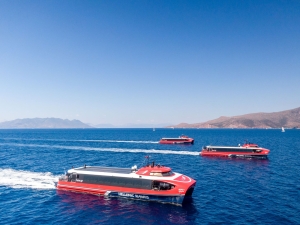
The Athens Exchange listed company Attica Holdings reported excellent financial figures for the 3rd quarter of the fiscal year 2022.
- Consolidated revenue stood at Euro 220.17mln for the third quarter of 2022 and Euro 421.61mln for the period 01.01.2022-30.09.2022 compared to Euro 148.31mln and Euro 270.5mln in the corresponding 2021 periods, an increase of 48.45% and 55.86% respectively.
- Consolidated earnings before interest, taxes, investing and financial results, depreciation and amortisation (EBITDA) stood at Euro 62.33mln for the third quarter 2022 and Euro 52.73mln for the period 01.01.2022-30.09.2022 against Euro 47.11mln and Euro 42.74mln in the corresponding 2021 periods.
- Consolidated earnings before interest and tax (EBIT) stood at Euro 49.09mln for the third quarter of 2022 and Euro 14.62mln for the period 01.01.2022-30.09.2022 against Euro 33.34mln and Euro 4.31mln in the corresponding 2021 periods.
- Consolidated Profit after taxes stood at Euro 60.70mln for the third quarter 2022 and profit after taxes of Euro 30.16mln for the period 01.01.2022-30.09.2022 against Profit after taxes of Euro 32.74mln and loss after taxes of Euro 1.31mln in the corresponding 2021 periods.
For the forthcoming months of 2022, which constitute months of low traffic, the Group’s traffic volumes are expected to be at pre Covid-19 levels.
The Group holds adequate liquidity with its cash and cash equivalents standing at Euro 75.67mln on 30.09.2022 compared to Euro 97.36mln as at 31.12.2021. Moreover, on 30.09.2022 the Group maintains undrawn credit lines amounting to Euro 15mln.
In October 2022, the Company has entered into bilateral credit facilities with three Greek credit institutions for a total amount of Euro 210mln and tenors from five to seven years, successfully concluding the long-term refinancing of all Group's credit facilities maturing in 2022- 2023. The above agreements result in the reduction of the average interest rate margin of the Group.
Moreover, ICAP S.A., pursuant to its regular reassessment of the Company, upgraded its credit rating by one (1) notch by assigning it a ΑΑ credit rating (low credit risk zone).
Further to the agreement signed on 23.9.2022 between the Company and the largest shareholders and creditors of "ANEK S.A.”, concerning the merger through absorption of ANEK by the Company, the Board of Directors of ATTICA decided the commencement of the process of merger through absorption of ANEK by ATTICA. The 31st of December 2021 was set as transformation date.
ELNAVI Newsletter
More information: ELNAVI,
19, Aristidou str., Piraeus 185 31,
Tel.: +30 210 45.22.100, e-mail: This email address is being protected from spambots. You need JavaScript enabled to view it.

Columbia Shipmanagement (CSM) and Marine Capabilities (MARCAP LLC) have signed a Memorandum of Understanding in Abu Dhabi that will lead innovation and shape the technological future of the maritime sector in the Middle East Gulf region.
The two organisations, who place quality performance, targets and goals at the heart of what they do, will initially focus their partnership on ship management, crewing, IT and Performance Optimisation and will work to identify new opportunities to challenge the existing status quo by generating vessel performance optimisation models that will shape the future of the maritime sector in the Gulf.
serving the largest oilfield and construction companies across the Arabian Gulf (including both United Arab Emirates and the Kingdom of Saudi Arabia), the Arabian Sea, and across the Red Sea.
CSM is a leading integrated maritime and logistics services platform with a focus on performance optimisation and using advanced digital technologies to deliver its services. It is already focusing heavily on delivering digitised solutions to the region via its office in Saudi Arabia and sees its partnership with Marcap as an opportunity to strengthen the digital credentials of the Gulf.
CSM and Marcap are operating in a region that is forward-looking and future-oriented and have a mutual understanding that the future will be driven by technological advances in key areas like crew welfare and cost-competitiveness together with vessel performance optimisation. The confidence that the resulting sizeable value of this partnership will lead to massive benefits is undisputable, they feel.
Commenting on this partnership during the signing ceremony, Mark O'Neil, President and CEO of CSM, said: “We are very excited to be partnering and cooperating with Marcap. I think from the first meeting we had with Mr. Qiblawi and all of Marcap’s team, we realised they are a company that mirrored our culture and corporate values. We are very excited to be working together, to seize the opportunities and face the challenges of the region which are obvious to everyone. We are very keen on developing the market in Saudi Arabia and the wider Gulf region, where the opportunities are immense. With friends like Marcap, I think everything is possible.”
On the same level, Marcap President & CEO Samer Qiblawi, added: “We met in Cyprus two weeks ago, with a very warm-hearted welcome. We look forward to this cooperation with a lot of hope and enthusiasm, trusting it to be a very fruitful cooperation, to expand in terms of skills and capacities in the markets we work in. CSM also shares this outlook and we are proud to be in partnership with one of the key players in the maritime industry. We certainly welcome this partnership with all our friends at Columbia Shipmanagement.”
Image: CSM President and CEO, Mark O'Neil, and Marcap President & CEO Samer Qiblawi, (L-R)
ELNAVI Newsletter
More information: ELNAVI,
19, Aristidou str., Piraeus 185 31,
Tel.: +30 210 45.22.100, e-mail: This email address is being protected from spambots. You need JavaScript enabled to view it.
AHEPA celebrated its 100 years in Athens
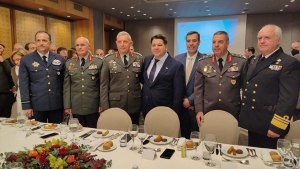
The members of AHEPA in Greece and the AHEPA Maritime "St' Nicholas" celebrated its 100 years of service in Athens in Divani Caravel Hotel.
The event was honored by the presence of the following distinguished personalities: Honoring the US ambassador in Greece Mr. George James Tsunis, the Hellenic National Defence General Mr. Konstantinos Floros and the leadership of Hellenic Army, Navy and Airforce. During the event, speeches addressed by Minister of Health Mr. Θάνος Πλεύρης and the State Secretary of Defence Mr. Nikos Hardalias, Mr. Dimitris Mattheou president of the Chapter AHEPA Maritime "St' Nicholas" HJ-45and the Vice President Mr. Dionisis Politis.
Order of AHEPA Supreme President Mr. Jimmy Kokotas, among other distinguished speakers presented the 100 years history of AHEPA and the role for defending the Hellenism, Education, Philanthropia, Civic responsibility and its values to excellence for every individual and family.
ELNAVI Newsletter
More information: ELNAVI,
19, Aristidou str., Piraeus 185 31,
Tel.: +30 210 45.22.100, e-mail: This email address is being protected from spambots. You need JavaScript enabled to view it.

By Marina Aliferopoulou, Lawyer, LL.M. Mediator. Member of Wista Hellas, PhD candidate, University of the Aegean, Department of Shipping, Trade and Transport
I. Introduction.
Meaning of Sanctions.
Sanctions are an essential tool in the EU’s common foreign and security policy (CFSP), through which the EU can intervene where necessary to prevent conflict or respond to emerging crisis;
EU restrictive measures are not punitive, they are intended to bring about a change in policy or activity by targeting non-EU countries, as well as entities and individuals, responsible for the malign behaviour at stake 1 , 2 .
Implementation. The EU applies sanctions in order to:
Promote international peace and security.
Prevent conflicts.
Support human rights.
Defend international law.
The sanctions may target governments of non-EU countries, as well as companies, groups, individuals through:
Travel Bans.
Embargoes.
Asset freeze.
Restrictions on imports/exports.
(Competent Directorate).
1 Overview of sanctions and related tools (europa.eu).
2 Sanctions tools, EU Sanctions Tool (europa.eu): EU sanctions map, Financial Sanctions Consolidated List, Due Diligence Help Desk-Iran, EU sanctions tool-Iran.
The proposals for Regulations on sanctions for adoption by the Council of the European Union are prepared by the Directorate General for Financial Stability, Financial Services and Capital Markets Union (DG FISMA).
II. The applicable regime.
(Regulation).
The European Council’s Regulation (EU) no. 833/2014 concerning restrictive measures in view of Russia’s actions destabilizing the situation in Ukraine 3 is in force, as it is amended 4 , 5 and is currently (10 October 2022) consolidated (“the Sanctions Regulation”):
The Regulation provides, among others, that:
(Article 3ea):
It shall be prohibited to provide access, after 16 April 2022, to ports and, after 29 July 2022, to locks in the territory of the Union, to any vessel registered under the flag of Russia, with the exception of access to locks for the purpose of leaving the territory of the Union.
The prohibition shall also apply, after 8 April 2023, to any vessel certified by the Russian Maritime Register of Shipping. Also, it shall apply to vessels that have changed their Russian flag or their registration. 6
The above prohibitions shall not apply in the case of a vessel in need of assistance seeking a place of refuge, of an emergency port call for reasons of maritime safety, or for saving life at sea.
However, by way of derogation from the above, the competent authorities may authorize a vessel to access a port or lock, under such conditions as they deem appropriate, after having determined that the access is necessary for: (a) import or transport into the Union of natural gas and oil, including refined petroleum products, titanium, aluminium, copper, nickel, palladium and iron.
3 EUR-Lex - 32014R0833 - EN - EUR-Lex (europa.eu)
4 The amendments and implementing regulations are the following: Council Regulation (EU) no 960/2014 of 8 September 2014, Council Regulation (EU) no 1290/2014 of 4 December 2014, Council Regulation (EU) 2015/1797 of 7 October 2015, Council Regulation (EU) no 2017/2212 of 30 November 2017, Commission Implementing Regulation (EU) 2019/1163 of July 2019, Council Regulation (EU) no 2022/262 of 23 February 2022, Council Regulation (EU) no 2022/328 of 25 February 2022, Council Regulation (EU) 2022/334 of 28 February 2022,
Council Regulation (EU) 2022/345 of March 2022, Council Regulation (EU) 2022/394 of March 2022, Council Regulation (EU) 2022/428 of 15 March 2022, Commission Implementing Regulation (EU) 2022/595 of 11 April 2022, Council Regulation, Council Regulation (EU) 2022/879 of 3 June 2022, Council Regulation (EU) 2022/1269 of 21 July 2022, Council Regulation (EU) 2022/1904 of 6 October 2022.
5 See also, the presentation of Bruce Paulsen, Seward & Kissel, Sanctio ns Related to the Russian Oil Price Cap, at the Marine Money event, 13 October 2022, at Stavros Niarchos Lighthouse. Timeline of events: “June 3, 2022, EU passes its sixth sanctions package which includes a prohibition for EU operators to insure or finance the transport of crude oil or petroleum products from Russia to third countries, going into effect Dec. 5 2022 for crude oil and February 5, 2023 for petroleum products. September 2, 2022, G7 issues a statement announcing the price cap and maritime services exception. September 9, 2022: OFAC issues a Preliminary Guidance on the implementation of the maritime services ban and price cap exception. September 29, 2022, EU proposes 8 th sanctions package against
Russia which includes a Russian oil price cap. October 6, 2022, EU approves 8 th sanctions package which marks the beginning of the implementation of the price cap within the EU”.
6 A ‘vessel’ means: (a) a ship falling within the scope of the relevant international conventions; (b) a yacht, of 15 meters in length or more, which does not carry cargo and carrying no more than 12 passengers; or (c) recreational craft or personal watercraft as defined in Directive 2013/53/EU of the European Parliament and of the Council.
ore, as well as certain chemical and iron products as listed in Annex XXIV 7 ; (b) the purchase, import or transport of pharmaceutical, medical, agricultural and food products, including wheat and fertilizers, whose import, purchase and transport is allowed under the Regulation;
(c) humanitarian purposes; (d) transport of nuclear fuel and other goods strictly necessary for the functioning of civil nuclear capabilities; or (e) the purchase, import or transport into the Union of coal and other solid fossil fuels, as listed in Annex XXII 8 , until 10 August 2022.
Also, by way of derogation from the above, the competent authorities may authorize vessels that have changed their Russian flag or their registration to the flag or register of any other State prior to 16 April 2022, to access a port or a lock, under such conditions as they deem appropriate, after having determined that: (a) a Russian flag or registration was required by contract; and (b) the access is necessary for the unloading of goods strictly necessary for the completion of renewable energy projects in the Union, provided that the import of such goods is not otherwise prohibited under the Regulation 9 .
(Article 3i):
It shall be prohibited to purchase, import, or transfer, directly or indirectly, goods, which generate significant revenues for Russia thereby enabling its actions destabilizing the situation in Ukraine, as listed in Annex XXI 10 of the Regulation, into the Union, if they originate in Russia,
or are exported from Russia· also, it is forbidden to provide relevant to the above technical assistance, or brokering services 11 , 12 .
7 Article XXIV-List of Goods as referred to in article 3ea(5)(a).
8 Article XXII-List of coal and other products as referred to in Article 3j.
9 Also, by way of derogation from the above, the competent authorities may authorize, under such conditions as they deem appropriate, a vessel to access a port or lock provided that the vessel: (a) has flown the Russian Federation flag under a bareboat charter registration initially effected prior to 24 February 2022, (b) has resumed its right to fly the flag of the underlying Member State registry before 31 January 2023, and (c) is not owned, chartered, operated or otherwise controlled by a Russian national or any legal person, entity or body incorporated or constituted under the law of the Russian Federation.
10 Annex XXI-List of Goods and Technology referred to in Article 3i.
11 However, by way of derogation from the above, the competent authorities may authorize the purchase, import or transfer of the goods listed in Annex XXI of the Regulation, or the provision of related technical and financial assistance, under such conditions as they deem appropriate, after having determined that this is necessary for the establishment, operation, maintenance, fuel supply and retreatment and safety of civil nuclear capabilities, and the continuation of design, construction and commissioning required for the completion of civil nuclear facilities, the supply of precursor material for the production of medical radioisotopes and similar medical applications, or critical technology for environmental radiation monitoring, as well as for civil nuclear cooperation, in particular in the field of research and development.
12 As of 10 July 2022, the above prohibitions shall not apply to the import, purchase or transport, or the related technical or financial assistance, necessary for the import into the Union, of: (a) 837 570 metric tonnes of potassium chloride of CN 3104 20 between 10 July of a given year and 9 July of the following year; (b) 1 577 807 metric tonnes combined of the other products listed in Annex XXI under CN 3105 20, 3105 60 and 3105 90 between 10 July of a given year and 9 July of the following year. The import volume quotas set out shall be managed by the Commission and the Member States in accordance with the management system for tariff-rate quotas provided for in Articles 49 to 54 of Commission Implementing Regulation (EU) 2015/2447. The Member State concerned shall inform the other Member States and the Commission of any authorization granted under paragraph 3c within two weeks of the authorization.
(Article 3j):
It shall be prohibited to purchase, import or transfer, directly or indirectly, coal and other products, as listed in Annex XXII of the Regulation into the Union, if they originate in Russia, or are exported from Russia. It shall be prohibited to: (a) provide technical assistance, brokering
services or other services related to the goods and technology referred to above and to the provision, manufacture, maintenance and use of those goods and technology, directly or indirectly in relation to the prohibition referred to above; (b) provide financing or financial
assistance related to the goods and technology referred to above for any purchase, import or transfer of those goods and technology, or for the provision of related technical assistance, brokering services or other services, directly or indirectly in relation to the prohibition referred to above. The above prohibitions in shall not apply to the execution until 10 August 2022 of contracts concluded before 9 April 2022, or ancillary contracts necessary for the execution of such contracts 13 .
(Article 3m):
It shall be prohibited to purchase, import or transfer, directly or indirectly, crude oil or petroleum products, as listed in Annex XXV 14 , if they originate in Russia or are exported from Russia. It shall be prohibited to provide, directly or indirectly, technical assistance, brokering services, financing or financial assistance or any other services related to the above prohibition. The prohibitions shall not apply: (a) until 5 December 2022, to one-off transactions for near-term delivery, concluded and executed before that date, or to the execution of contracts for the purchase, import or transfer of goods falling under CN 15 2709 00 concluded before 4 June 2022, or of ancillary contracts necessary for the execution of such contracts, provided that those contracts have been notified by the relevant Member States to the Commission by 24 June 2022 and that the one-off transactions for near-term delivery are notified by the relevant Member States to the Commission within 10 days of their completion; (b) until 5 February 2023, to one-off transactions for near-term delivery, concluded and executed before this date, or to the execution of contracts for the purchase, import or transfer of goods falling under CN 2710 concluded before 4 June 2022, or of ancillary contracts necessary for the execution of such contracts, provided that those contracts have been notified by the relevant Member States to the Commission by 24 June 2022 and that the one-off transactions for near-term delivery are notified by the relevant Member States to the Commission within 10 days of their completion; (c) to the purchase, import or transfer of seaborne crude oil and of petroleum products listed in Annex XXV of the Regulation, where those goods originate in a third country and are only being loaded in, departing from or transiting through Russia, provided that both the origin and the owner of those goods are non-Russian; (d) to crude oil falling under CN 2709 00 which is delivered by
13 See also, The London p&i club, “Ukraine-EU Sanctions-EU adopts Eight Package of Sanctions against Russia”, 12 October 2022; Britannia p&i club, “EU sanctions-updated FAQs published by the EU on the carriage of certain Russian cargoes including coal and fertilizers”, 31 October 2022; West of England, Tony Paulson, “Ukraine Conflict-EU adopts eighth sanctions package against Russia; North p&i club, “EU Sanctions-clarification Published on the Carriage of Certain Russian Cargoes”, 21/09/2022; Gard p&i, “EU sanctions-updated FAQs published by the EU on the carriage of certain Russian cargoes including coal and fertilisers”, member circular n.8/2022, September 2022.
14 Annex XXV-List of crude oil and petroleum products referred to in articles 3m and 3n of the Sanctions Regulation.
15 CN=Combined Nomenclature.
pipeline from Russia into Member States, until the Council decides that the prohibitions in paragraphs 1 and 2 shall apply. If the supply of crude oil by pipeline from Russia to a landlocked Member State is interrupted for reasons outside the control of that Member State, seaborne crude oil from Russia falling under CN 2709 00 may be imported into that Member State, by way of an exceptional temporary derogation from paragraphs 1 and 2, until the supply is resumed or until the Council decision referred to in paragraph 3(d) applies with regard to that member State, whichever is the earliest. As of 5 December 2022, and by way of derogation from paragraphs 1 and 2, the competent authorities of Bulgaria may authorize the execution until 31 December 2024 of contracts concluded before 4 June 2022, or of ancillary contracts
necessary for the execution of such contracts, for the purchase, import or transfer of seaborne crude oil and of petroleum products listed in Annex XXV of the Regulation originating in Russia or exported from Russia. As of 5 February 2023, and by way of derogation from paragraphs 1 and 2, the competent authorities of Croatia may authorize until 31 December 2023 the purchase, import or transfer of vacuum gas oil falling under CN 2710 19 71 originating in Russia or exported from Russia, provided that the following conditions are fulfilled: (a) no alternative supply of vacuum gas oil is available; and (b) Croatia has notified the Commission, at least two weeks prior to the authorization, of the grounds on which it considers that a specific authorization should be granted, and the Commission has not objected within that period. The goods imported following a derogation granted by a competent authority under paragraph 5 or 6 shall not be sold on to buyers located in another Member State or in a third country. The transfer or transport of crude oil delivered by pipeline into Member States as referred to in paragraph 3(d) to other Member States or to third countries, or its sale to purchasers in other Member States or in third countries, shall be prohibited 16 , 17 , 18 .
(Article 12).
16 All consignments and containers of such crude oil shall be clearly marked as 'REBCO: export prohibited'. As from 5 February 2023, where crude oil has been delivered by pipeline into a Member State, it shall be prohibited to transfer or transport petroleum products falling under CN 2710 which are obtained from such crude oil to other Member States or to third countries, or to sell such petroleum products to purchasers in other Member States or in third countries
17 By way of temporary derogation, the prohibitions referred to in the third subparagraph shall apply as from 5 December 2023 to the import and transfer into Czechia, and to the sale to purchasers in Czechia, of petroleum products obtained from crude oil which has been delivered by pipeline into another Member State as referred to in paragraph 3(d). If alternative supplies for such petroleum products are made available to Czechia before that date, the Council shall terminate that temporary derogation. During the period until 5 December 2023, the volumes of such petroleum products imported into Czechia from other Member States shall not exceed the average volumes imported into Czechia from those other Member States over the same period during the previous five years.
18 The prohibitions shall not apply to purchases in Russia of goods listed in Annex XXV of the Regulation, which are required in order to meet the essential needs of the purchaser in Russia or of humanitarian projects in Russia. Member States shall report to the Commission by no later than 8 June 2022 and every three months thereafter on the amounts of crude oil falling under CN 2709 00 imported by pipeline, as referred to in paragraph 3(d). Such import figures shall be broken down per pipeline. In the event that the exceptional temporary derogation referred to in paragraph 4 applies with regard to a landlocked Member State, that Member State shall report to the Commission every three months on the amounts of seaborne crude oil falling under CN 2709 00 which it imports from Russia, for as long as that derogation applies. During the period until 5 December 2023, Member States shall report to the Commission every three months on the amounts which they export to Czechia of petroleum products falling under CN 2710 obtained from crude oil which has been delivered by pipeline as referred to in paragraph 3(d).
It shall be prohibited to participate, knowingly and intentionally, in activities the object or effect of which is to circumvent prohibitions in this Regulation.
(Article 13).
This Regulation shall apply:(a) within the territory of the Union; (b) on board any aircraft or any vessel under the jurisdiction of a Member State; (c) to any person inside or outside the territory of the Union who is a national of a Member State; (d) to any legal person, entity or body, inside or outside the territory of the Union, which is incorporated or constituted under the law of a Member State; (e) to any legal person, entity or body in respect of any business done in whole or in part within the Union.
III. Impact on Ports- Trade & Insurance.
Access to Ports.
The access to ports is monitored via the Union Maritime Information and Exchange System 19 , which also links to EQUASIS 20 . All EU Member States have access to this system. Any attempt to circumvent the sanctions by the change of the flag of the vessel could be identified by the port authorities through a check of the IMO number of the vessel· in addition, under SOLAS, the ships are also obliged to keep on board the synopsis report with the history of change of flags. Also, port authorities have access to the above monitoring system. Furthermore, ship-to-ship operation can occur between a Russian flagged vessel and a third country flagged vessel in international waters, a ship-to-ship operation between Russian and EU-flagged vessels, and a Russian flagged vessel and third-country flagged vessel in territorial waters of a Member State.
If a ship-to-ship operation takes place with the objective to circumvent the prohibition of article 3ae of the Regulation, such an operation is caught by the non-circumvention clause of Article 12. The determining element is that such ship-to-ship operation is orchestrated in order for a vessel that is not subject to the port access ban to call in an EU port, where otherwise a Russian flagged vessel could not call in. Where a vessel has been authorized to call on a port in order to unload goods subject to derogation, it must obtain a separate authorization. Russian flagged recreational ships that were berthed in the port of a Member State before 16 April 2022 do not fall under the scope of the prohibition since their sole presence does not amount to access into a Union port; however, leaving a Union port, any request to return would result in calling into a Union port and be prohibited under Article 3ea 21 .
Oil imports-Reporting obligations under the oil import restrictions-Export restrictions on maritime navigation goods and technology-Export related restrictions.
Article 3m of the Regulation prohibits, subject to certain exceptions and derogations, imports of goods set out in Annex XXV, if such goods originate from Russia 22 . It is therefore necessary to determine, if the product originates from Russia. EU operators and national authorities must conduct appropriate due diligence before purchasing goods listed in Annex XXV from other
19 UMIES, was established under Directive 2002/59/EC.
20 Electronic Quality Shipping Information System.
21 Access to EU ports (europa.eu), Frequently Asked Questions-as of October 2022.
22 Oil imports (europa.eu), Frequently Asked Questions- as of 8 November 2022.
Member States, which benefit from the exceptions laid down in Article 3m(3)(d) (crude imports by pipeline), or from specific derogations (for Bulgaria and Croatia). When purchasing such goods, they should do the necessary checks to ensure that such goods do not originate from
Russia, are not exported from Russia or are not petroleum products (CN 2709 10), which are obtained from crude oil originated or exported from Russia. However, the purchase of Russian seaborne crude oil by an EU company is allowed, when the goods are exported from Russia towards a third country and are not transiting Union territory. Furthermore, the aim of the reporting obligation included in Art. 3m(3) is to monitor the flows of oil still entering the EU after the ban on seaborne oil established with the 6 th sanctions package adopted on 3 June 2022 23 .
The data provided by Member States will remain confidential except for some high level aggregated numbers referring to the total EU level of oil imports. It is prohibited to sell, supply, transfer or export certain maritime navigation goods and technology (paragraph 1 of Article 3f of
the Sanctions Regulation), related technical assistance, brokering services or other services related to those above, directly or indirectly, to any natural or legal person, entity or body in Russia, or for use in Russia (paragraph 2(a) of article 3f of the Sanctions Regulation)·however, if the intended end-use of the marine navigation and radio communication equipment falls under the scope of maritime safety, the exporter may apply for an authorization and a case-by case assessment is made by the competent authority of the Member State in which the exporter is resident or established· this is also applicable for the related technical or financial assistance. As far as Export-related restrictions are concerned, it shall be prohibited to sell, supply, transfer or export, directly or indirectly, dual-use goods and technology, whether or not originating in the Union, to any natural or legal person, entity or body in Russia or for use in Russia 24 , 25
The Sanctions Regulation has expanded the scope of the export restrictions (since 2014, the restrictions applied to the military sector and now to civilians end-users or uses, with very limited exceptions and derogations). The Sanctions Regulation also prohibits the export of
additional “Advanced Technology” items to limit the enhancement of Russia’s military and technological capacity in sectors and lasers marine, chemicals that could be used in the process of manufacture of chemical weapons, special materials and related equipment, manufacturing equipment and other sensitive items, such as those used by law enforcement bodies. Finally, the Sanctions Regulation identifies entities connected to Russia’s defence and industrial base, on whom even tighter export restrictions are imposed.
Insurance & Reinsurance.
It shall be prohibited to provide insurance and reinsurance, directly or indirectly, in relation to goods and technology listed in Annex XI of the Sanctions Regulation to any person, entity or body in Russia or for use in Russia 26 . After a wind down period of 6 months, during which
contracts signed before 4 June 2022 can still be executed until December 5, EU operators will be prohibited from insuring and financing the maritime transport of goods set out in Annex XXV to third countries 27 , 28
23 Oil reporting obligation (europa.eu), Frequently Asked Questions-as of 26 August 2022.
24 In particular, see articles 2, 2a, 2aa, 2c, 2d, 2b, 3 of the Sanctions Regulation 833/2014, as it is in force.
25 Export restrictions on maritime navigation goods and technology (europa.eu), Frequently Asked Questions-as of
26 April 2022. Export Related restrictions (Europa.eu), Frequently Asked Questions-as of 10 October 2022.
26 See Article 3c (2) of the Sanctions Regulation.
Execution of Contracts & Claims.
No claims in connection with any contract or transaction the performance of which has been affected, directly or indirectly, in whole or in part, by the measures imposed under the Sanctions Regulation, including claims for indemnity or any other claim of this type, such as a claim for compensation or a claim under a guarantee, notably a claim for extension or payment of a bond, guarantee or indemnity, particularly a financial guarantee or financial indemnity, of whatever form, shall be satisfied, if they are made by: (a) legal persons, entities or bodies listed in the Annexes to this Regulation or legal persons, entities or bodies established outside the Union whose proprietary rights are directly or indirectly owned for more than 50 % by them; (b) any other Russian person, entity or body; (c) any person, entity or body acting through or on behalf of one of the persons, entities or bodies referred to in points. In any proceedings for the enforcement of a claim, the onus of proving that satisfying the claim is not prohibited, shall be on the person seeking the enforcement of that claim 29 , 30 .
27 Insurance and reinsurance (europa.eu), Frequently Asked Questions-as of 26 August 2022.
28 Skuld, Insight Russia sanctions, 10 October 2022: «Insurance Cover. The Association’s Rules contain a standard exclusion for liability for liabilities, costs or expenses where payment by the Association or the provision of cover may expose the Association to the risk of being subject to a sanction, prohibition or any adverse action (Rule 30.4.6). Liability is also excluded when there is a shortfall due to an inability to recover reinsurance or pool contributions from other insurers or P&I Clubs which are themselves unable to pay due to sanctions legislation
(Rule 32.6). the Association is also able to terminate cover where a Member has exposed or may expose the Association to the risk of being or becoming subject to a sanction, prohibition, restriction or other adverse action by a state or international organization or competent authority (Rule 3.3.2a). Similar provisions exist in the Terms & conditions for non-mutual covers…».
29 See article 12 of the Sanctions Regulation.
30 The term “contract” refers to a binding commitment between the parties. An “ancillary contract” is a contract necessary for the execution of another (principal) contract, that is, a contract without which the main contract cannot be executed, such as insurance, financing etc. Execution of contracts and claims (europa.eu), Frequently Asked Questions-as of 26 August 2022.
ELNAVI Newsletter
More information: ELNAVI,
19, Aristidou str., Piraeus 185 31,
Tel.: +30 210 45.22.100, e-mail: This email address is being protected from spambots. You need JavaScript enabled to view it.