


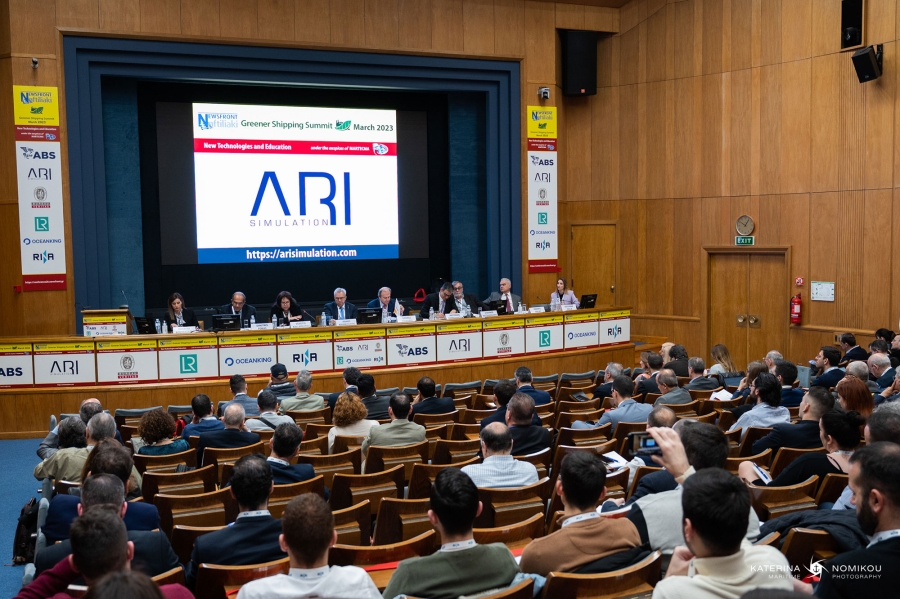
“The new technology cannot replace the importance of training of crews and key personnel”, declared Panos Kourkountis, the keynote speaker at Greener Shipping Summit.
Indeed, this was a clear message to come out of the event as panelists and delegates discussed the summit's theme 'New Technologies and Education'. Another clear message was that the industry's traditional education system "should become most flexible and modernised".
The event was organised by Newsfront / Naftiliaki under the auspices of Greece's powerful technical body Martecma (Marine Technical Managers Association).
Mr. Kourkountis, chairman of Martecma, noted technology has affected shipping in a positive manner. Its application to design, construction and operation has resulted in "better and safer ships than in the past".
"The fast pace of changes due to technology also brings serious risk," he said. "There is no period for the building of experience. Education is the only means to understand, evaluate, build and safely operate the new systems."
Then we are getting double messages from countries on the way to decarbonise with many of the regulations having nothing to do with the environment but only geopolitics.
Then when it comes to new fuels – hydrogen, methanol, ammonia, biofuels, batteries and electric power – the industry has very little knowledge and to go forward "we need the proper education".
"Whether the future ships will be fueled by hydrogen or methanol a blackout is enough to strip the ship of a sophisticated high-tech system leaving it with the people who have the capabilities and right virtues," said the Martecma chairman.
When it came to discussing the management and understanding of new equipment to be used on the next generation of ships, several panelists were quick to say there is a need to "teach the teachers". Indeed, the first panelist, Dimitris Fokas, training manager of the Angelicoussis Shipping Group, declared "teachers have to change the way they teach", a view shared by Ioannis Golias, md of the Eugenides Foundation, who also warned maritime educators need to prepare for what is coming as staff do not have to only know what to do but how to do it.
Fokas also said it is vital the correct balance be found of what is available and what is not, while Venetia Kallipolitou, of the Tsakos Group, said the interface between the office and the vessel must be robust and shipping companies must cooperate with educational institutes.
There was considerable discussion throughout the day on 'soft skills' and 'hard skills'. Stavros Hatzigrigoris, a former Martecma chairman, argued that soft skills will be downgraded in the medium term as people with hard skills are required to deal with today's needs and the training of people with hard skills should be the priority. RINA's training manager, Katerina Palla disagreed saying there is a need for soft skills when it comes to handling innovation. Summit chairman, George Tsavliris contended "re-skilling and up-skilling" is what is required.
When it comes to new equipment and green shipping and AI, Panos Zachariadis, technical director of Atlantic Bulk Carriers, said Greek shipping is now being left behind. ABS' business development manager, Maria Kyratsoudi, said AI is here but "we are missing the back-up systems", while Zachariadis said AI "needs controls otherwise it will takeover". Applied Research International's Gaurav Bajaj said when it comes to AI we have to go step-by-step and focus on what is required. John Kokarakis, of Bureau Veritas, stressed digitalisation is related to AI because of the data it provides.
Rizos Krikkis, gm Oceanking Engineering, said current trends pose three questions: What green technologies seem attractive for shipping; What will be the role of the after-sales and training for their adaption; and What are the major concerns for their sustainability.
Nikolaos Fragiadakis, director of marine engineering at the Merchant Marine Academy of Aspropyrgos, said the pandemic saw the introduction of teaching new tools which are not methods but now he uses his computer and cell-phone and not chalk and blackboard. Further, academies have to produce decision-makers with a technical skill and for maritime academies this is the difficult thing.
A student of the Aspropyrgos academy, Nikolaos Karagiannis, said students today are searching for the new technologies which are a combination of classical advanced engineering and computerisation.
National Technical University of Athens associate professor of maritime transport, Nikolaos Ventikos, told the summit that updating the curriculum is critical and the NTUA is trying to do it continually to meet the needs of today. He gave the example of a newly elected member to the staff who is a specialist in sustainability and new vessel design how the university is striving to make use of findings in international projects.
However, NTUA PhD candidate, research engineer, Konstantinos Louzis, felt the curricula of universities have “fallen a little behind because of the fast pace of change”, and this has presented challenges.
University of Piraeus’ Thanos Pallis noted the growth of e-learning means many students are part-time. He also stressed there is a need to teach students how to manage data. He also referred to the fact most students have a relative or a friend at sea and this has influenced the choice of a career. “The career at sea is not promoted,” said Pallis who also noted many qualified Greeks work abroad.
Hellenic Institute of Marine Technology president, Nikolaos Liapis, said new technologies do exist but are not being applied to the shipping industry. He said Greek technology companies do exist and they can work with universities, but they need funding and support. He believes Greece could become one of the leading technology producers in the maritime sector in the world but it needs academia and the industry to come to together.
Captain Michael Malliaros, gm, Euronav Ship Management (Hellas), said the industry is facing huge challenges and there is a great need for collaboration. “Actions from individual companies will not have the impact we want to produce the people with the skills needed to run vessels in the future,” he said. He said the willingness of individual companies to educate or train the people is not enough, all the stakeholders need to collaborate.
As Summit chairman, George Tsaviiris, summed up: “Shipping isone of the few industries where you have to be passionate, willing, daring and a romantic.
ELNAVI Newsletter
More Information: ELNAVI,
19, Aristidou str., Piraeus 185 31,
Tel.: +30 210 45.22.100, e-mail: This email address is being protected from spambots. You need JavaScript enabled to view it.