


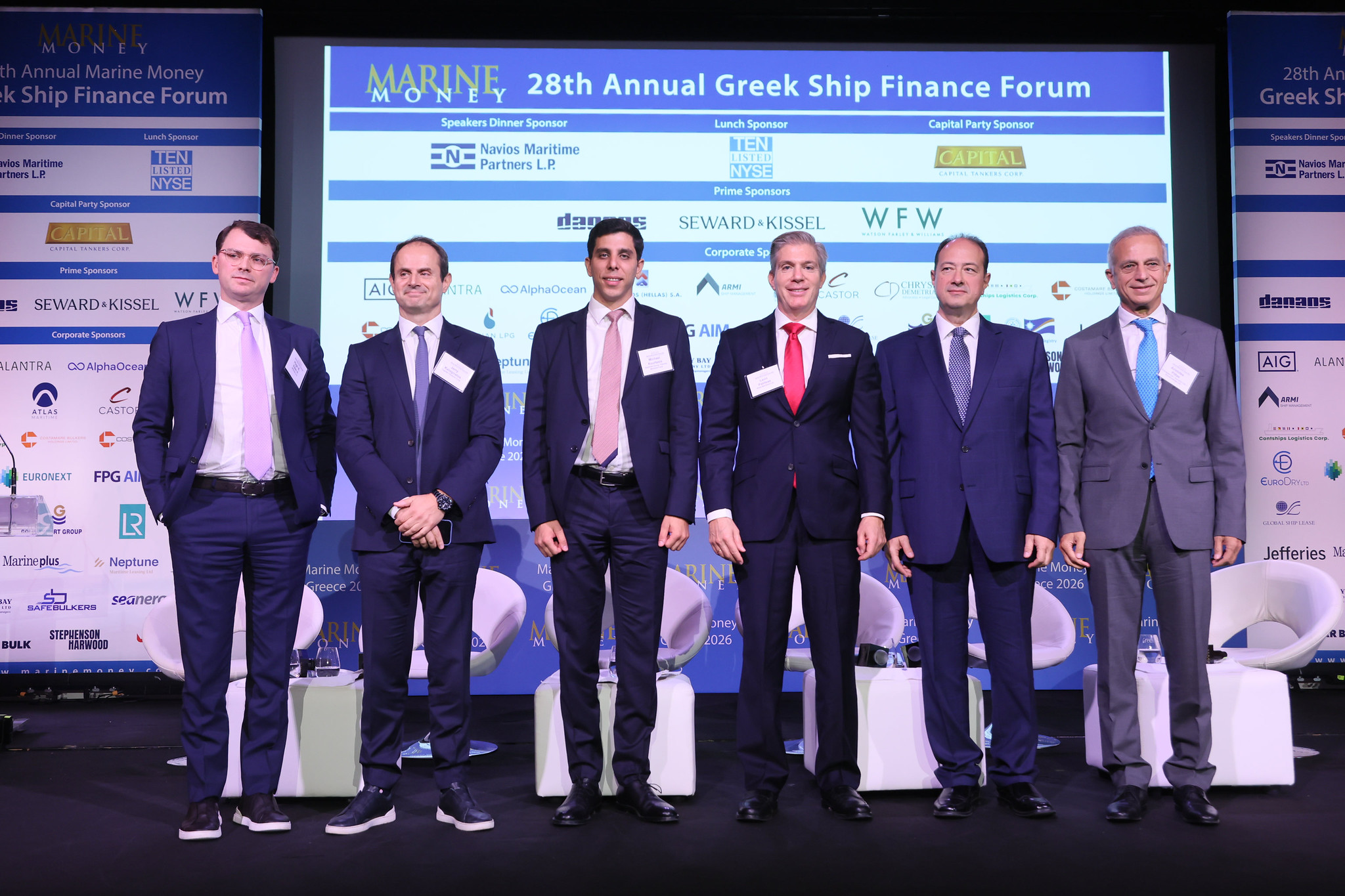
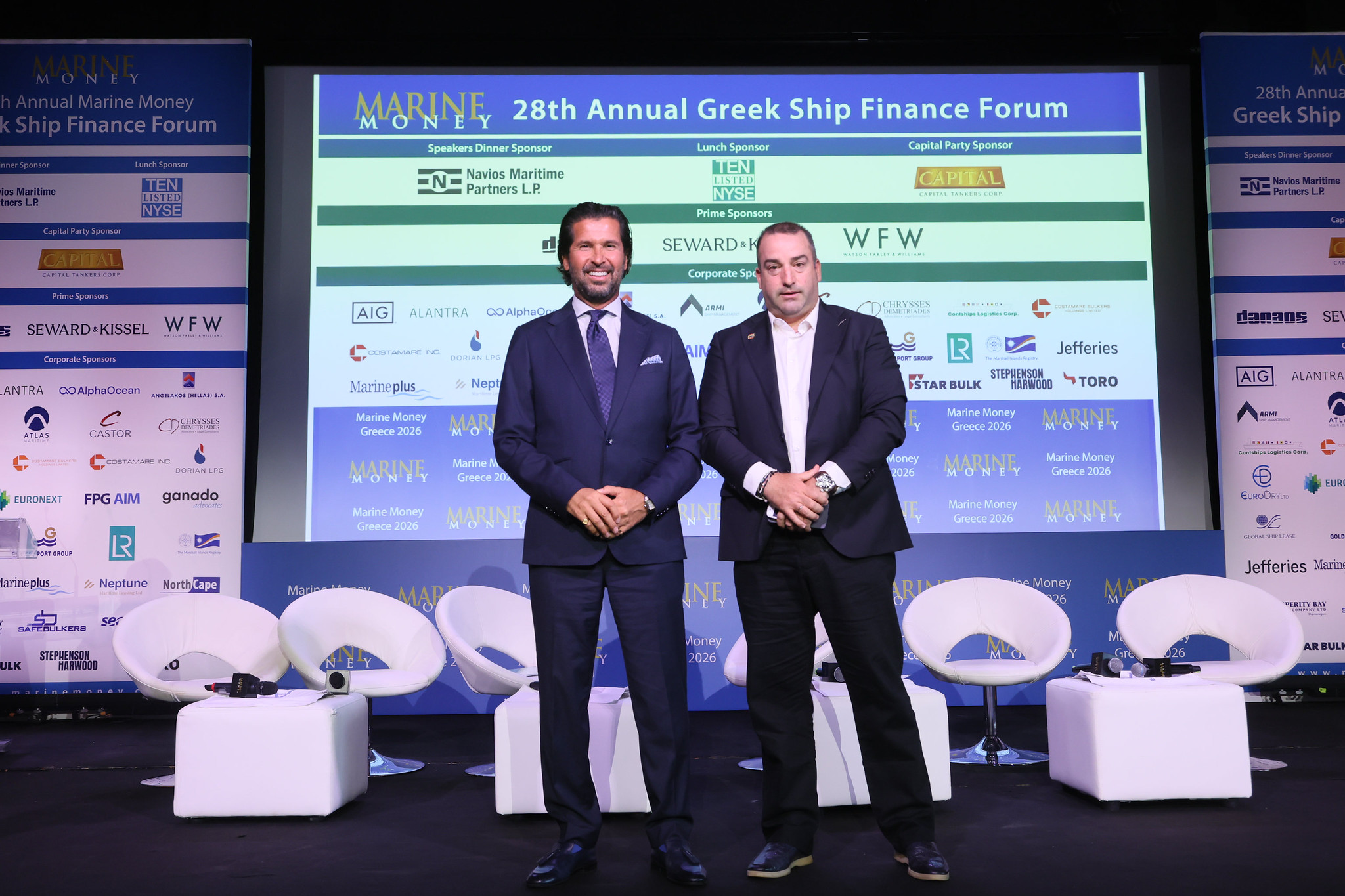
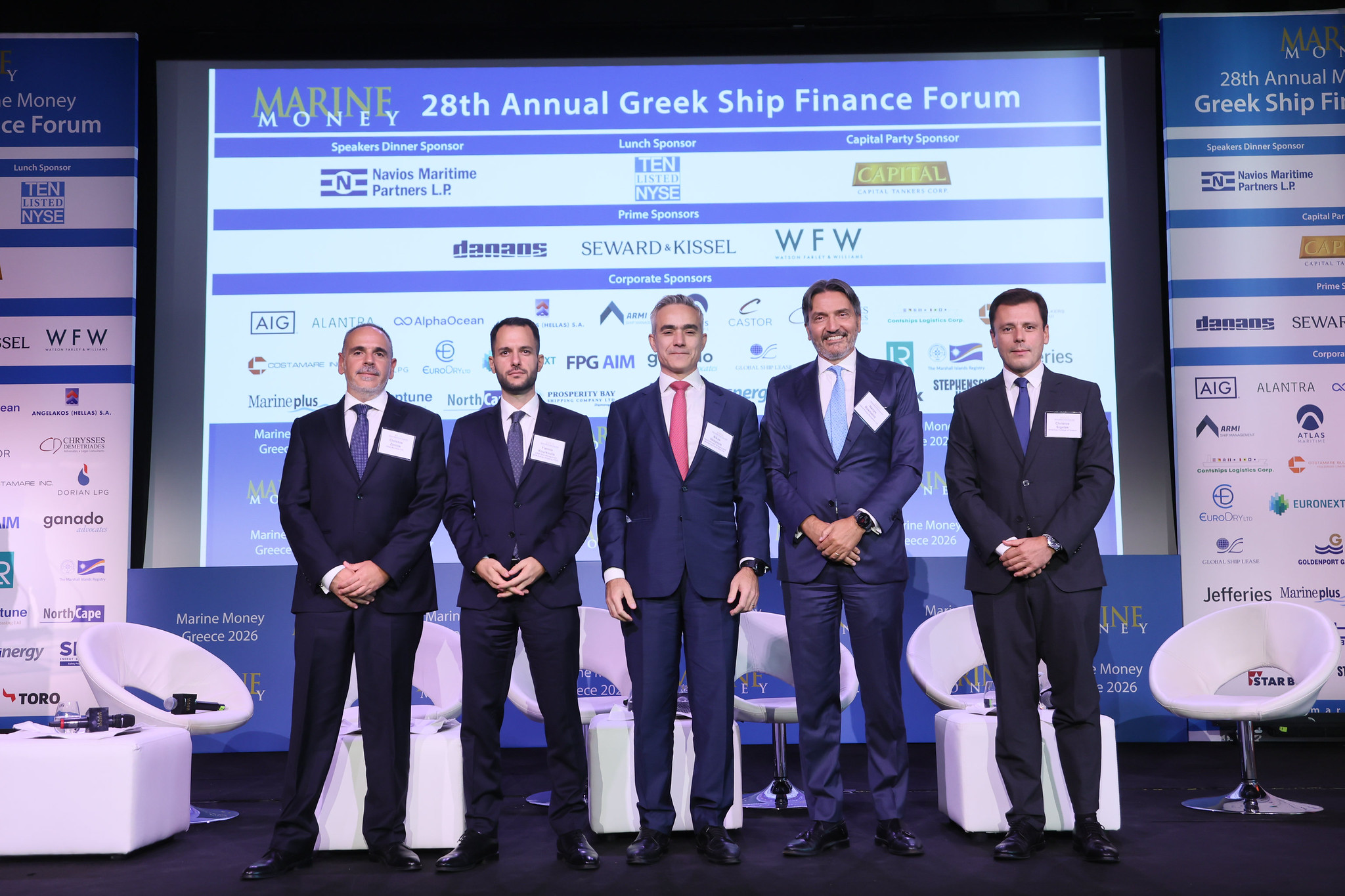
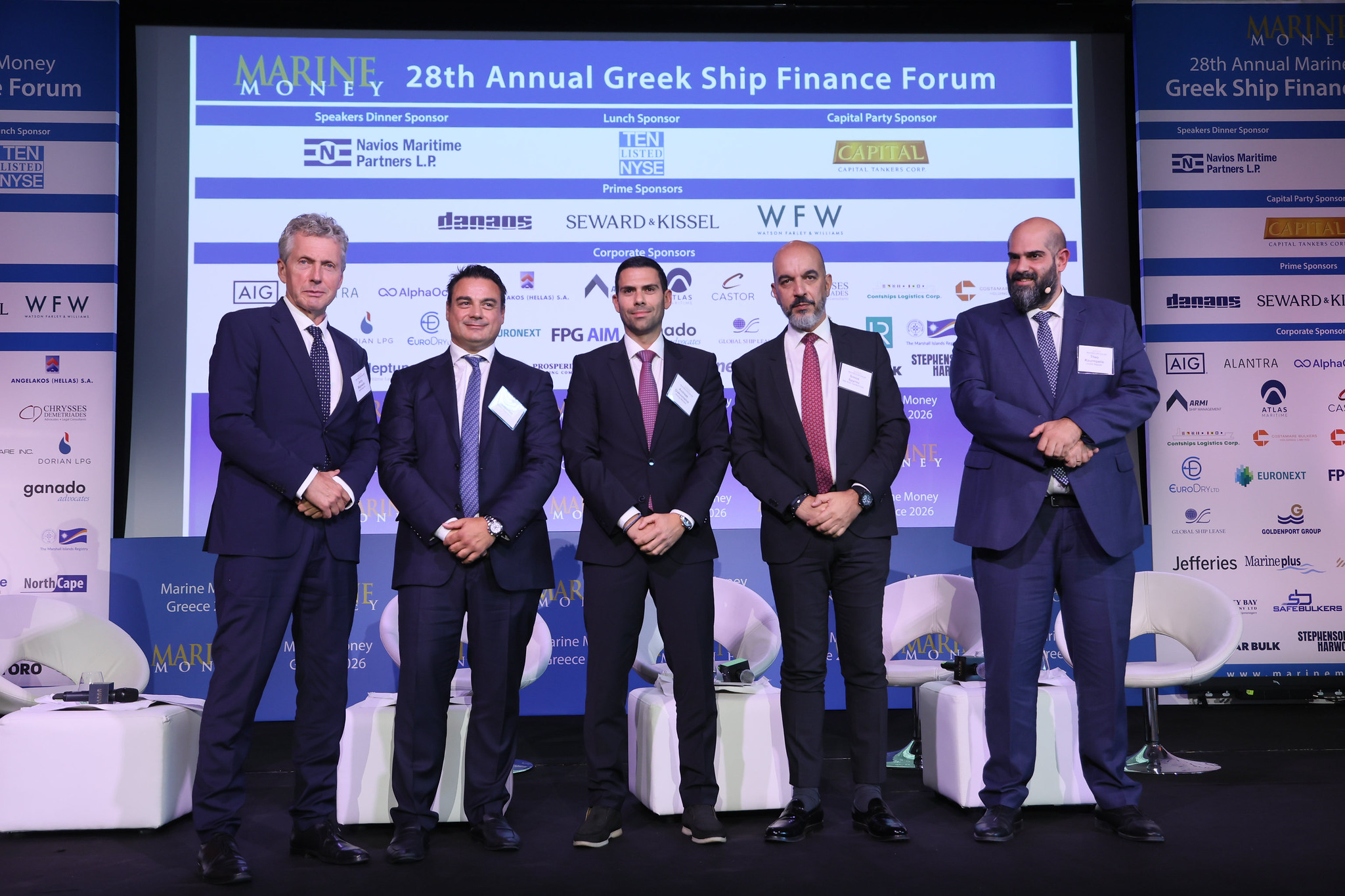




Smart Investing for Future Gain
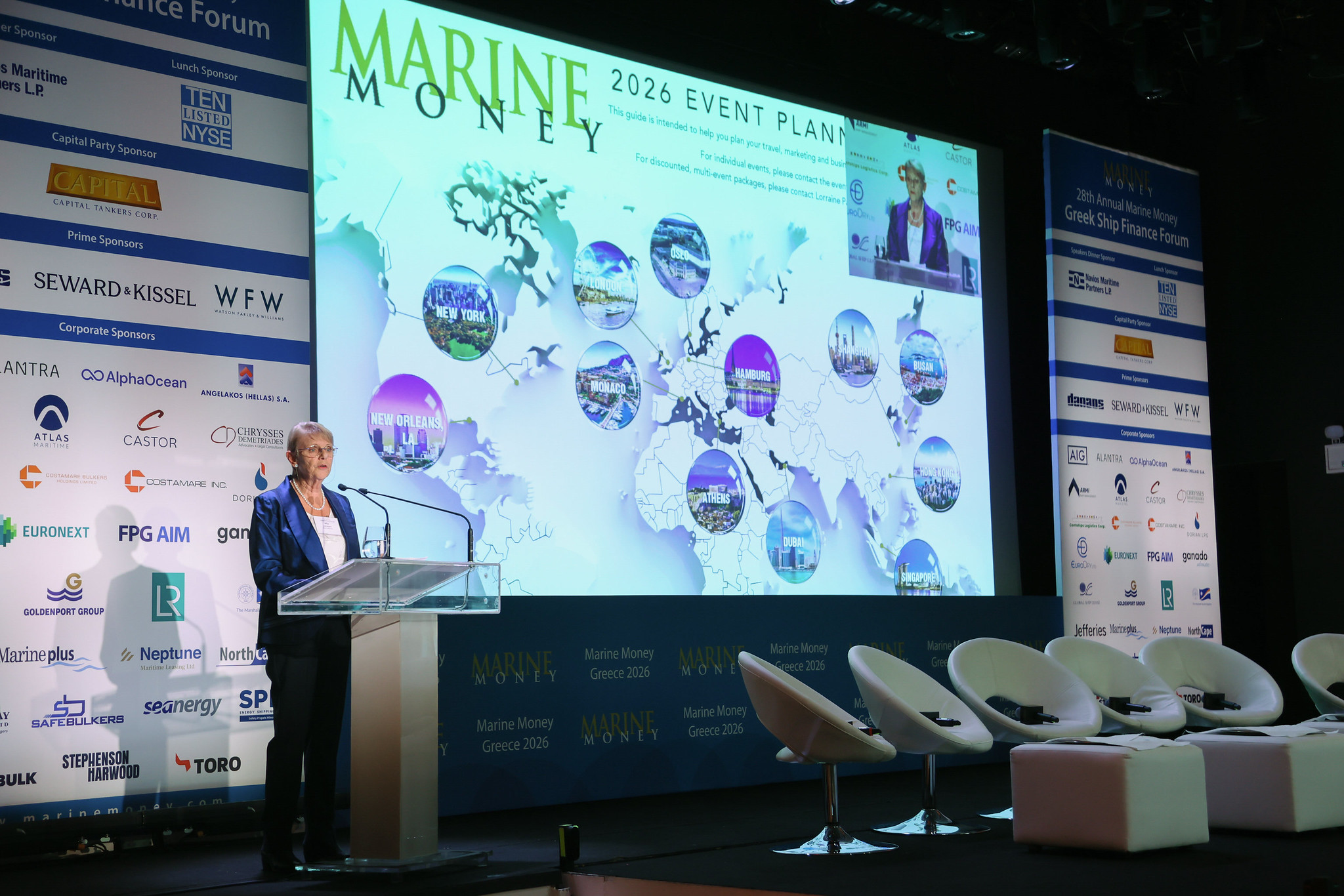
The Annual Marine Money Ship Finance Forum brought together international shipowners, financiers, and maritime executives to address strategic investments, geopolitical shifts, and evolving capital markets. Opening the conference, Mia Jensen, Director Greece & Events at Marine Money, set the theme "Smart Investing for Future Gain," reflecting a shipping industry that remains resilient and liquid despite ongoing global trade disruptions.
Navigating Disruptions
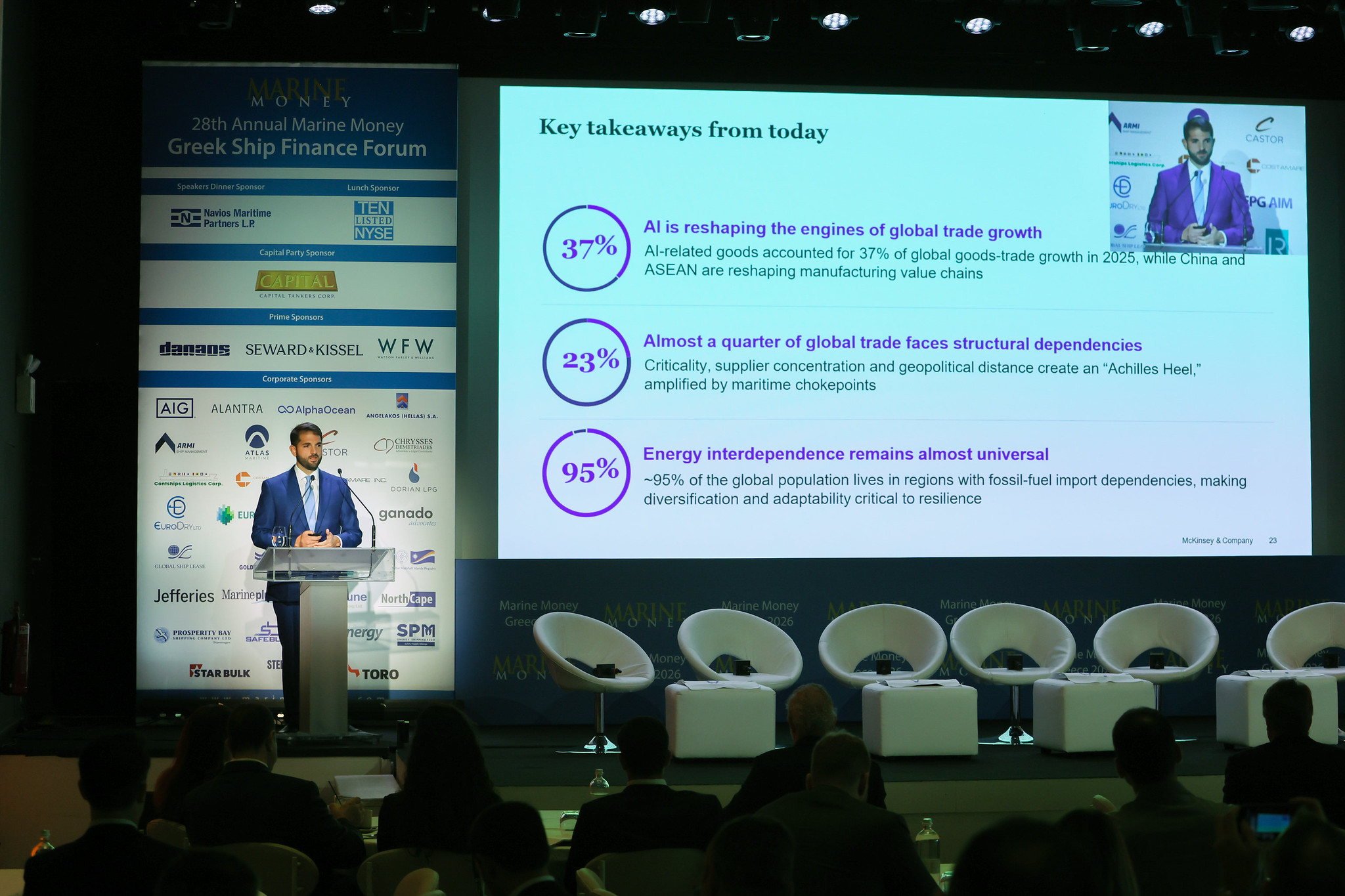
Delivering the keynote presentation, Apostolos Zampelas, Partner and Leader of Shipping Practice at McKinsey & Company, presented a detailed analysis of the macro environment reshaping maritime trade pointing out:
- Over $1 trillion worth of cargo trades annually through the Strait of Hormuz. The global energy system remains highly interdependent, directly impacting oil market supply and production.
- Artificial Intelligence is actively reshaping trade engines, with AI-related goods accounting for 37% of global goods-trade growth in 2025, while China and ASEAN continue to restructure manufacturing value chains.
- 23% of global trade faces critical dependencies, creating vulnerabilities amplified by marine chokepoints, supplier concentration, and geopolitical distance.
- Approximately 95% of the global population lives in regions dependent on fossil-fuel imports, making fleet adaptability and route diversification essential.
Navigating 2026 and Market Expectations
In a discussion moderated by Hugh B. Eden (Jefferies LLC), industry leaders reflected on market confidence amid geopolitical volatility in Venezuela, the Middle East, and the Black Sea:
Leon Patitsas (Atlas Maritime Ltd.) stressed the central role of tankers in the global energy agenda, predicting continued strength due to depleted inventories. He highlighted that expanding AI data centers will drive long-term energy demand, while advising owners to maintain readiness for market corrections and potential "black swans."
Stratos Desypris (Navios Maritime Partners) noted that a new global trade architecture has bolstered charter rates, supporting disciplined investments in newbuildings with secure charter coverage.
Aristides Pittas (Euroseas / Eurodry / Euroholdings) expressed caution regarding rising orderbooks, though noting that global tonnage grew at only ~2% annually between 2015 and 2025. He cited persistent inflation, rising interest rates, and trade recession as key risks, urging strong balance sheet management.
Jerry Kalogiratos (Capital Tankers Corp.) highlighted fleet aging and shadow fleet risks, expecting market equilibrium to restore as unmaintained, sanctioned vessels go for scrap during upcoming market corrections. He also emphasized human capital and crew safety at sea.
Michael Kourtesis (SeaHawk Group) raised concerns over crew safety in volatile zones like the Black Sea and the Strait of Hormuz, while confirming optimism for growing energy demand and opportunities in the secondhand asset market.
Capital Markets & The Growing Role of Euronext Athens
A dedicated session moderated by Lillian Georgopoulou (Euronext Athens) explored how European financial markets—specifically Euronext and the Athens Exchange—are providing alternative equity and bond solutions to complement traditional bank debt.
Alexandros Argyros (AXIA Ventures Group Ltd.) emphasized the potential of the Athens Stock Exchange to become a major European financial hub, noting that successful listings require critical mass, a compelling investment thesis, and deeper integration with European financial markets.
Nikos Kalapotharakos (Capital Clean Energy Carriers Corp.) discussed asset-specific capital strategies, pointing out how Norway (Oslo) caters to energy, the US (New York) to gas, and Athens to European infrastructure, noting strong retail investor interest in shipping bond offerings and dual and exclusive listings like Capital Maritime Finance.
Spyros Capralos (Star Bulk Carriers Corp.) explained Star Bulk’s secondary listing in Athens, aiming to mitigate geopolitical risks associated with pure US listings while establishing Athens as a maritime finance center akin to Oslo.
Alexandros Giannakas (Seanergy Maritime Holdings Corp.) praised Athens as one of Europe's top-performing stock markets, highlighting Seanergy's successful €100 million bond issuance and the value of an investor base that understands shipping cyclicality.
Konstantinos Adamopoulos (Safe Bulkers Inc.) noted how Safe Bulkers' pioneering dual listing paved the way for other shipping entities to access flexible capital beyond standard bank finance.
Captain of Industry, A Conversation with Harry N. Vafias
In an exclusive interview conducted by Chris Vartzis (Stephenson Harwood), Harry N. Vafias—Founder and CEO of StealthGas, Imperial Petroleum, and Non-Executive Chairman of C3is Inc.—shared insights from overseeing a combined fleet of 105 vessels across Nasdaq-listed entities and private management companies (Brave Maritime & Stealth Maritime).
Highlighting that the group operates with zero bank leverage, Mr. Vafias explained that eliminating debt accelerates decision-making, improves fleet valuation, and provides structural safety during market downturns.
Reflecting on the 2008 downturn, he cited the importance of fixing long-term contracts during peak markets and thoroughly analyzing new projects rather than making hasty decisions.
Outside of shipping, Vafias discussed his investments in real estate and ventures sourced through Dragons' Den, noting that commercial discipline applies universally across business sectors.
The SHIPS for America Act
Brian Maloney, Partner at Seward & Kissel LLP, delivered an update on the proposed SHIPS for America Act, detailing US efforts to expand its commercial maritime presence:
The act seeks to expand the internationally trading US-flagged fleet from roughly 80 vessels toward a target of 250 vessels.
Proposed Strategic Commercial Fleet payments outline escalating annual funding: $150 million in FY 2026, scaling up to $1.0 billion in FY 2030 and $2.1 billion by FY 2035.
Senate consideration remains pending, with ongoing deliberations regarding funding allocations for the Maritime Security Trust Fund.
Fleet Renewal & Financing
The final panel, of the morning session moderated by Jerzy Majewski (NorthCape AS) and introduced by Theo Kourmpelis (Lloyd's Register), focused on Greek shipowners commanding nearly half of all global vessel orders currently placed at shipyards.
Costas Delaportas (DryDel Shipping Inc.) outlined DryDel’s focus on eco-friendly newbuildings built to high specifications in Japanese yards, noting that newbuilds offer superior engine performance and operational efficiency compared to inflated secondhand prices.
Andreas Giakoumelos (Venergy Maritime Ltd.) described the current bank financing environment as a "honeymoon period" for CFOs, with plentiful liquidity enabling favorable terms despite long-term uncertainty around alternative fuels.
Theo Kourmpelis (Lloyd's Register) confirmed that crude and product tanker orderbooks spiked due to structural fleet aging and geopolitical rerouting around Ukraine and Hormuz, reaffirming that underlying demand fundamentals support Greek renewal programs.
Simos Spyrou (Star Bulk Carriers Corp.) discussed Star Bulk’s balanced approach using M&A, resale deliveries, and targeted divesting of older assets to hedge against long delivery lead times. He emphasized maintaining strong cash reserves to navigate market cycles and competitive lending conditionns.
Diverse Finance Sources & Chinese Leasing Dominance
Navigating Capital Options
A panel moderated by Alexia Hatzimichalis (Watson Farley & Williams LLP) evaluated Q4 2026 financing trends.
Alexis Stephanou (Goldenport Group) highlighted that improved corporate credit profiles allow owners to optimize pricing, stressing that capital sources must be tailored to specific project characteristics.
Sakis Voudris (Neptune Maritime Leasing Ltd.) described the advantages of leasing as a flexible tool for mid-sized shipowners, and marked tha Neptune’s solutions are backed by institutional investors Costamare and Latsco.
Symeon Pariaros (Euroseas / EuroDry / EuroHoldings) noted that while liquidity is abundant, pricing is secondary to structure, flexibility, and alignment with ESG criteria.
Nicholas Petrakakos (Alantra) and Mathias Børresen (NRP Maritime Asset Management) observed that while commercial bank debt remains dominant for newbuildings, corporatization is opening doors to alternative credit funds and structured equity.
The Power of Chinese Lease Finance
Moderated by Christoforos Bisbikos (Watson Farley & Williams), panelists Niovi Iasemidi (Capital Tankers Corp.), Dimitris Glynos (TMS), and Geoffroy Gunet (G Shipbrokers S.A.) analyzed why Chinese leasing maintains a strong foothold.
They mentioned as Key Advantages the High Loan-to-Value (LTV) ratios, predelivery financing, long tenors, and rapid market adaptability make Chinese leasing highly attractive for large-ticket newbuilding projects.
Panelists noted trade-offs including lack of direct asset ownership, exposure to global geopolitical shifts, and untested performance during severe market downcycles. In contrast to European banks operating with selective client criteria, Chinese leasing continues expanding aggressively across asset classes.
The New Generation, Future Leadership in Shipping
Moderated by Nick Daskalakis (Alpha Shipping Advisors Ltd), a panel of next-generation maritime executives discussed family legacies, technology, and strategic direction.
Diamantis N. Pateras (Contships Management Inc.), representing the seventh generation in shipping, stressed that the new generation must build upon core family values while adapting to stricter international regulatory frameworks and prioritizing corporate resilience.
Eirini Pitta (Euroseas / EuroDry / EuroHoldings) emphasized earning industry trust through technical competence. On decarbonization, she noted LNG currently offers a viable transition pathway while technology matures, advising against passive waiting.
Philippos Tsangrides Panagopoulos (Magna Marine) highlighted the value of operating a debt-free fleet, viewing shipping as a marathon. He advocated acquiring high-specification, Japanese-built secondhand vessels to navigate market cyclicality.
George Vranopoulos (Marine Plus SA) highlighted the transformative role of AI and holistic technical design in maximizing hull and engine efficiency, emphasizing long-term partnerships and business ethics.
Smart Investing for the Next Five Years
In the final closing panel moderated by Prof. Christos Sigalas (The American College of Greece), executive CFOs Harrys Kosmatos (TEN Ltd.), Nikos Gkezepis (Neptune Lines), Yiannis Kourkoulis (Armi Shipmanagement / SPM Energy Shipping), and Christos Zenios (Atlas Maritime Ltd.) outlined core strategies for the next five years such as Balancing conventional high-efficiency designs with optionality for alternative fuels.
Channeling targeted capital into AI and digital performance tools optimize fleet operations and fuel consumption.
Maintaining robust liquidity reserves and conservative leverage to withstand market volatility seize counter-cyclical growth opportunities.
ELNAVI Newsletter
More Information: ELNAVI,
19, Aristidou str., Piraeus 185 31,
Tel.: +30 210 45.22.100, e-mail: This email address is being protected from spambots. You need JavaScript enabled to view it.