


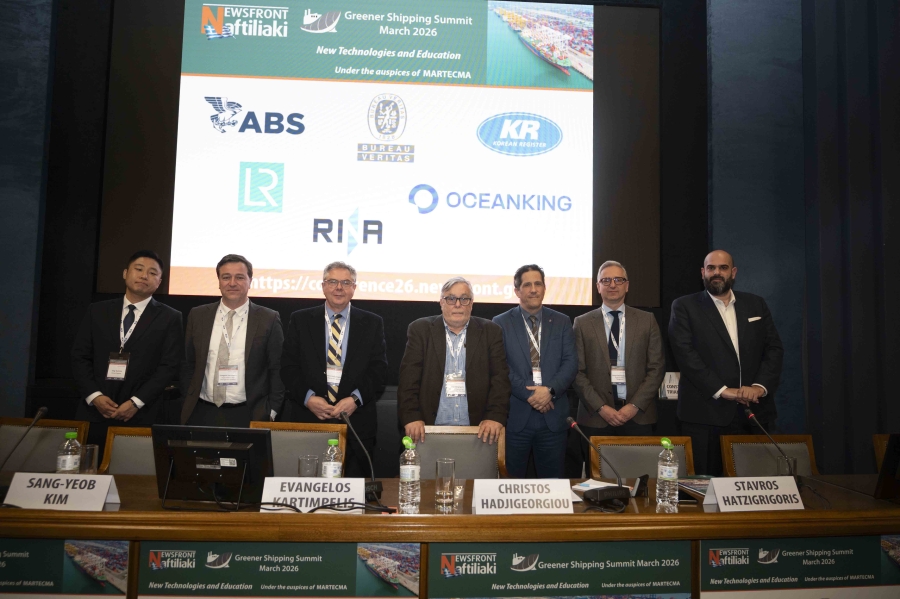
Organized by Newsfront/Naftiliaki under the auspices of Martecma
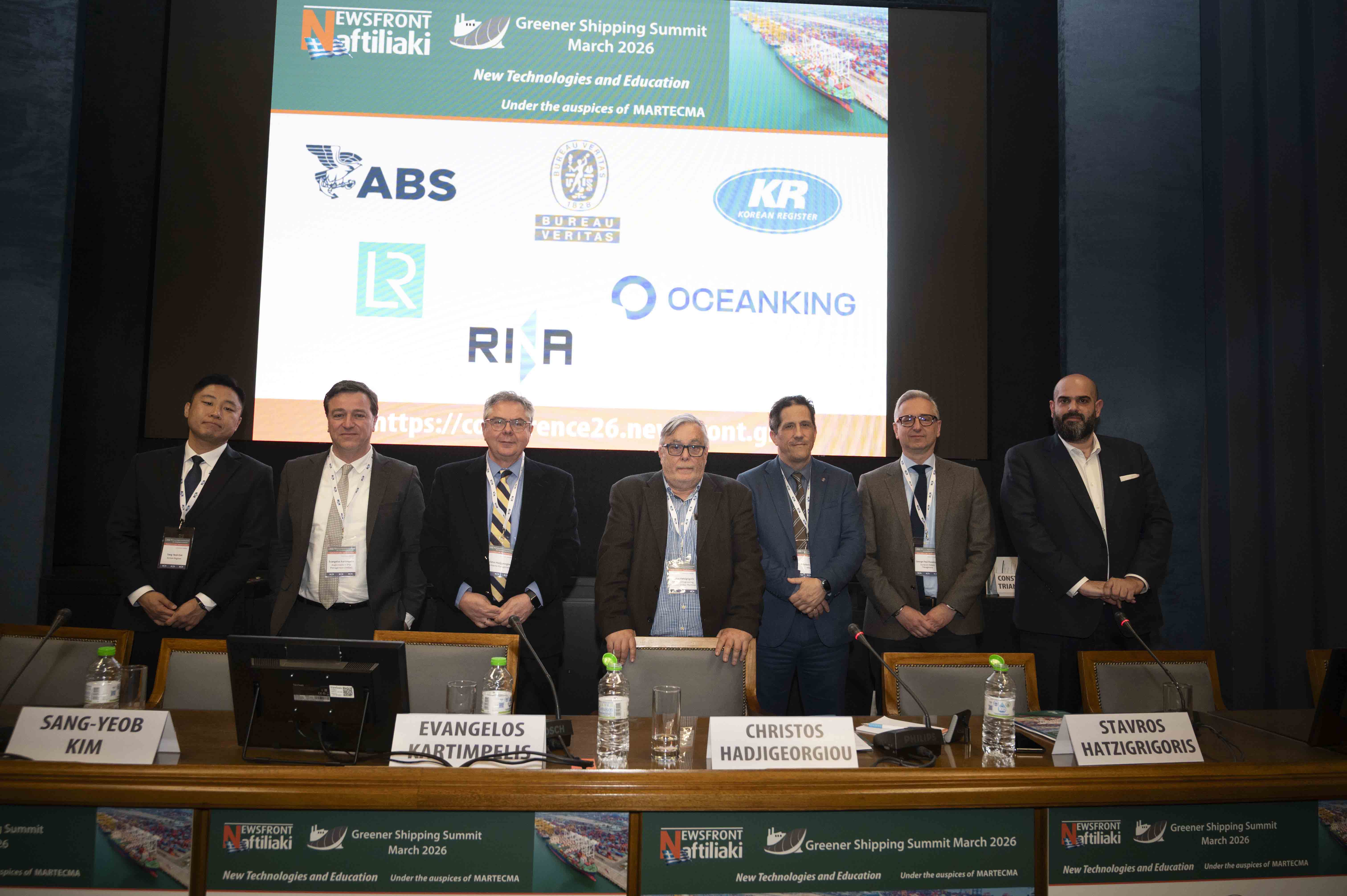
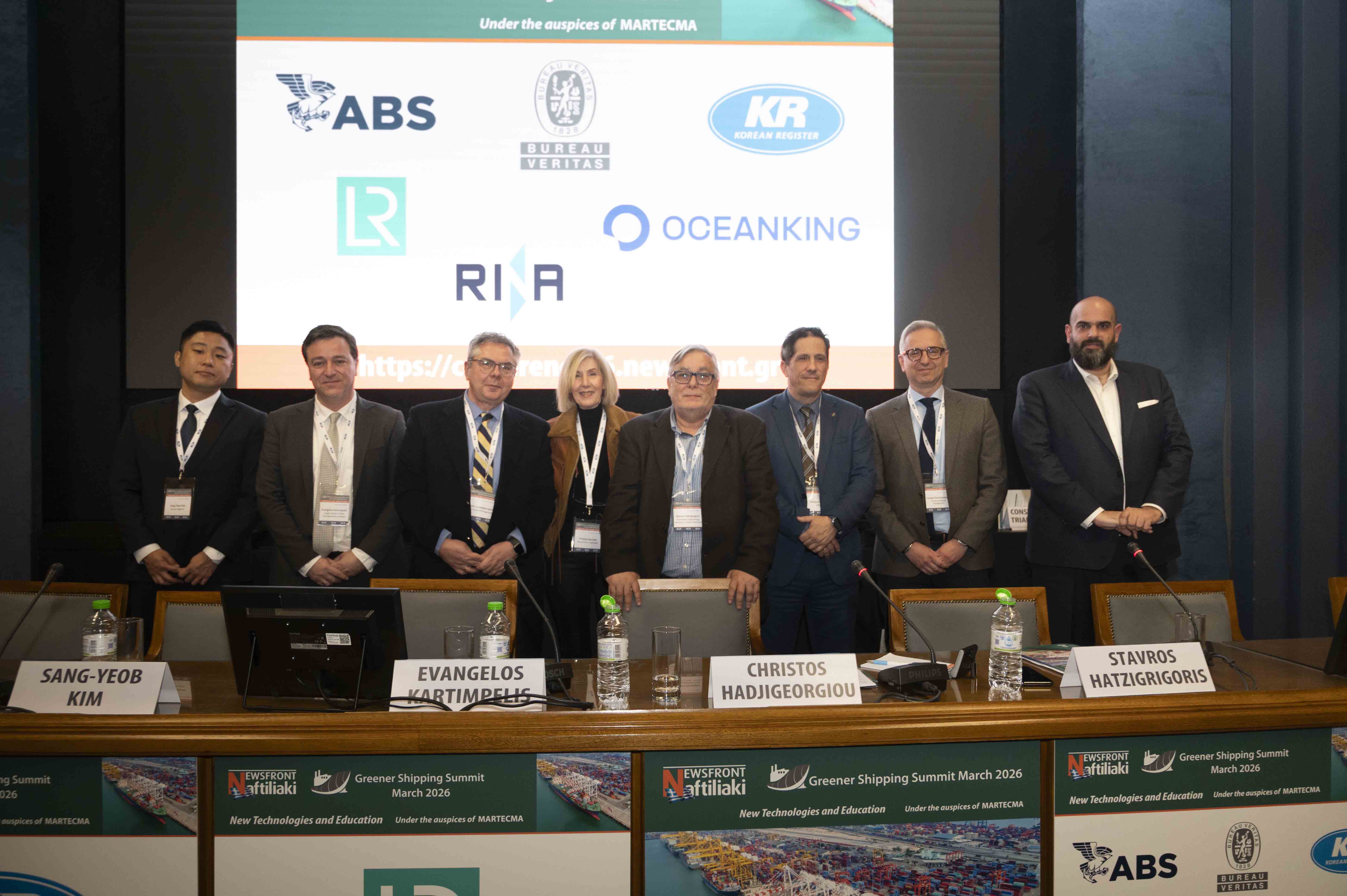
Once again, the voice of the wider Greek Shipping industry was loud and clear at this year’s Greener Shipping Summit: New Technologies and Education, which was organized by Newsfront/Naftiliaki under the auspices of the Marine Technical Managers Association (Martecma) at the Eugenides Foundation, on March 31. The conference, chaired by Christos Hadjigeorgiou, managing director of Almi Marine Management, was completely successful with hundends of delegates engaging in fruitful discussions.
According to the presentation by keynote speaker Evangelos Kartimpelis, managing director of Anglo-Eastern Ship Management (Hellas) SA, geopolitical instability and route diversions increase voyage times by 30-50%, directly impacting fuel burn and emissions. At the same time, the IMO Net-Zero Framework (NZF) aims for global implementation around 2027, introducing a goal-based fuel standard and a greenhouse gas pricing mechanism, while compliance with EU ETS and FuelEU Maritime requires strict timelines for reducing GHG intensity. The investment strategy prioritizes immediate “no-regrets” efficiency solutions, such as wind-assist and voyage optimization, paving the way for the future use of green fuels (bio-methanol, e-ammonia). Finally, companies must integrate geopolitical risks into their emissions forecasting and model the cost of compliance with the NZF against potential levy and carbon pricing scenarios.
In the first panel, participants discussed leveraging AI to access historical and technological shipping data, AI-driven performance optimisation, and predictive maintenance, along with the risks of using AI tools without critical thinking or filtering.
The moderator of the first panel, Fotis Belexis, technical director of Star Bulk Carriers, in his introduction, said that “AI is as good as the data it is built upon and of course the algorithm.
Without a robust data strategy, having quality data AI cannot deliver a reliable or scalable outcome.” He added that shipping faces a challenge where data is fragmented, inconsistent, or difficult to access immediately.
To what extent can AI realistically transform historical shipping data into forward-looking decision intelligence and what would it take, in practical terms, to get there, was a question answered by John Kokarakis, technical director, SEEBA Zone, Bureau Veritas, who said the main purpose of AI is the utilization of data in order to make decisions. Adding that it is offering support to the decision and by no means replacing the human element. That is the reason we must ensure that data must be accurate, high quality, and transparent.
Konstantinos Agas, Training and Development manager, Pantheon Tankers/Alpha Gas/Alpha Bulkers, discussed the role of AI-powered knowledge agents in supporting marine troubleshooting and procedural guidance, and the key challenges in ensuring their reliability and practical adoption onboard and ashore. He said the great advantage of AI tools is that they are excellent in questions that have to do with generic issues, as they combine data from many various sources, but we start to have problems when we look to very specific issues when we may have reliability and data brake issues.
Nikolaos Ventikos, professor, Laboratory for Maritime Transport, School of Naval Architecture and Marine Engineering, National Technical University of Athens (NTUA) referring to how training and education evolve to prepare professionals to work effectively with AI, said that educational institutions need to structurally reinform skepticism as we need to challenge AI all the time as we need the human judgement to remain sharp and cognitively prioritized.
Nicolas Timpelis, IT Projects Support manager, IONIC, responding on how to design systems that encourage validation rather than blind reliance on AI outputs and how to control the use of open/public AI tools versus internal systems, said that “we are trying to build an internal system that is better as it is customized on specific needs and day to day operations and at the end of the day the end-user will have a better result than using a public tool.”
The second panel, devoted to new technologies and retrofits, carbon capture technologies, alternative fuels for shipping, and shore power, was moderated by Stavros Hatzigrigoris, Advanced Engineering Services at Zodiac Maritime, who pointed out the challenges face shipping.
Evangelos Kartimpelis commented on Carbon Capture and Storage (CSS) technology by stating that although the technology exists, a lack of investments in land infrastructure and transportation delay this technology’s commercial availability. Regarding shore power, Kartimpelis explained the commercial risks associated with the ports’ huge needs in energy to supply all docked vessels.
Sang-Yeob Kim, senior researcher, ship and offshore technology team at Korean Register focused on a presentation that proposes a holistic, data-driven approach to decarbonisation, replacing intuition-based planning with standardized, precision simulations. Through the KR-POWER ecosystem, high-frequency data is analyzed to distinguish technical degradation (engine, hull) from operational variables like weather and trim. This method aims to optimize fuel consumption and ensure measurable compliance with international maritime regulations such as CII and GFI.
Theo Kourmpelis, global tanker segment director of Lloyd’s Register, praised the Greek shipbuilding industry and ship operators’ work in reducing the vessels’ carbon footprint. Moreover, Kourmpelis commented on shore power’s challenging development by highlighting the challenges associated with vessels and cable studies, as well as the problem with the management of boil-off gas engines in dual-fuel containerships.
Nikolaos Michas, key account manager, tanker segment at RINA, explained that green fuels are unavailable because of the huge amounts of renewable energy they require. Michas said that geopolitical events affect energy prices and urged the industry to develop alternative ways to reduce its emissions.
George-Paul Perantzakis, technical manager at Dynacom Tankers Management Ltd, highlighted the unpredictability related to cost for alternative fuels, as they keep rising. Apart from LNG, which is mature technology, Perantzakis argued that biofuels will be considered a more attractive and reliable alternative to conventional fuels for immediate results in the short-run. On the contrary, he stressed that other carbon-free fuels are significantly more expensive and face challenges.
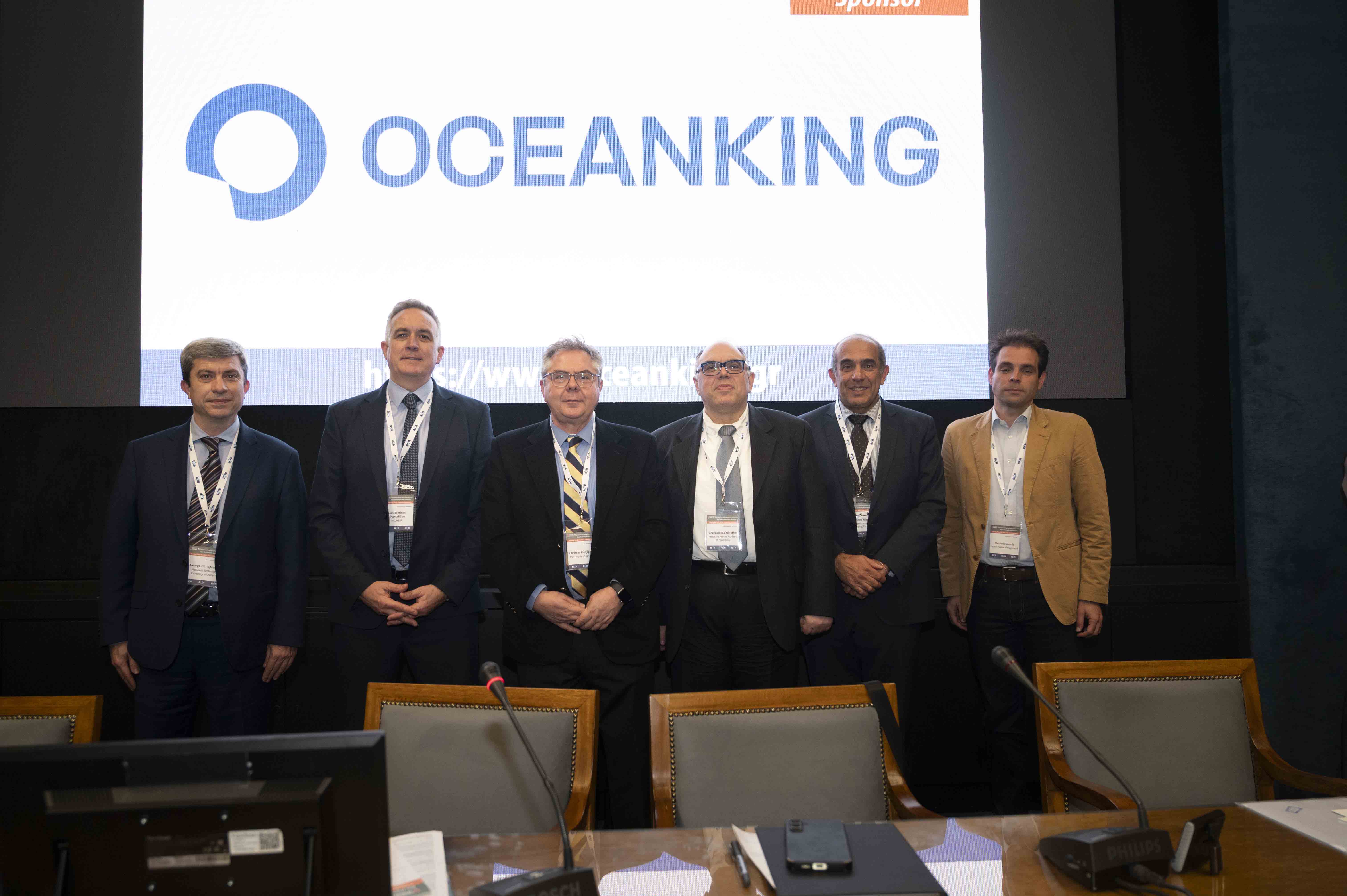
The conference’s third panel, moderated by Helmepa’s head of maritime affairs and stakeholder development, Constantinos Triantafillou, focused on education and the procedural direction is should take to adapt to new requirements and challenges and the new ways of training for maritime professionals. In this challenging landscape, Triantafillou emphasized Helmepa’s study about crew fatigue that stems from new regulations and duties.
George Dimopoulos, associate professor, School of Naval Architecture, Division of Marine Engineering at NTUA, emphasized the need the curriculum to focus more on core theory and methodology to help students decompose and address complex problems. Regarding the wide range of new technologies, he said that the need is to train new engineers to understand methodologies than a specific set of technologies.
Dimitris Fokas, training manager at Angelicoussis Shipping Group, stressed that the Group was one of the first having dual-fuel engines and, thus, developed its training program to adapt to these. Regarding the role of AI, he explained that it is difficult to say how it will transform training. However, he expressed his optimism and trust in Greek shipping’s adaptability to difficult environments.
Thodoris Galanis, group IT manager at Latsco Marine Management Inc, emphasized that digital literacy and competence is extremely important for maritime operations and part of safety and efficiency. Regarding AI, Galanis stressed that it will “democratize” expertise. Lastly, he argued that cyber-security is essential to shipping, as it is linked to operational efficiency.
Charalambos Yakinthos, director, School of Engineers at Merchant Marine Academy of Macedonia, stressed that Merchant Marine Academies (AEN) should be evolved into innovation hubs in where research is conducted. He further explained that Academies should implement innovation modules and use Virtual Reality (VR) to lead hands-on experience. Lastly, regarding environmental requirements, Yakinthos said that Greek Academies are training environmental leaders and not just engineers.
In the fourth panel, participants discussed in depth Policy, Regulation, and Market Developments, EU ETS and FuelEU – lessons learned and market implications, as well as what to expect from the IMO regarding NZF.
The moderator Haris Giantzikis, Technical Manager, Arcadia Shipmanagement, opened the discussion saying he is not optimistic about a clear outcome concerning NZF at IMO later in October this year, especially with a war continuing in the Middle East.
Lefteris Koukoulopoulos, Regional Decarbonisation Specialist, DNV, speaking on the same hot issue presented the positive position that shipping (owners and organizations) wants a working framework on the issue so every company decides with a clear strategy for the future, because “ a no decision is worse than any global framework” and he presented the various proposals presented for a new NZF.
Dimitris Mytilinis, Senior Performance Engineer, Latsco Marine Management, said that “from the operator's perspective we need clarity and stability over time” as companies need to know and understand the long-term direction presented by the regulators. He also discussed the need for various fuel availability on all ports with applied infrastructure at the terminals. He also referred to the uncertainty of smaller companies about fleet renewal as they are not sure of the specific type of alternative fuel they should invest in.
George Nikolaidis, Engineer II, Regulatory Affairs, ABS, reported on the mid-term measures currently stalled at the IMO and made an extended reference about what this means for the future of the CII framework. He also spoke about concerns on the safety aspect and the cost premium of new alternative fuels and that in this situation onboard Carbon Capture and Storage is viewed as a complementary pathway to decarbonise shipping.
Alexander Prokopakis, executive director, IBIA, called the current proposal in the IMO ‘dead’ and called it not a failure of IMO but “a failure of governments”. He added that for the fuel supply chain to make alternative fuels available at scale while keeping costs realistic, needs clarity, timing and incentives.
The busy day was concluded with a lunch that gave wide opportunities to delegates for networking. The conference was met by success, as over 400 delegates, representing 262 companies from 11 countries took part, something that reflects the relevance and success of the program. The engaging discussions, often leading to lively and insightful exchanges between speakers and delegates both during and beyond the sessions, significantly enhanced the overall experience.
ELNAVI Newsletter
More Information: ELNAVI,
19, Aristidou str., Piraeus 185 31,
Tel.: +30 210 45.22.100, e-mail: This email address is being protected from spambots. You need JavaScript enabled to view it.