


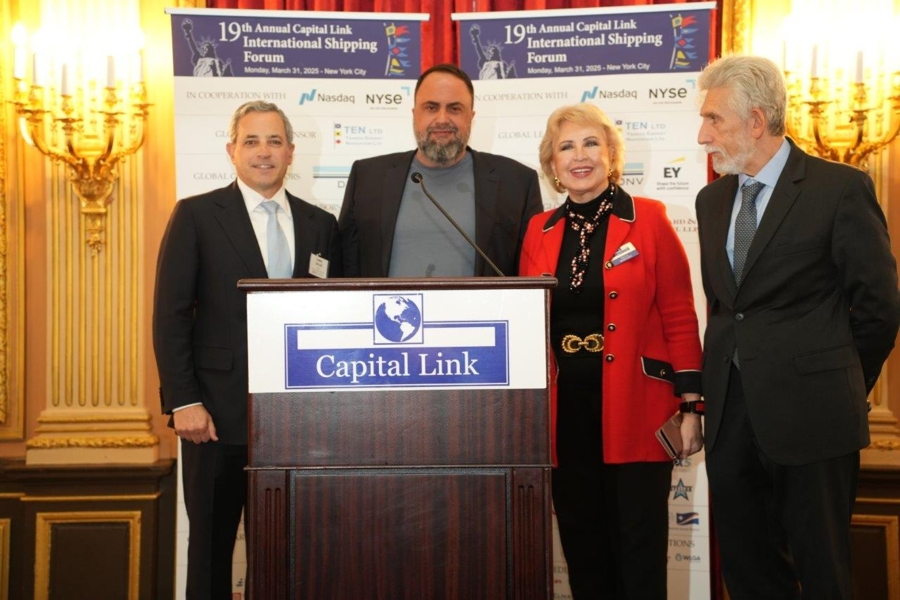
Evangelos Marinakis, Founder & Chairman of Capital Maritime & Trading Corp., delivered KEYNOTE REMARKS at the Official Luncheon that was held in the context of the 19th Annual Capital Link International Shipping Forum, on Monday March 31, 2025 at the Metropolitan Club in New York City. The Forum was held in cooperation with New York Stock Exchange - NYSE and Nasdaq.
Mr. Chris Taylor, Chief Development Officer – NYSE GROUP, delivered Introductory Remarks.
Mr. Evangelos Marinakis, Founder & Chairman - Capital Maritime & Trading Corp., stated: “I'm happy to be here today with all of you. I saw many friends whom I hadn’t seen in quite some time—friends with whom we started out, let’s say, back in the early '90s. So, it was a pleasant surprise to see them again and to see that they’re still strong, healthy, and doing well in business. Since the U.S. elections and the beginning of Mr. Trump’s administration in January, we’ve seen many changes—numerous announcements and discussions on various global matters—which have made our lives more complicated, but at the same time, much more interesting. In shipping, we often benefit from geopolitical events. When there’s uncertainty, I believe that, at the end of the day, it tends to work in shipping’s favor—perhaps in the short term, but also, in the long term, we often see benefits.
Of course, it all depends on how entrepreneurs react—how they analyze the situation and form a strategy.
In my opinion, we’ll face many challenges ahead, especially regarding tariffs. The current discussions we’re following are no longer limited to China; now there are tariffs affecting the EU and other countries as well.
All of this has a direct impact on shipping, because it affects the transportation of goods. In the short term, I expect a negative impact, but I don’t believe such restrictions are sustainable in the long run.
Another issue that concerns us is the future of Chinese-built tonnage. We're not only talking about vessels owned by Chinese companies. In the last 10 to 15 years, due to the way the shipbuilding industry has developed, shipowners often had no choice but to consider building in China—for three main reasons: first, due to the capacity; second, because of competitive pricing; and third, because Chinese shipyards have improved their quality significantly. In many cases, their standards are approaching those of Korean or even Japanese yards. As a result, a large number of ships—owned by both listed and private companies worldwide—have been built in China.
Currently, we’re seeing charterers—even in short or period charter negotiations—trying to avoid Chinese-built tonnage. Some do this to negotiate better rates; others are genuinely concerned about the risks, particularly when cargoes are being transported in and out of the United States. They simply don’t want to take the risk. If this trend continues, we will end up with a two-tier market, and ultimately, the consumer will bear the cost. Delivered commodity prices will rise, especially for goods entering or leaving the U.S. on non-Chinese-built vessels. I believe this situation could last longer than any of us would like to think.
On the other hand, the economic situation in Europe is not looking good. We anticipate a recession. There were similar predictions even before COVID, but due to the pandemic and the past five years—which flew by quickly—this recession was postponed. In fact, several industries, including shipping, saw record profits during that time, particularly in the container and dry cargo sectors. Rates soared, and we witnessed extraordinary market conditions.
The Russia-Ukraine war also affected the tanker market, pushing freight rates to exceptionally high levels. The market was very strong for a time. Then came the conflict between Israel and Palestine, along with disruptions in the Suez Canal—which had a real impact on our business and on freight rates. At the same time, the Panama Canal faced its own issues with draught restrictions. For the first time in history, both canals were not fully operational at the same time. This pushed rates higher, but this advantage won’t last forever. Eventually, these factors will normalize. Our strategy going forward is to continue modernizing our fleet while staying highly aware of emissions, environmental concerns, and the latest IMO regulations. Even though the Trump administration may not push ahead with environmental regulations in the U.S., we remain committed to reducing emissions and being environmentally conscious. We pay a premium to build eco-friendly and dual-fuel ships. For a while, there will be a transitional phase where we use less-polluting energy sources, even though we haven’t yet seen charterers, oil majors, or liner companies paying a premium for these vessels. Still, we’ve expanded our newbuilding program with dual-fuel technology in container ships. We take a long-term view and believe it will pay off.
The key is to remain financially strong so we can withstand market cycles. Eventually—especially in Europe—environmental regulations will move forward, and dual-fuel LNG vessels will offer clear advantages in terms of both emissions and cost, particularly when the Russia-Ukraine war ends. We hope that will happen soon—possibly within the year. When gas prices fall, using LNG will become significantly more cost-effective—not only from an environmental standpoint, but also financially, due to lower fuel consumption.
Things we thought could never happen—such as tensions with China, Russia, or the Israel-Palestine conflict—are happening. The years ahead will be very interesting. I believe that, ultimately, these developments will benefit shipping and our companies. In the short term, we may have to endure some pain and wait for normalization. But once again, I say: all this volatility and all these geopolitical changes tend to support our industry in the long run. Regarding the European economy, I said three years ago—when the Russia-Ukraine war began—that the EU sanctions strategy would backfire. In the end, it was the European citizen who paid the price.
Russian oil continued to be exported to China and India at deep discounts. Meanwhile, European countries bought refined products from those same refineries at record-high prices.
So, despite the sanctions, Russia actually received more income than before, while Indian and Chinese refineries enjoyed record profits. And it was the European consumer who footed the bill.
This is one of the reasons I believe a recession in Europe is now unavoidable. I also think the Trump administration is taking the right approach toward the Russia-Ukraine war. In the last three years, Europe has made no serious effort to stop this war. Innocent people—especially children—are dying. And after three years, there is no justification for this to continue. It’s senseless, and it must stop.
These are my personal views on the economic outlook in Europe and the future of shipping. What I wish for everyone here today is to remain strong and healthy. Because when you are strong and healthy, you can navigate crises and embrace daily challenges. In the end, we all try to do our best—for our companies, our shareholders, and the future.
Thank you very much.”
ELNAVI Newsletter
More Information: ELNAVI,
19, Aristidou str., Piraeus 185 31,
Tel.: +30 210 45.22.100, e-mail: This email address is being protected from spambots. You need JavaScript enabled to view it.