



-
Home

-
Ports - Shipping
- elnavi

elnavi
Survitec’s revolutionary Seahaven, world’s largest inflatable lifeboat wins technology award
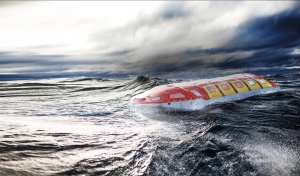
Survitec’s revolutionary Seahaven, the world’s largest inflatable lifeboat, has won the technology category of this year’s Safety4Sea awards.
The self-propelled inflatable lifeboat surpassed Safety4Sea’s judging criteria of providing a “significant technological achievement or significant contribution to maritime safety”.
Seahaven, officially introduced to the market in April, is already redefining how passengers and crew evacuate ships in an emergency, with Norwegian Cruise Line Holdings Ltd. (NCLH), Independent Maritime Advisors Ltd, and a major shipbuilder looking at incorporating the system into new designs.
Typically, a 4,000-passenger capacity cruise ship would require at least 12 to 16 lifeboats and up to four MES with liferafts. Just four Seahavens would be required to evacuate the same number of passengers in the same amount of time, freeing up 85% of cruiseship space for new passenger experiences.
Claude Sada, Managing Director, Survival Craft at Survitec, said: “We are delighted Seahaven won this important award so soon after its official market launch earlier this year.
At Survitec, we continue to push boundaries and look for new, innovative ways to protect lives at sea. This award indicates the important contribution Seahaven will make to cruiseship safety.”
Commenting on the accolade during yesterday’s virtual awards ceremony, Stew Gregory, who led the Survitec design team, said: “On behalf of our Seahaven team, I am thrilled to receive the 2022 Safety4Sea Technology Award. I would like to pay particular tribute to my colleagues at Survitec for their vision, insight, innovation and dedication in bringing this idea to life and to market.
“With Seahaven, we have provided a safe alternative to conventional lifeboats. We have optimised our revolutionary helical slide technology to achieve a rapid four-minute deployment time and minimise crew actions and the margin for operator error. We have also solved the significant challenge of being able to evacuate a growing number of cruise passengers quickly, safely and comfortably.”
ELNAVI Newsletter
More information: ELNAVI,
19, Aristidou str., Piraeus 185 31,
Tel.: +30 210 45.22.100, e-mail: This email address is being protected from spambots. You need JavaScript enabled to view it.
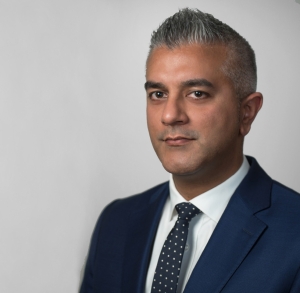
International law firm and maritime specialist Hill Dickinson has appointed partner Jasel Chauhan to its board.
In addition to heading the Piraeus office since 2020, Jasel also heads the international finance team at the firm. He has more than 16 years' experience in banking and finance legal services, 14 years of which have been focused in the marine sector.
Jasel’s appointment represents the first international partner to join the board and he brings a fresh perspective as the firm looks to deepen ties with its current international platform and global client base.
Jonathan Brown, Hill Dickinson chair, commented: “Jasel’s appointment recognises the immense contribution he brings to Hill Dickinson. He took over the helm in Piraeus in very difficult circumstances and despite those challenges has steadily grown our presence in Greece to double in size over the past three years.”
He added: “Jasel’s appointment reflects the wealth of talent developing at the firm and the importance of our younger partners taking on roles within senior management as the legal sector modernises for a new generation of clients and colleagues.”
Jasel said: “I’m delighted to join the board at this exciting time, when all law firms are looking to adapt to new challenges and demands, and I’m very much looking forward to contributing to Hill Dickinson’s future growth and development.”
Hill Dickinson employs more than 950 people, including over 200 partners and legal directors, across offices in Liverpool, Manchester, London, Leeds, Newcastle, Monaco, Piraeus, Singapore and Hong Kong.
Image: New Hill Dickinson board member Jasel Chauhan.
ELNAVI Newsletter
More information: ELNAVI,
19, Aristidou str., Piraeus 185 31,
Tel.: +30 210 45.22.100, e-mail: This email address is being protected from spambots. You need JavaScript enabled to view it.
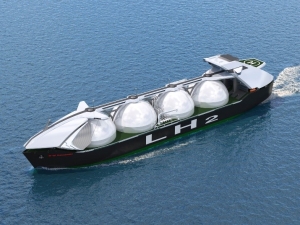
Liquefied hydrogen and liquefied carbon dioxide – and the ships designed for their transportation – can make a significant contribution to realizing a carbon-neutral society, says ClassNK.
As climate concerns continue to grow and the need to develop new energy sources becomes more urgent, the maritime sector’s environmental challenges include not only ship emissions but the safe carriage of alternative fuels.
As a clean fuel which does not emit carbon dioxide (CO 2 ) when burned, hydrogen (H 2 ) offers significant ‘green’ potential and, in Japan, work is already under way to establish a supply chain to facilitate a ‘Hydrogen Society’. Land-based CO 2 capture, utilization and storage (CCUS), meanwhile, has been attracting global attention for its ability to capture carbon generated by thermal power plants and factories and either use it as a resource or store it in a stable underground geological formation.
In their gaseous forms, both hydrogen and carbon dioxide can be transported over short distances via pipeline. However, in the liquid states which offer greater energy density per cubic meter and facilitates storage, both H 2 and CO 2 must be transported in tanks, either in trucks or aboard ships.
Over long distances, the most efficient means of transporting liquefied H 2 (LH 2 ) and liquefied CO 2 (LCO 2 ) is by sea. The development of LH 2 and LCO 2 carrier vessels has therefore emerged as one of the most promising areas for innovation in the maritime sector.
As an active contributor to advanced initiatives targeting decarbonization both within and beyond the shipping industry, ClassNK is supporting the development and safe operation of LH 2 and LCO 2 carriers.
Since H 2 is liquefied at the extremely low temperature of -253 degrees Celsius and presents hazards including flammability and permeability, handling the substance requires the observance of intensive safety procedures. In 2017, to contribute to the safe seaborne transportation of LH 2, ClassNK published its “Guidelines for Liquefied Hydrogen Carriers”, which are based on the International Maritime Organization’s (IMO) Interim Recommendations for Carriage of Liquefied Hydrogen in Bulk.
The leading classification society has since applied its guidelines in surveying, at the construction phase, the hull structure, machinery, onboard equipment and other components of the world’s first LH 2 carrier ship. Built by Kawasaki Heavy Industries, Ltd. (KHI), a member of the CO 2 -free Hydrogen Energy Supply-chain Technology Research Association (HySTRA), Suiso Frontier was added to ClassNK’s register on 3 December 2021. The Society continues to support the vessel’s safe operation through in-service surveys, utilizing the knowledge gained through these surveys to keep its guidelines up to date.
Earlier this year, ClassNK issued an approval in principle (AiP) for a large LH 2 carrier from KHI. The Society had previously granted the company an AiP for the design of the cargo containment system, at 40,000 m 3 class per tank. Four such tanks will feature on board KHI’s forthcoming large LH 2 carrier, giving the vessel a total LH 2 -carrying capacity of 160,000 m 3 . For the same ship, ClassNK granted AiPs for cargo-handling systems, which are key design elements of the vessel, and dual-fuel main boilers that use H 2 boil-off gas as fuel.
As well as helping to establish the Hydrogen Society, ClassNK has been active in its support of the CO 2 economy, recently issuing an AiP for LCO 2 carriers developed by Mitsubishi Shipbuilding and Nippon Yusen Kabushiki Kaisha (NYK Line). The Society executed the design review based on Part N of its Rules for the Survey and Construction of Steel Ships, which incorporate the IMO’s International Code for the Construction and Equipment of Ships Carrying Liquefied Gases in Bulk (IGC Code). The AiP confirms adherence to the rules regarding the design of each cargo tank system, hull form and other components, accounting for different tank-pressure settings for medium- and large-scale vessels.
Applying the same set of rules incorporating the IGC Code, ClassNK in August granted an AiP for the design of a large-scale LCO 2 carrier by Mitsui O.S.K. Lines, Ltd. (MOL). MOL had launched research and development (R&D) on the adoption of a large-scale LCO 2 carrier in response to a call for proposals by Japan’s New Energy and Industrial Technology Development Organization (NEDO) to complete the conceptual design, under a project entrusted by NEDO to Japan CCS Co., Ltd (JCCS).
The vessel design is one element of NEDO’s initiative “CCUS R&D and Demonstration Related Project/Large-scale CCUS Demonstration Project in Tomakomai/Demonstration Project on CO2 Transportation”. The MOL ship is intended as a practical solution to the need for the long-distance transportation of 1 million tons of CO 2 a year, based on NEDO’s vision to implement CCUS technology by 2030.
ClassNK has been directly supporting advancements in CCUS since 2020, when the Society joined the “Carbon Capture on the Ocean” (CC-Ocean) project to test a small-scale ship-based CO 2 –capture demonstration plant. Conducted in collaboration with Kawasaki Kisen Kaisha, Ltd. (“K” Line) and Mitsubishi Shipbuilding Co., Ltd. – part of the Mitsubishi Heavy Industries (MHI) group – the world- first demonstration resulted in the successful separation and capture of CO 2 from the test ship’s engines. Earlier this year, the project received the “Marine Engineering of the Year” award from the Japan Institute of Marine Engineering.
Through its active role in the verification of LH 2 and LCO 2 carriers and related technologies, ClassNK is facilitating the development of two fast-growing markets that promise to make a significant contribution to realizing a carbon-neutral society.
ELNAVI Newsletter
More information: ELNAVI,
19, Aristidou str., Piraeus 185 31,
Tel.: +30 210 45.22.100, e-mail: This email address is being protected from spambots. You need JavaScript enabled to view it.
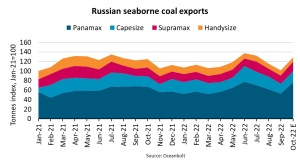
As a part of European Union sanctions against Russia, the block banned coal imports from Russia starting 10 August.
About two months have passed and Russia has struggled to redirect its coal exports, with export volumes down 7.0% y/y in this period and down 5.0% year to date.
Despite the drop in volumes, tonne mile demand has seen an increase by almost 30% in the last two and a half months. Since the coal sanctions were announced by the EU in April, average haul for Russian coal exports have risen by nearly 50%, or around 1,250 miles.
“So far, capesizes have seen the biggest increase in tonne miles following the ban, largely due to India’s increased interest in discounted Russian coal. India’s government mandated an increase in coal imports over the summer, due to a surge in energy demand and low coal inventories. This resulted in a boost to tonne miles as capesizes laden with Russian coal from European ports sailed around Africa,” says Filipe Gouveia, Shipping Analyst at BIMCO.
“As import demand from India normalises, it is unclear whether the country will continue to buy Russian coal shipped from primarily Black Sea, Baltic and Arctic ports,” Gouveia says.
So far in 2022, China remains the largest buyer of Russian coal which has accounted for 22.6% of total Chinese coal imports. Even though Chinese coal import volumes dropped 25.7% so far this year, imports from Russia grew 3.5%, likely due to discounted prices.
“In the coming months, panamax and supramax ships should continue to see demand from China for Russian coal. However, the country’s ambitious coal mining target and increasing investments in renewable energy could cool the appetite for coal imports. In the first eight months, coal mining increased 13.8%, while electricity production from renewables rose 16.7%,” adds Gouveia.
ELNAVI Newsletter
More information: ELNAVI,
19, Aristidou str., Piraeus 185 31,
Tel.: +30 210 45.22.100, e-mail: This email address is being protected from spambots. You need JavaScript enabled to view it.
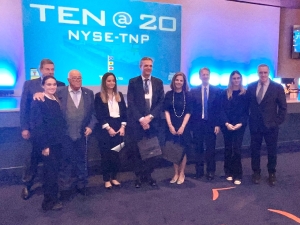
Following a proactive environmental policy and a crisis resistant growth model, TEN, the 1st Greek shipping company to be listed in the New York Stock Exchange in 2003 has been the forerunner of innovation in the sector of shipping.
In the recent TEN Strategy Meeting that took place in Grand Resort Lagonissi in Athens, the founder and CEO of TEN Dr. Nikolas P. Tsakos remarked that the company has managed nearly 30 years ago to record a remarkable CAGR (Calculated Growth Rate) of 15% despite having to successively navigate the rough seas of the 1996-98 Far East Crisis, 9/11, the 2009-2011 credit crisis, most recently the COVID-19 pandemic and the Ukrainian conflict.
The meeting included speeches by prominent personalities of the diplomatic, economic and shipping fields such as Daniel Speckhard, President and CEO of Corus International who presented global political and security outlook and Maria Vassalos, analyst from Goldman Sachs who presented the world’s economic outlook including structural cyclical panic and geopolitical drivers”.
Foteini Kanellopoulou analyst from Clarksons presented the tanker market outlook and Bjarne Schieldrop Commodities Analyst from SEB Group presented an oil market update.
Dr. Tsakos outlined that TEN has the most diversified fleet and consists of 72 double-hull vessels with four dual-fuel LNG powered oil tankers with a deadweight tonnage (dwt) of 120.000 metric tons each under construction, the first in a series of hybrid environmentally friendly vessels, to replace its conventional tankers.
He also noticed that the company has registered more than $1 billion in profits, and distributed $500 million in uninterrupted dividends at a yield of 5.25% annually to its shareholders.
TEN was also included in the recent edition of TIME magazine as one of the world’s rising stars in the sector of shipping.
As the magazine says: TEN has not only set a benchmark for financial and operating performance within the sector but has also perfected the art of what it describes as its ‘crisis-resistant growth model’.
It must be also noticed that TEN was awarded by the major oil Equinor as the best shipowning company servicing the group.
As Dr. Tsakos mentioned “Thanks to an extensive acquisition strategy, tallying $5 billion, TEN has built up an expanding base of tailor-made vessels for its customer base.
Following the success of the Double-Double design in the period of 1998-2006 the new stage of technological evolution calls for the drastic reduction of CO2 emissions. With the order of 4 new vessels to be delivered in 2023, TEN is at the forefront of these changes”.
ELNAVI Newsletter
More information: ELNAVI,
19, Aristidou str., Piraeus 185 31,
Tel.: +30 210 45.22.100, e-mail: This email address is being protected from spambots. You need JavaScript enabled to view it.
Euronav sells world’s biggest tanker VLCC “Europe”
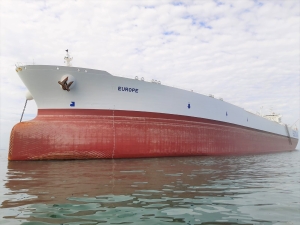
Euronav NV has sold the ULCC (Ultra Large Crude Carrier) Europe (2002 – 441,561 dwt). The vessel is debt free and the sale will generate a capital gain of USD 34.7 million. The vessel will be delivered to her new owners during the current quarter and will be used for storage.
The VLCC "Europe" has a capacity of 3 million barrels of crude oil. She was one of only four ships of such scale constructed in 2002 and 2003. Euronav has an ongoing interest in all of the three other ULCCs. The company retains ownership of the Oceania (2003 – 441,585 dwt) and 100% ownership since July 2022 of the FSO Asia (2002 – 432,023 dwt) and FSO Africa (2002 – 432,023 dwt), with both ULCC vessels converted into purposed-built FSO vessels under long term contract in Qatar.
The company has also sold the Suezmax Cap Philippe (2006 - 158,920dwt), generating a capital gain of USD 12.9 million. The vessel is debt free and has been delivered to her new owners on Thursday 13 October. Euronav continues to actively manage its fleet ahead of incoming regulations such as EEXI (Energy Efficiency Existing Ship Index) starting in January 2023.
Euronav is an independent tanker company engaged in the ocean transportation and storage of crude oil. The Company is headquartered in Antwerp, Belgium, and has offices throughout Europe and Asia. Euronav is listed on Euronext Brussels and on the NYSE under the symbol EURN. Euronav employs its fleet both on the spot and period market. VLCCs on the spot market are traded in the Tankers International pool of which Euronav is one of the major partners. Euronav’s owned and operated fleet consists of 1 V-Plus vessel, 39 VLCCs (and three to be delivered), 22 Suezmaxes (of which two vessels are time chartered in and three vessels to be delivered) and 2 FSO vessels.
ELNAVI Newsletter
More information: ELNAVI,
19, Aristidou str., Piraeus 185 31,
Tel.: +30 210 45.22.100, e-mail: This email address is being protected from spambots. You need JavaScript enabled to view it.
Maritime knowledge rooted in primary and growing in secondary & vocational schools in Greece
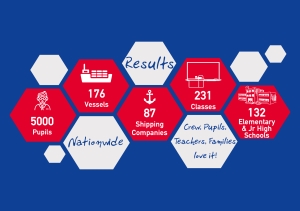
Pupils of all ages are more interested than ever to attend school and Captains spirits are lifted as they are “bridged” to shore by a class’s e-mail, because of this amazing maritime educational program.
Adopt a Ship offers the chance for exchange of valuable seafaring information and it covers all bases. “It is the best response to what children and shipping need today. If there is any doubt, just look at the wonderful results of the program” says, Irene Notias, director of the program and Project Connect in Greece.
Children need to know what types of vocations are out there for them to choose and seafarers need to be recognized as key workers. Adopt a Ship is influencing both. To date, over 5000 pupils of Greece, their teachers and families know about shipping because of the program which instills seafaring awareness and practical maritime knowledge in children and steers them towards progress and new horizons otherwise unknown to them and their families.
“There is no doubt that the Adopt a Ship program is the best branding for international shipping and what is extraordinary is that it is the public and private school teachers of elementary, Jr High, and Vocational schools of Greece that are voluntarily teaching it in a very unique, interactive way that it comes to life in Greece.”
Only a month and a half since Project Connect was awarded the authorization by the Ministry of Education, there are over 100 elementary, Jr High and EPAL (Vocational) classes of 55 schools all over Greece that have applied to be connected to vessels that they will adopt and follow their voyages for the entire school year.
So far, thirty-eight (38) Greek shipping company members, have enrolled 85 vessels.
SHIP MANAGEMENT CORP., CAPITAL GAS SHIP MANAGEMENT CORP, CAPITAL SHIP MANAGEMENT CORP, CHANDRIS (HELLAS) INC, CHRONOS SHIPPING, COMMON PROGRESS, COSTAMARE SHIPPING COMPANY, DANAOS
SHIPPING, DIANA SHIPPING SERVICES, EASTERN MEDITERRANEAN MARITIME, EMPIRE BULKERS, EMPIRE CHEMICAL TANKERS, EMPIRE NAVIGATION, EMPROS LINES SHIPPING CO, EUROBULK, FAFALIOS SHIPPING,
HALKIDON SHIPPING CORPORATION, LATSCO MARINE MANAGEMENT INC, LOAD LINE MARINE, MARAN, SEA TRADERS, SHELTON NAVIGATION, STARBULK, SUN ENTERPRISES, TECHNOMAR SHIPPING.
The pupils of all school levels are learning that it is shipping that transports most of the goods they are using. They are learning about ports, geography, cultures, commerce & trade, cargoes, history of Greek Shipping, the different types of vessels, English language, and much more. They are also gaining soft skills from empathy for crew, and teamanship as they compose letters to Captains at sea together.
“Adopt a Ship”, as XRTC’s Director, Mr George Xiradakis stated last year, “is the solution to the decreasing numbers of seafarers world-wide.” Five percent (5%) of the pupils participating in the program have declared they aspire to become Captains and some are females.
The Project Connect team is working round the clock to meet the needs of the schoolteachers, to match them with vessels and source schools located near Marine Academies and vessels. There is a need for more vessels.
Together with the seafaring captains and crew, teachers who are bringing value to the sustainability of our beloved shipping community, by implementing the Adopt a Ship program in their weekly school lesson plans.
Project Connect aims to help prepare the next generation workforce that will sustain our future shipping companies with high standards and excellence.
ELNAVI Newsletter
More information: ELNAVI,
19, Aristidou str., Piraeus 185 31,
Tel.: +30 210 45.22.100, e-mail: This email address is being protected from spambots. You need JavaScript enabled to view it.
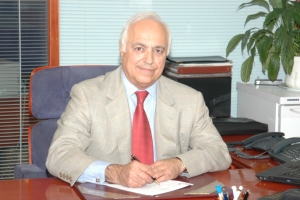
When I switched from my other activities to shipping in 1968 and studied Shipping Practice and Marine Insurance in London, I was very lucky to meet and acquire the friendship of several very knowledgeable and important figures in law and in the Insurance business. I was also privileged, in the office that I was working parallel to my studies, to work under Mr. Alex Kazantzis and in the university to have as tutor in law and Marine Insurance Mr. Donald Davis. Both of above two gentlemen where two of the top Arbitrators at the time and alternative Chairmen of the Arbitration Committee.
Both of them, every time we were discussing submissions for a case were telling me that all submissions have to be structural with a consistent line of thought, have to be precise, truthful and address the defence points in “Utmost Good Faith” which is also one of the Fundamental Principals of Marine Insurance. Unfortunately, the majority of the people I met 54 years ago and I became good friend with them have passed away and I have no audience to exchange my views with one or two exceptions.
For the Marine Insurance Business there are following leading centers, not that there are no other places that they have some marine capacity: London, Italy, Norway, France, Germany etc.
Most of the Marine Insurances are placed on ITC Hulls terms which is subject to Marine Insurance Act 1906 / Insurance Act 2015.
As said before the Act provides that the Insurance Contract is subject to the Fundamental Principal of “Utmost Good Faith”.
Regarding solicitors when they obtain their qualification to act as solicitors they give an oath that they will serve the law, meaning that their job is not to twist the terms of a contract but to treat a case along the provisions, the terms, and the intention of the cover sold as per the structure of the contract.
Underwriters frequently decline claims with the assistance if not the suggestion of their solicitors, alleging that the Assured has not acted in “Utmost Good Faith” claiming scuttling by want of due diligence of the Assured to avoid payment of a claim. In other cases that there is not even a hint of Owners involvement, they claim that the Assured has not discharged the onus of proof for the cause of damage (The Marel case) and decline the claim on this basis. The rejection was based on the inability of the crew to specify what was the object that the vessel hit at 23:00 hours and force 11 on the Beaufort scale. The fact that the underwriters proved themselves that around the vessel at 1000 meters depth were numerous containers, and a submarine, a week later, was pictured in Daily Telegraph with her bridge tower damaged in a yard in the area of the casualty, did not matter. Very handy cunning excuse and sick on behalf of the entire system. The findings in the judgement, per Lloyd’s Law Report 1992 reads in brief :
Page 416 right column top paragraph:
“Counsel for the underwriters was similarly precluded for contending that (…the Owner) was giving false evidence and that the court should accept him as truthful witness as indeed I do”.
Page 423 right column third paragraph.
“Third, the Owners case is supported by the consideration that the acceptance by underwriters and the court of the bona fides of the ship’s witnesses and by the court of the bona fides of (the Owners) is inconsistent with the ship having been deliberately sunk”.
Conclusion: However, we requested the Assured to give us an example of what was the floating object the ship collided with, but we are not convinced by the example the Owners gave as a probable cause.
From this, transpires that for several cases the allegation declining a case is not based on proofs as the Insurance Terms burdens the underwriters to put on the table, but on unsolicited and totally unsubstantiated excuses.
In another cases, the decline is based only on rumors as it was the case some 4-5 years ago and the subsequent theatrical show, arresting the Owner outside the London Court on completion of the hearing and the substantial publication of the relevant pictures in the Media. However, no one bothered to write that the Owner whose claim was declined on alleged and not proved scuttling was released after arrival in the police station because there was no charge for the arrest, meaning that the underwriters had not discharged the burden of proof of their allegation as the law provides.
Can one prove, and not say that I heard, I suspect … etc what it was the action of the Owner justifying underwriters not to pay a legitimate CTL? Obviously not, otherwise the court decision should have said so, and the theatrical arrest of the Owners would have been effective with consequences against the Owner.
If an Owner is not eligible to collect his claim based on allegations, what an underwriter must suffer if on proven willful actions, organize distortion of the facts on purpose to have an excuse and not a cause to escape the payment of a claim?
To understand from where I am coming from, recently an Owner having his vessel trapped and detained in Ukraine was told by his underwriters that he has no claim because his vessel is not trapped, and he keeps his vessel in Ukraine purposely, alleging detention by an insured peril, in order to establish and collect a CTL. Underwriters base their argument giving as a fact that the vessel next to his vessel m/v…….. had left without any problem and is now in France as per the signal of the AIS system. The Owner was alarmed, and he called his master requesting him to look for the vessel and confirms to him that she is not there anymore. The answer was clear. The m/v…. is still here next to our ship and here is the picture. If an Owner loses his CTL claim based on unfounded allegations and rumors can a responsible professional explain what the underwriter who used purposely false information to avoid payment of a claim should suffer?
Another set of underwriters’ policy contain following clauses:
-In the policy only Agreed insured amounts are entered
-An Owner can purchase any other cover that the underwriter will approve. Emphasis is given in the word “approve” which in effect means “agreed”.
-In the policy under the heading Hull & Machinery and Increased Value following sums
Insured are mentioned:
Hull & Machinery Agreed Value US$......
Increased Value US$......
Total insured under this section US$......
-Underwriters claim that because in the definition section of the policy only the Hull & Machinery value is mentioned as Agreed Value, the Increased Value sum insured is not payable. They Ignore though the fact that in the policy only agreed amounts are entered, that Increased Value policies are Hull & Machinery policies. In the policy under the heading “Hull & Machinery and Increase Value” both Hull & Machinery and Increased Value sums insured are entered and it states “Total Insured under this Section” is the total of the two different types of insurance. Also, they do not consider at all that in the policy there is a clause reading “An Owner can purchase any other cover that the underwriter will “approve”. Furthermore, they ignore the fact that the Increased Value policy is a Hull & Machinery cover. Therefore, it does not have to be mentioned separately in the definition section to be considered “agreed value”.
- Additionally, the policy has benefits for the hull section and a separate section for P&I covering the Owners’ third party’s liability including crew as well. When an Assured claimed from the carrier of his insurances his liability to the crew he was told that that the crew is not covered by the P&I section but from the benefits given by the Hull section. However, the benefits under the Hull section are not linked to any type of costs, meaning that they are paid as pain and suffering. Furthermore, said benefits under the Hull section have be paid by the very carriers in full without any reduction depending and corresponding to the removal of the crew, enforcing the view that the intension of the clause is for pain and suffering.
- The policy contains a clause which states that if the insured vessel is detained for more than 183 days, she is considered CTL, unless the underwriter on their own discretion decides otherwise for a lesser number of days. The underwriters’ discretion cannot increase the number of days because this will be an unfair term of the policy and will not stand in any court of law. The discretion can only decrease the number of days as the clause provides. The discretion alternative is inserted in the policy only for the reason of improving the policy. When the Assured claimed CTL, the claim was declined and in addition the underwriter announced that payments under the detention clause are payable on a without prejudice basis from 1st of August onwards because the Assured has not proved that his vessel is detained by an insured peril, (although till now has paid some crew evacuation expenses and four months detention benefits) which is a proof that the detention of the vessel is due to a peril insured against. We remind the underwriters that the Greek shipowners are very good and clever ship operators, unlike the British, and this is the reason the Greek fleet is one of the biggest if not the bigger fleet in the word. Greeks know very well that they will be better off by trading their ships making more than US$ 25,000 per day and running costs US$ 7,500 than having their vessel stuck in Ukraine in to collect from their underwriters US$ 7,700 per day and daily costs above US$ 15,000. Most probably British shipowners acted the way underwriters believe Greek shipowners act. They better consider if this was the way British shipowners used to work and they disappear.
- We remind underwriters and their solicitors that honorable underwriters like the Scandinavians, that they have a time limit after which a trapped vessel is considered a CTL have already paid. We kindly request and suggest insurance providers as well as Assureds have to operate in utmost good faith as the Marine Insurance Act 1906 requires.
Of course, the system will not bother because the wrongdoings of underwriters are legitimate actions but the unsubstantiated allegations against an Owner constitute criminal act committed by the Owner entitling the underwriter to refuse payment of a claim for no reason and without any proofs. What a gentlemen’s environment we are living in. Where is the doctrine.” My word is My Bon?”.
ELNAVI Newsletter
More information: ELNAVI,
19, Aristidou str., Piraeus 185 31,
Tel.: +30 210 45.22.100, e-mail: This email address is being protected from spambots. You need JavaScript enabled to view it.
BIMCO Shipping Number of the Week. Supply/demand balance at 2019 level as container volumes fall 4.6% y/y
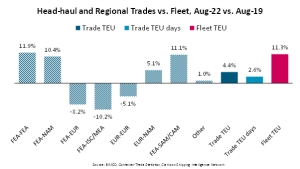
Since July 2020, the container market has benefitted from a surge in consumption of goods compared to pre-COVID levels, and head-haul and regional trade volumes have followed. Compared to the same period of 2019, container volumes in the second half of 2020 were up 5.7% while full year 2021 volumes were 9.0% higher. Volumes in the first half of 2022 were up 8.3%, also compared with H1 2019. Despite a growing fleet, capacity supply was unable to keep up as port congestion absorbed as much as 14% of the fleet, data from Sea-Intelligence shows.
According to new data released by Container Trade Statistics, head-haul and regional trade volumes in August 2022 were at their lowest level since February 2022. The volumes were 3.8% lower than in July and 4.6% lower than August last year, confirming the lack of peak season volumes in key trade lanes. In comparison to pre-COVID volumes in August 2019, the volumes were only 4.4% higher and TEU days were just 2.6% higher due to a change in trade mix.
“In August 2022, port congestion absorbed 6-8% more of the fleet than in August 2019. However, the fleet has grown 11.3% since August 2019 and capacity supply was therefore 3-5% higher. As trade TEU days were just 2.6% higher, the vessel supply/demand balance was back at, or just below, 2019 levels,” says Niels Rasmussen, Chief Shipping Analyst at BIMCO.
Despite the weakening of the market, time charter and container freight rates are yet to reach 2019 levels. On average, time charter rates measured by Clarksons have fallen 60% between the peak in April and early October this year, including 55% during the last month alone. Spot container freight rates ex Shanghai measured by Shanghai Shipping Exchange have equally lost about 60% since peaking in January, including a 50% decline during the last two months. However, both remain approximately 2.5 times higher than three years ago.
As expected, time charter rates have responded to the weaker supply/demand balance faster than container freight rates. Through blanked sailings, by closing services, and idling ships, liner operators can reduce supply to meet demand in the freight market whereas this is very difficult in the time charter market. However, liner operators have historically not been very successful at this, except when they have been battling heavy financial losses.
“Liner operators have taken steps to reduce supply to better match the weakening demand. According to Sea-Intelligence, blanked sailings in the Transpacific trade during the Golden Week lull added up to 10% more of weekly ship capacity than in a normal year. In addition, a number of liner operators have announced that they are closing Transpacific services. However, so far it has not been enough to stop rates from falling,” says Rasmussen.
Charter ship owners, on the other hand, do not have many tools to adjust supply in the time charter market. Currently, they do benefit from low availability of ships ready for a new time charter contract. During the last two years, many contracts for long periods were concluded which limits ship availability now. In addition, more and more ships appear to be heading to drydock for surveys and to prepare for EEXI and CII regulations. This delays rate reductions but does not protect rates from eventually adjusting fully to the weaker supply/demand balance. Many owners can in the meantime take solace in that the rate reductions do not impact the very high rates in the still active time charter contracts.
As predicted in BIMCO’s 3 rd quarter Container Shipping Market Overview and Outlook, lower congestion and weakening volumes are shifting the market downwards, and full “normalisation” of market conditions could be seen later this year or early next year.
ELNAVI Newsletter
More information: ELNAVI,
19, Aristidou str., Piraeus 185 31,
Tel.: +30 210 45.22.100, e-mail: This email address is being protected from spambots. You need JavaScript enabled to view it.
Cruise Industry demonstrates commitment to pursuing net-zero carbon cruising globally by 2050
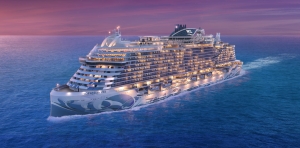
Cruise Lines International Association (CLIA), the leading voice of the global cruise industry, released the results of its 2022 Global Cruise Industry Environmental Technologies and Practices Report, showing progress towards achieving the industry’s vision of net-zero carbon cruising globally by 2050.
The 2022 report reinforces the cruise industry’s credentials as an innovator and early adopter of environmental technologies. Examples cited include the increasing number of vessels launching over the next few years that will be able to incorporate zero-emissions propulsion when available as well as the growing investment to equip ships to plug in to shoreside electricity where available. In fact, more than 15% of the vessels to be launched in the next five years will be equipped to incorporate fuel cells or batteries, and 85% of CLIA-member ships coming online between now and 2028 will be able to plug in to shoreside electricity, allowing engines to switch off at berth for significant emissions reduction.
President, and CEO, CLIA, Kelly Craighead said: “Innovation and engineering are at the heart of the industry’s vision for net zero carbon cruising. The cruise industry continues to lead the way by investing billions to incorporate new technologies, accelerate development of sustainable marine fuels—in particular, engines capable of using sustainable marine fuels—and enable shoreside electricity connectivity on existing and new ships. These are the fundamental building blocks for the decarbonisation of global shipping, and we are acting now for the future.”
Despite progress made, the report makes clear that a transition to sustainable marine fuels remains essential to achieving the maritime industry’s decarbonization goals and underscores the urgent need for governments to support research efforts to accelerate development of these fuels so that they are safe, viable and available for use at scale. To that end, CLIA is a supporting organization to the Getting to Zero Coalition’s Call to Action for Decarbonization of Shipping. This support is in addition to the leadership of its individual cruise line members and their partnerships with a number of other coalitions and organizations that are working to find critical decarbonisation solutions.
“The cruise industry has always been and will continue to be at the cutting edge of innovation when it comes to environmental and maritime technologies,” said Chairman of CLIA Global, Pierfrancesco Vago. “For this next phase of our journey to net-zero as an industry, we now need clear support from governments and policy-makers to ensure that the right infrastructure is developed also on land and to encourage the investment and innovation that will be required for the development of sustainable marine fuels at scale.”
The report notes that CLIA ocean-going cruise lines continue to progress reductions in emissions:
- Shore-side Power Capability – cruise lines continue to make significant investments for cruise ships to connect to shoreside electricity, allowing engines to be switched off in port. o 40% of global capacity (up 20% year over year) are fitted to operate on shore-side electricity in the 29 ports worldwide (less than 2% of the world’s ports) where that capability is provided in at least one berth in the port.
- 98% of new build capacity on order book (between now and 2028) is either committed to be fitted with shore-side electricity systems or will be configured to add shore-side power in the future.
- Liquefied Natural Gas (LNG) Fuel – The 2022 report found 61% of new-build capacity will rely on LNG fuel for primary propulsion. The use of LNG results in 95% to 100% fewer particulate matter (PM) emissions., virtually zero sulphur emissions, and an 85% reduction in nitrogen emissions. As a transitional fuel, LNG provides real benefits now, but also allows LNG-ready ships to adapt to a future generation of sustainable marine fuels.
- Exhaust Gas Cleaning Systems (EGCS) - More than 79% of global capacity utilizes EGCS to meet or exceed air emissions requirements, representing an increase in capacity of 7% compared to 2021. Additionally, 88% of capacity of non-LNG new builds will have EGCS installed, in line with already high historical level of investments.
- Advanced Wastewater Treatment Systems - 100% of new ships on order are specified to have advanced wastewater treatment systems and currently 78% of the CLIA ocean-going cruise line fleet capacity is served by advanced wastewater treatment systems (a 9% increase compared to 2021).
The industry’s commitment to pursue net-zero carbon cruising by 2050, announced earlier this year, is consistent with the target set by the Paris Agreement, and is supported by the industry’s intermediary objective to reduce the rate of carbon by 40% across the global fleet by 2030, compared to 2008, which is consistent with the International Maritime Organization’s (IMO) Initial Strategy for GHG reduction.
ELNAVI Newsletter
More information: ELNAVI,
19, Aristidou str., Piraeus 185 31,
Tel.: +30 210 45.22.100, e-mail: This email address is being protected from spambots. You need JavaScript enabled to view it.