


-
Home

-
About Elnavi
- elnavi

elnavi
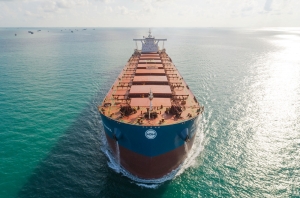
Chevron and Angelicoussis come up with a Joint Study Agreement to explore how tankers can be used to transport ammonia, a potential lower carbon marine fuel. The initial study will evaluate the ammonia transportation market, existing infrastructure, the safety aspects of ammonia, potential next generation vessel requirements and a preliminary system to transport ammonia between the U.S. Gulf Coast and Europe. Future opportunities will focus on additional global markets.
Ammonia is a carrier of hydrogen and is believed to have potential to lower the carbon intensity of the marine industry. Through the JSA, the Angelicoussis Group and Chevron aim to advance ammonia’s technical and commercial feasibility at scale, particularly as an export for petrochemicals, power, and mobility markets.
“We are pleased to collaborate with the Angelicoussis Group on this study, help advance lower carbon energy at scale and progress marine transportation of ammonia,” said Mark Ross, President of Chevron Shipping Company. “I’m proud of the collaboration between Chevron Shipping, Chevron New Energies and the Angelicoussis Group and look forward to driving progress toward our energy transition goals.”
“Global value chain solutions are critical for growing the hydrogen market, and we believe shipping will play a crucial role. Chevron is leveraging its international functional marine expertise and collaborating with the Angelicoussis Group to pursue the delivery of lower carbon proof points to the market,” said Austin Knight, Vice President, Hydrogen, Chevron New Energies.
“Through collaborating with Chevron Shipping Company on this study, we aim to make a meaningful contribution to prepare our industries for the transition towards lower carbon operations,” said Maria Angelicoussis, CEO of the Angelicoussis Group. “Combining our many years of experience in seaborne transport of liquid and gaseous energy sources with Chevron’s vast experience in the energy business provides a solid basis for this endeavor.”
“Ammonia has potential as a hydrogen vector and is considered one of the alternative fuel options to decarbonize shipping. We believe this study will contribute towards identifying the technical, operational and commercial challenges of carrying ammonia at scale and using it as a fuel in a safe and sustainable way,” said Stelios Troulis, Green Ships and Energy Transition Director for the Angelicoussis Group.
Chevron and the Angelicoussis Group have a long-standing relationship dating back to 2000. Since then, the partnership has grown from conventional vessels to include multiple LNG carriers, as well as joint work on energy transition initiatives. The teaming of Chevron Shipping, Chevron New Energies and the Angelicoussis Group on this study supports and accelerates both organizations’ ambitions to become leading, global clean energy providers by focusing on all aspects of the hydrogen supply chain.
ELNAVI Newsletter
More Information: ELNAVI,
19, Aristidou str., Piraeus 185 31,
Tel.: +30 210 45.22.100, e-mail: This email address is being protected from spambots. You need JavaScript enabled to view it.
The Cyprus Shipping Chamber embraces the formal approval of the new EU ETS law by the European Parliament. The law engages the calls of European Shipowners through the European Community Shipowners’ Associations (ECSA), to earmark revenues generated by EU ETS allowances, to facilitate the decarbonisation of the shipping industry.
At least 20 million ETS allowances, which correspond to around 2 billion Euro under the current ETS carbon price, will be allocated to maritime projects under the Innovation Fund, for the uptake of research and innovation to facilitate the production of cleaner fuels and the effective energy transition of the maritime sector.
Moreover, the EU Parliament upheld the mandatory pass-through of ETS costs to the commercial operator of the vessel, supporting the “polluter-pays principle”, which was another ECSA proposal and the three year phase-in period for the gradual inclusion of emissions from shipping.
While this development is indeed a groundbreaking achievement for European Shipping, the Chamber strongly supports ECSA’s position, that, it is also essential that the “Net Zero Industry Act” properly recognises the strategic role of shipping in Europe’s security, competitiveness, and autonomy by including the development of dedicated production capacity of renewable fuels of non-biological origin (RFNBOs) in the Act’s definition.
The Chamber is firmly committed to continue contributing, through ECSA, towards the EU’s efforts to accelerate a sustainable and just green transition of the maritime sector.
ELNAVI Newsletter
More Information: ELNAVI,
19, Aristidou str., Piraeus 185 31,
Tel.: +30 210 45.22.100, e-mail: This email address is being protected from spambots. You need JavaScript enabled to view it.
CLIA guides tourism students through the world of cruising and celebrates 2023 as “the European Year of Skills”
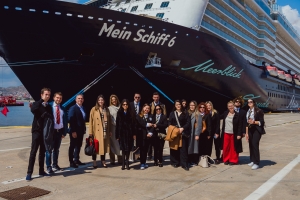
The opportunity to get onboard Mein Schiff 6 cruise ship of TUI Cruises at the Port of Piraeus in Greece, and to be informed about career opportunities in the cruise business and industry’s actions on sustainability, was given to Hospitality and Tourism Management students of BCA College, on Friday, April 7 by the Cruise Lines International Association (CLIA) in cooperation with TUI Cruises.
This educational ship visit is part of CLIA’s priority to engage with students and young people who are interested in the dynamic cruise industry and raise awareness about its significant and growing impact on the economy and employment at global, European, and local level.
Maria Deligianni, CLIA’s National Director for the Eastern Mediterranean, stated: “Seeing is believing. We want to offer to the students the opportunity to experience what cruising is about”. And added: “2023 is the European Year of Skills and we want to contribute to the development of skills in our industry. As a cruise industry we are sailing to a better future, and these young students are our future”.
As part of the same initiative, on Tuesday April 4, Maria Deligianni visited BCA College and spoke to Shipping students about the international cruise industry and how it sails sustainably.
The cruise industry offers a high-quality work environment with competitive wages and benefits, as well as training for crew members to perform jobs skillfully and advance on a rewarding career path.
The CEO of TUI Cruises Wybcke Meier stated: “The cruise business offers a wide variety of career opportunities. They range from purely maritime jobs, to hotel operations including healthcare majors, cooks and entertainment specialists, and to ground handling, shore excursion providers and travel and shipping agents as well as the people in the office. We were delighted to co-host with CLIA this cruise ship visit onboard our Mein Schiff 6 and inform the students about the career paths offered by our industry”.
CLIA member cruise lines employ a multinational workforce. Often more than 60 nationalities may be working together onboard ship at any one time.
“It is a source of pride for the industry to employ so many people from different nationalities, cultures, and backgrounds. Multinational crews work together with respect in safe working environments to deliver the guest experience that is unique to a cruise holiday”, said Maria Deligianni.
Cruise also provides the most advanced opportunities for women in maritime, as 94% of women seafarers across the world are working in the cruise industry. At the same time, the industry is remarkable for its job satisfaction levels, which are reflected by the strong employee retention rates at upwards of 80%.
It is worth noting that, according to the latest CLIA data, the cruise industry generates annually more than 1,1 billion euros to the Greek economy and supports 15,100 jobs (2021 figures). Looking ahead and at global level, the cruise sector is expected to move closer to 2019 levels in 2023 with passenger volume forecast to reach 27 million to 33 million cruisers globally, a global contribution to the economy of $155B and more than 1.2M jobs and $50B in wages.
About the Cruise Lines International Association (CLIA)
CLIA is the world's largest cruise industry trade association, providing a unified voice for the industry as the leading authority of the global cruise community. On behalf of its members, affiliates and partners, the organization supports policies and practices that foster a secure, healthy, and sustainable cruise ship environment, promoting positive travel experiences for the more than 30 million passengers who have cruised annually. The CLIA community includes the world's most prestigious ocean, river, and specialty cruise lines; a highly trained and certified travel agent community; and a widespread network of stakeholders, including ports & destinations, ship development, suppliers, and business services. For further information, please visit cruising.org or europe.cruising.org
ELNAVI Newsletter
More Information: ELNAVI,
19, Aristidou str., Piraeus 185 31,
Tel.: +30 210 45.22.100, e-mail: This email address is being protected from spambots. You need JavaScript enabled to view it.
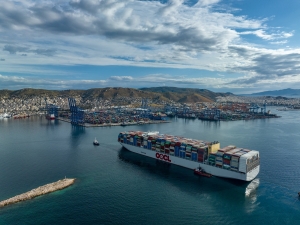
OOCL SPAIN on its maiden voyage - one of the largest container ships (mega vessels) in the world and the first one of its size that that will be regularly calling at the Port of Piraeus Terminal’s facilities.
“OOCL SPAIN” - owned by Orient Overseas Container Line, member of COSCO SHIPPING Group - launched in March this year on a round trip that connects Asia with Europe.
On its maiden voyage of 84 days, "OOCL SPAIN" calls at 13 different ports, from China and Southeast Asia to Northwest Europe. The choice of Piraeus as an intermediate transfer station is primarily attributed to the high level of services provided by PCT S.A., in terms of the speed of service of vessels and cargos in transit, the technological superiority of the services offered, as well as the strategic location of Piraeus, which makes it a key hub in maritime freight flows to and from Asia as well as other parts of the world.
With an overall length of 399.9 meters and a molded width of 61.3 meters, the “OOCL SPAIN", built in 2023, has a nominal container capacity of 24,188 TEUs. The use of the latest intelligent technology on board combined with the acquisition of big data, upgrade the functions of OOCL SPAIN, allowing improvements in fuel efficiency, and long-term navigation safety.
ELNAVI Newsletter
More Information: ELNAVI,
19, Aristidou str., Piraeus 185 31,
Tel.: +30 210 45.22.100, e-mail: This email address is being protected from spambots. You need JavaScript enabled to view it.
Columbia Shipmanagement (CSM) shows commitment to innovation and cutting-edge technology
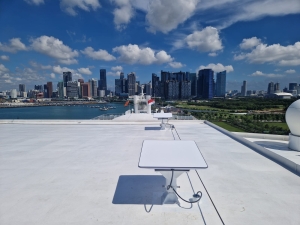
Leaders in innovation, the ship management arm of the Columbia Group, Columbia Shipmanagement (CSM), is conducting a trial of the new Starlink satellite internet service on a number of vessels.
The Starlink service, provided by a constellation of low-earth orbit (LEO) satellites operated by SpaceX, is designed to deliver reliable and high-speed internet connectivity to ships and vessels across all sectors of the maritime industry.
Columbia Group CEO, Mark O’Neil said: “We are delighted to be trialing this technology to keep our ships better connected. Starlink has the potential to revolutionise the maritime industry by providing reliable and affordable internet connectivity to ships, even in the most remote parts of the world. This can help improve crew welfare, reduce costs, and enhance safety and security, making it a game-changer for the industry.
“Columbia is committed to our excellent crew and as part of our ICARE philosophy, we focus on different aspects of crew welfare, connectivity being one of them, so we are very pleased to be adopting this new technology among our fleet.”
Starlink is expected to also help cruise companies reduce costs associated with traditional satellite internet services, and provide better connection services for crew members, as well as add a new level of guest experience, enabling them to enjoy high-speed connectivity while at sea.
It can also enhance safety and security by offering a reliable connectivity in remote areas, enabling better communication with stakeholders, emergency services and authorities, as well as enable real time data exchange and communication.
Real time data exchange is important so that a vessel can become a connected EDGE endpoint integrated into the owners or ship managers operations. Ships are not anymore, the remote, disconnected endpoint that may or may not be able to send and receive data.
Starlink can facilitate remote monitoring of vessel performance and maintenance needs, allowing for proactive maintenance scheduling and reducing the risk of unplanned downtime. This can help improve vessel availability and reliability, as well as reduce costs associated with maintenance and repairs.
CSM is widely exploring Starlink in conjunction with a SD WAN (Software defined wide area network) in order to combine proven satellite internet technology as well as cellular 5G near shore connectivity into a unified communication package that will enhance every aspect of maritime operations.
CSM is part of Columbia Group, a fully integrated maritime and logistics services platform including technical ship management, crew management and training, procurement, performance optimisation tools, and crew care solutions, among others.
ELNAVI Newsletter
More Information: ELNAVI,
19, Aristidou str., Piraeus 185 31,
Tel.: +30 210 45.22.100, e-mail: This email address is being protected from spambots. You need JavaScript enabled to view it.
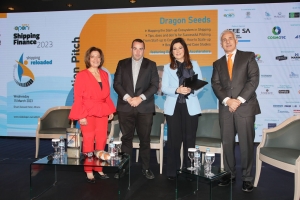
The world of shipping is undergoing a series of profound changes, with new developments in financing, environmental protection, fuels, navigation and human resources. These changes were explored at the 6th annual Slide2Open Shipping Finance Conference 2023.
During his keynote presentation, the Managing Director of IEEE SA Standards Association, Dr Ing. Konstantinos Karachalios introduced IEEE, a huge ecosystem of knowledge, which can be beneficial to shipping.
In the panel discussion moderated by the Conference organizer and IEEE SA Ambassador for Maritime, Ms Despina Travlou, the President of the Hellenic Chamber of Shipping and Deputy Chairman of Contships Management Inc., Dr George D. Pateras noted that there is a huge hype about the environment, but greenwashing is also at play. If we keep on burning the fuel that we currently burn more effectively, we may achieve lower emissions. He also noted that Greece is ahead of the curve and is investing millions in research to this respect. Mr Leonidas Dimitriadis Eugenides, IMO Ambassador for Greece and President of Eugenides Foundation, stressed the importance of the human factor. Greek shipping accounts for more than half EU deadweight. But in terms of people, we need more, both onboard and ashore (at least another 10,000 officers). Professor Costas Synolakis intervened asking about market forces. Mr Vassilios Terzis, Managing Director of Queensway Navigation Co. Ltd and First VP of the Hellenic Shortsea Shipowners Association explained that in the shortsea shipping, electricity is an environment friendly solution. Battery vessels and port facilities are also discussed, but nothing is really done, apart from 2 battery filling stations in Rotterdam. Everything will have to be different by 2050, but realism is missing. IMO needs a lot of good advisors, because it has a critical role, but does not help the shipping industry. It is the leader, without giving any direction or solution on what to be done.
The second panel discussion, “What will it take to bring shipping finance back to its roots”, was moderated by Mr Angelos Roupas Pantaleon who asked about the regulatory framework for banks, on the occasion of the recent bank run. Mr Bart Veldhuizen, Founder, Aquarius Maritime Capital Ltd, noted that probably the regulatory bodies in the US eased up their oversight on smaller institutions. Mr Konstantinos Petropoulos, General Manager, Head of Shipping and Structured Finance at Piraeus Bank said that, after previous events, maybe we do not have enough regulation! Mr Vasilis Papagiannopoulos, Director of Common Progress Co. Na Ltd, sees that there is reciprocity and very good service from their bankers. Regulation is a very interesting topic, as one cannot regulate everything, not everything is black or white. Shipping is based on relationship banking, maybe not as it was in the ‘80s, but good support from bankers has helped Greek shipping flourish, and this is still there to a large extent. He believes that there is always room for bank executives who know the business to support new companies that are hard to find financing. The question of “who finances the ships” is not irrelevant for Europe, as it has much to gain from a big industry, very important in terms of supply chains and resilience. Therefore, there is not only a business side, but also a political side of ship financing. Mr Nicholas Petrakakos, Managing Partner at ALANTRA, noted that the regulatory framework has allowed the emergence of credit funds and leasing in shipping. This type of fund is more sophisticated and less regulated. For Greek shipping, transition to private capital approach has been slow, to the benefit of banks. Therefore, relationship banking is helpful, but may not drive innovation in financing, as alternative financing does.
The third panel started immediately afterwards and focused on “Sustainable Development in Shipping – Best Practices”. Mr Vasileios Petousis, Energy & Sustainability Officer, Seanergy Maritime Holdings Corp. answered that sustainability is very complex for shipping, better coordination among stakeholders is necessary to achieve sustainability. Mr Christos Matsikoudis, Area Sales Manager EastMed, Wärtsilä Voyage, explained that complying to regulations depends on time, how fast is the industry going to adapt and trust. Ms Helena Athoussaki, Head of ESG, Sustainability & Climate Change, Motor Oil Group, said that ESG is a challenge. She noted that when ESG is integrated in a company, this helps addressing risk management and finding opportunities. Mr Konstantinos Oikonomou, CEO, Marine Tours Group of Companies, explained that travel has a very serious environmental footprint and agreed that integrated ESG into their operations is a challenge, noting that it is not something that comes cheap. Systems are in place that help the shipping to better manage their travel.
Ms Elisabeth Calbari, Neuropsychologist, Executive Leadership Consultant and Founder of Self-Balance engaged in a most interesting conversation with Mr Makram Daouk, Business Director of Crossworld Marine and Ms Maria Korkontzelou, Crew Manager of Seanergy Maritime Holdings Corp. on “Human Sustainability of Crews and Offshore Managers in the Maritime Industry”. More specifically Ms Calbari stressed the importance of the human element onboard and ashore. In terms of challenges, Ms Korkontzelou noted to achieve human sustainability and this is done through empowerment and training in leadership, soft skills, communication skills of multinational seamen and the company personnel. Mr Daouk stressed that nowadays very specific skills are required, the world fleet is increasing, the demand is huge, responsibility is much higher and less people now go to ships. Discussants agreed that cheap crews have hidden costs, as in the long run the gap will widen. Investment in people is necessary. A healthy worker, happy and proud for his/her work, can only benefit the company and the industry.
The fourth panel of the day came in the form of the AMMITEC Open Forum on “Autonomous Shipping – Balancing the benefits against safety and security concerns”. Moderator Dr Matthew Maheras, CIO, Metrostar Management Corp. Vice President of the BoD, A.M.M.I.T.E.C. introduced the panelists, Mr Michalis Michaloliakos Phd, MSc, Head of ICT & Cyber Security Services, TMS Cardiff Gas Ltd, Mr Frank Palaiokrassas, Head of Data Governance & Analytics, Bernhard Schulte Shipmanagement, Ms Katerina Raptaki, Digital Transformation, Cyber Security and e-Governance specialist, Navios Group of Companies, Member of the BoD of A.M.M.I.T.E.C. discussed on the feasibility and commercial use of autonomous ships, their impact on the environment, the potential costs to the industry and the effects on personnel, both on board and ashore. More specifically, Dr Maheras noted that 2022 was a landmark for autonomous shipping with an autonomous crossing of the Atlantic. Obviously technology is here and regulations are evolving fast. Is large-scale autonomous shipping going to happen soon? “Can AI navigate ships in open sea today?” ChatGPT was asked this question and answered “yes, …. however, this is yet relatively rare”. Mr Frank Palaiokrassas replied that the holy grail of autonomous navigation does not have all the answers yet. Shipping companies nowadays run on data and the IT department has come to the heart of shipping companies. Mr Michalis Michaloliakos noted that autonomous does not mean unmanned, the human element is always important. Ms Katerina Raptaki added that we need to spend a lot of time to discuss with the community about the advantages and disadvantages with autonomous shipping. Financial benefits, better performance, safety considerations are important.
In her greeting speech, Ms Eirini Veniamis Mangos, Vice President of ICC Women Hellas and Director of Golden Union Shipping, noted that members of ICC come from different industries, aiming at the positive reinforcement of women. It is essential that more and more women are integrated into shipping, not only ashore, but also onboard.
Harry N. Vafias, Founder and CEO of Stealthgas Inc. and of Imperial Petroleum Inc., discussed with Mr Angelos Roupas Pantaleon on “Dragon Seeds – Start-ups and successful pitching”. The conversation was moderated by journalist Irene Nikolopoulos. Mr Vafias shared insights on how he approaches life and mentioned that life is a non-stop pitch, a non-stop negotiation, and this applies to everything and every relationship. He emphasized the importance of persistence, timing, luck, good industry knowledge, and negotiation skills in achieving success. Mr Vafias noted that timing is the most crucial factor of all. His discussion shed light on the intricacies of pitching and starting a successful business, offering valuable advice to those looking to enter the industry.
The fifth panel discussion was moderated by Ms Eirini Liadis, ICT Senior Sales Specialist, OTE Group, who discussed “Connected Oceans: Harnessing the Power of Space-based technologies for Operational Excellence”.
Mr Philip Nielsen Co-founder of Oriani explained that space technology can be disruptive, because it provides one, truly global communication network from everywhere. This increased hyperconnectivity will have tremendous advantages, including autonomous operations. Satellite technology can make shipping more efficient, and bring about more meaningful operations, enabling real time decision making. Technology nowadays is not about software; it is about connectivity, which now comes from space, and people. In the past captains were wondering what happens below; now they will be wondering what happens above.
The sixth panel discussion of the conference, “Paving the Next Steps of Maritime Sustainability: Maturing Electrification and Environmentally Friendly Fuels” was moderated by Professor John Prousalidis, Professor of Marine Electrical Engineering, NTUA. Dr John Kokarakis, Technical Director SEEBA Zone, Bureau Veritas, talked about alternative fuels. It is difficult to make a forecast; it will most probably be a multi-fuel future. Fuel selection criteria depend on green production, storage, availability of bunkering, compulsion, price, etc. Methanol is becoming popular these days, while he predicts that hydrogen will be used more in the future, though it is difficult to store. In any case, huge investment is required. Mr Spyridon Paschalis, President of the Association of Passenger Shipping Companies (SEEN) and Chief Executive Officer of Attica Group, explained that passenger shipping companies have to comply with new regulations, which are very demanding. They are looking for unified protocols of port equipment, interoperability between ports, aligned time plans of installation between ports and vessels, reasonable pricing and taxation of electricity, acceptable investment payback period and electricity to be considered as maritime fuel. Mr Theocharis V. Terzis, Business Development Manager, Queensway Navigation Co. Ltd, talked about short sea shipping, which is quite ready to go electric. As a sector, it is very close to the shore and electrifying the vessels is by far the optimal option for the moment. Also, as a solution it has zero noise and zero smell. Financial incentives and port infrastructure are required. Mr Dimitris Spyrou, Consultant, Piraeus Port Authority S.A. explained that the port of Piraeus has made steps towards tackling the environmental impact of its activities. The decarbonisation plan of the Piraeus Port Authority also includes steps towards alternative fuels. Accompanying measures have also been introduced and work is undergoing in the technical, legal, regulatory and financial area. Bunkering is a great challenge. The support and cooperation with competent authorities is of major importance.
Mr Alexander Hadjipateras, SEVP, Dorian LPG (USA, LLC and MD, Dorian LPG Management Corp discussed with Mr Angelos Roupas Pantaleon about the human element in shipping, from the perspective of the younger generation. Mr Hadjipateras noted that ship is the floating business of the company and it is essential to instill a sense of ownership. This is achieved through crew loyalty, training and managing structure. Technology and the human element are bridged together and help improve efficiency. As for shipping cycles, they use time charters, while hedging portfolios, monitoring the market and reacting accordingly. Managing in-house is rewarding while getting hands-on experience is necessary.
On a friendlier note, Mr George Alexandratos, General Manager of Apollonia Lines SA and Vice President of the Hellenic Chamber of Shipping, discussed with Mr George Laios, Deputy CEO of Intermodal Group and Vice President B of the Association of Banking and Finance Executives of Hellenic Shipping, on how he sees the dry market. He stressed that shipping is the cheapest way to transfer cargos, this is why it accounts for 90% of world transport, and this will not stop any time soon. Over the past 30 years, we have the shortest order book and for the first time this year and up to 2025 there will be more scrap than incoming new vessels. This gives ground for optimism. He believes in the Greek maritime cluster and stressed the need to go together and promote shipping, putting it to the fore.
The final panel discussion of the day, “Capital Markets: Reconnecting the Dots – Reattracting companies and investors”, was moderated by Mr Angelos Roupas Pantaleon. Ms Peggy Papastavrou, Listings Director, presented the Athens Stock Exchange (147 listed stocks, with a market cap of €71 billion). 3 Greek shipping companies, listed on NASDAQ and NYSE, have issued bonds on the Athens Stock Exchange. Ms Papastavrou explained why it is worth listing on the Athens Stock Exchange and stressed their support to ESG principles. Ms Papastavrou noted that she believes that the bond project is a huge victory. She agrees that we cannot compete to the US market. In terms of dual listings, two out of the three companies that made dual listings still have most of their activity in Greece. The third is the one that managed to be included to the major index of that foreign exchange. For US listed companies, if they have a dual listing in Athens, they will get exposure and visibility to a differentiated investor base.
Mr Alexis Stephanou, Chief Financial Officer of Goldenport Group in discussing the attractiveness of a stock exchange, explained that with the hindsight one key feature that was attractive at the time of the ipo is that especially on the London stock exchange, investors are predominantly yield oriented, so, given that shipping is a cyclical business, there was considerable dividend in the first years. Stability is required to grow your business. Mr Christos Timagenis, Partner, Timagenis Law Firm, explained that European capital markets are not that attractive, because of legislation that is more restrictive. US listed companies have the opportunity to do overnight offerings. These are fundamental issues, that cannot be solved individually. Also European capital markets have a different philosophy, where rules are preventative, at the end of the day presenting obstacles. We will see equity listings in Greece. Mr Stavros Gyftakis, Chief Financial Officer, Seanergy Maritime Holdings Corp., said that when comparing the US to the EU capital markets, one finds more depth in the US – and the figures are incomparable. Retail investors have to be brought to the centre of the narrative. Openness, consistency and continuity in the capital market are necessary.
Mr Konstantinos Delaportas, Chief Executive Officer, Meadway Shipping & Trading Inc. discussed with Mr Alexandros Damianidis, Partner, Assets & Structured Finance Group, Watson Farley & William on the story of Meadway and its presence in different parts of the world (including Singapore and Dubai). They combine ship owning with operating, in order to be close to the cargo. For the years ahead he sees that the fundamentals are strong (supply and demand), China has opened up again and foresees growth, elements that will boost trade. As concerns fleet renewals, he is more pro new builds, as new vessels have new engines, lower operating expenses and less emissions. They prefer to build their ships in Japan, where design is more improved, specifications much better. Turning to fuels, he believes that for the dry bulk sector, it will not be easy to find a good alternative to oil. Finally, as regards shipping finance, he believes that it is easier to find finance than find a ship!
The last discussion of the day was that between Mr Theocharis V. Terzis, Business Development Manager, Queensway Navigation Co. Ltd and Mr John N. Cotzias, Project & Finance, Xclusiv Shipbrokers, President, Hellenic Shipbrokers, who discussed challenges in their company. The market is good and obviously the question is what will happen in terms of environmental compliance. Every trading pattern has its own solution. Electrification is a solution for the bunkering segment. For the asphalt market, different solutions are being explored. There is a lot of technology, let’s take one step at the time. The point is what the regulators will do at the end. Many ship owners are ready for the future, but the rest of the stakeholders are not as ready to follow.
As always, the conference came to its close with the most interesting speech of Mr George Tsavliris, Principal of Tsavliris Salvage Group and non-executive Chairman, OneGlobal Broking, Greece and Cyprus. Mr Tsavliris noted that the proceedings of the conference were very interesting. He placed emphasis on the basic idea some of the speakers spoke about, the idea of encouraging the new generation. Let’s not forget the fact that the biggest strength of any country is its next generation, Mr Tsavliris said. Being a romantic Greek he finalized by quoting poet Odysseas Elytis who mentioned the following beautiful saying: «Εάν αποσυνθέσεις την Ελλάδα, στο τέλος θα απομείνουν μία ελιά, ένα αμπέλι και ένα καράβι»; If you decompose Greece what will remain will be an olive tree, a vineyard and a boat. Which means that these are the elements that you can build Greece from the beginning.
ELNAVI Newsletter
More Information: ELNAVI,
19, Aristidou str., Piraeus 185 31,
Tel.: +30 210 45.22.100, e-mail: This email address is being protected from spambots. You need JavaScript enabled to view it.
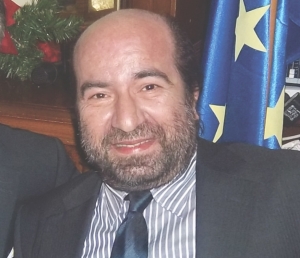
The maritime world of Piraeus mourns the loss of a pioneer and modest shipowner, Nikos Leventakis, who passed away very early at the age of 64.
He leaves behind his notable wife Evita Makryonitis and their two children Dimitris and Maria who are successfully active in shipping.
Nikos Leventakis had been leading the company Gregomar Shipping Agency for 40 years offering his valuable knowledge and expertise in shipping which was one of his many passions.
However, he was much more than just a great professional. He was a great man and those who were lucky enough to know him can certainly speak of his integrity, honesty, compassion and sense of humor.
It must be noted that Grecomar operates a state of the art fleet of bulk carriers with an energy efficiency capabilities consisting of handymax and supramax vessels.
In a recent interview to ELNAVI Nikos Leventakis, had commented that the shipping market fundamentals and his company’s initiatives to meet the environmental challenges.
He had predicted that the dry cargo market will remain strong due to the demanding framework of the decarbonization targets towards 2030.
As he had said: “Our fleet has been built according to the highest standards of safety and efficiency and are equipped with eco type engines”.
Nikos Leventakis had an excellent knowledge of the financial and technological requirements of shipping and he was very concerned and dedicated to his company's human workforce, on board an ashore.
He had also outlined: “At Grecomar we are committed to the principle “People first” investing enough time and resources to the continuous training of our crew.
We believe that seafarers must also be trained in new technology in order to achieve higher safety standards along with skills required to adapt to market trends”.
For Grecomar the sea environmental protection is crucial.
As he had pointed out: “Our company is committed to traditional shipping values powered by new ideas. This means that we care for the welfare and safety of our seafarers providing quality and efficient seaborne transportation services in the dry bulk sector.
We aim to maintain our 60-year reputation in shipping as one of the most reliable and consistent pure dry bulk shipping companies.
Therefore, our future efforts and initiatives will always be led by our passion and vision towards low and eventually zero carbon footprint and a more sustainable shipping environment”.
With these ideas, Nikos Leventakis was established as one of the most insightful and visionary shipowners who laid the foundations of the new era for Greek shipping.
Farewell Nikos Leventakis!!
ELNAVI Newsletter
More Information: ELNAVI,
19, Aristidou str., Piraeus 185 31,
Tel.: +30 210 45.22.100, e-mail: This email address is being protected from spambots. You need JavaScript enabled to view it.
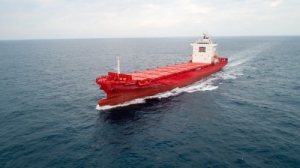
Three new-built containerships that were constructed in Hyundai Mipo Dockyard in S. Korea added to the fleet of Capital-Executive Ship Management Corp.
The company took delivery of the newbuildings C/V ‘Asterios’, C/V ‘Adamastos’ and C/V ‘Aias’, the first three of nine 1,827 TEU sister container vessels, each equipped with 355 refrigerated containers.
Through optimized hull lines and the application of cutting-edge technologies aimed at improving energy efficiency and reducing the environmental footprint, the 1,827 TEU container vessels C/V ‘Asterios’, C/V ‘Adamastos’ and C/V ‘Aias’, can achieve up to 65% lower energy consumption compared to older designs, 80% lower NOx emissions from the Tier III NOx catalyst, while they are also prepared to run on LNG in the future.
Capital-Executive Ship Management Corp. currently operates a fleet of 41 vessels including 35 container carriers and 6 modern bulk carriers with a total dwt of 2.95 million tons approx. and total TEU of 167,187. The fleet under management includes vessels of Nasdaq-listed Capital Product Partners L.P.
ELNAVI Newsletter
More Information: ELNAVI,
19, Aristidou str., Piraeus 185 31,
Tel.: +30 210 45.22.100, e-mail: This email address is being protected from spambots. You need JavaScript enabled to view it.
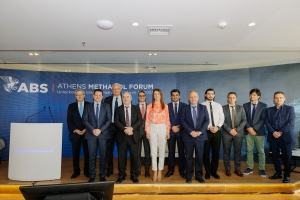
The role of methanol as shipping fuel was examined by ABS and leading members from the Greek shipping industry. An in-depth discussion of the potential of methanol as a marine fuel to support shipping’s decarbonization objectives, hosted by ABS under the title “Athens Methanol Forum: Unlocking the Value of Methanol”. The event brought together shipowners, operators, shipyards and equipment manufacturers for an afternoon of presentations and a panel discussion followed by an evening reception.
“ABS is committed to supporting the safe adoption of methanol by the industry and today’s event is an aspect of that. In this forum, we brought together a unique blend of the people, the companies and the regulators that can help us understand where we are, where we need to go and what must happen in order for long-term change to occur,” said Vassilios Kroustallis, ABS Senior Vice President, Global Business Development.
“Methanol is increasingly being recognized as a compelling alternative pathway for owners and operators. With practical benefits related to ease of storage and handling, tank-to-wake carbon intensity reduction, as well as a pathway to carbon neutrality through green methanol, methanol presents an immediate and promising solution,” said Panos Koutsourakis, ABS Vice President, Global Sustainability.
The Methanol Institute’s (MI) Rafik Ammar, Manager of Government and Public Affairs in Europe, joined the event, providing the latest information from the 34-year-old global trade association on methanol as fuel.
ABS specialists shared material on market trends for alternative fuels, existing and emerging technologies supporting methanol’s scale-up and the current regulatory framework around methanol. The agenda also included presentations from George Drossos, Head of Marine New Sales and Promotion from MAN; Dimitris Koliaroudakis, Director of Project Department from Technava; and Stamatis Achillas, Head of Business Development and Sales from Wartsila.
A panel discussion focused on the viability, advantages and roadblocks in the methanol pathway was led by ABS Business Development Manager Maria Kyratsoudi and featured Rafik Ammar; Loukas Barbaris, President, Safe Bulkers; and Panos Kourkountis, Technical Director, Sea Traders.
ELNAVI Newsletter
More Information: ELNAVI,
19, Aristidou str., Piraeus 185 31,
Tel.: +30 210 45.22.100, e-mail: This email address is being protected from spambots. You need JavaScript enabled to view it.
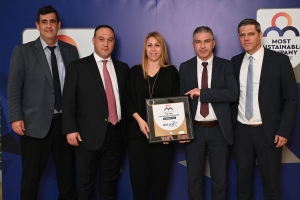
Attica Group, the parent company of SUPERFAST FERRIES, BLUE STAR FERRIES and HELLENIC SEAWAYS, received its distinction as ‘One of the top companies shaping the Business Map of Sustainable Development in Greece’ at the QualityNet Foundation’s ‘The most Sustainable Companies in Greece 2023’ event.
This distinction is awarded to companies that implement a holistic approach to Sustainable Development, which is systematically incorporated into their business operations, making them model companies in the Greek market.
Attica Group was evaluated based on the SUSTAINABILITY PERFORMANCE DIRECTORY – a technical business indicator for evaluating an organisation’s performance on Sustainable Development issues – and received distinctions in three categories:
- Sustainability Leaders
- Top Sustainable Companies
- Sustainable Companies
Companies are ranked based on three criteria:
- The Initiatives, Actions and Programmes they develop with regard to the Thematic Pillars of Sustainable Development.
- The Policies, Systems and Procedures they develop to support their Responsible Entrepreneurship.
- Their Disclosure of non-financial data.
This distinction acknowledges and rewards the Group’s commitment to ensuring that its business operations are based on transparency, accountability, sustainability and incorporation of environmental, social and governance (ESG) criteria into day-to-day operation, as well as its commitment for transition to a sustainable future in line with ESG standards.
Attica Group is engaged in passenger shipping through SUPERFAST FERRIES, BLUE STAR FERRIES, HELLENIC SEAWAYS and AFRICA MOROCCO LINK, operating 35 vessels providing modern, high-quality transportation services in Greece and abroad. Attica’s vessels serve 61 unique destinations in 4 countries, connecting 79 ports and transporting more than 6 million passengers, 1 million passenger vehicles and 500,000 trucks every year.
ELNAVI Newsletter
More Information: ELNAVI,
19, Aristidou str., Piraeus 185 31,
Tel.: +30 210 45.22.100, e-mail: This email address is being protected from spambots. You need JavaScript enabled to view it.