



-
Home

-
About Elnavi
- elnavi

elnavi
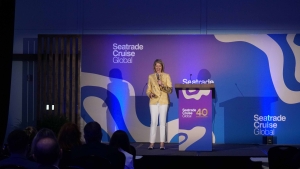
Theodora Riga, President of MedCruise and President of the Corfu Port Authority, delivered the Trends in the Med keynote presentation on April 8 during this year’s Seatrade Cruise Global in Miami.
MedCruise - Trends in the Med Presentation at Seatrade Cruise Global 2025 Theodora Riga, President of MedCruise and President of the Corfu Port Authority, delivered the Trends in the Med keynote presentation on April 8 during this year’s Seatrade Cruise Global in Miami. Her presentation offered a comprehensive overview of the latest developments shaping the cruise industry, with a focus on global, Mediterranean, and MedCruise-specific trends.
A standout insight from the presentation was that MedCruise ports account for 21.6% of all global cruise sailings. Additionally, it was revealed that 52% of cruise ships scheduled for delivery between 2025 and 2036 will be powered by alternative fuels — a strong indicator of the industry’s commitment to sustainability.
Turning to the Mediterranean region, The President noted that out of the 461 cruise ships expected to operate worldwide in 2025, 183 will be sailing in the Mediterranean — an increase of 11 ships from 2024.
MedCruise ports, in particular, have experienced a notable rise in activity. Cruise passenger movements grew by 9.23% from 2023 to 2024 and by 15.5% compared to 2019. Cruise calls also saw an upward trend, increasing 7.94% from 2023 to 2024 and 16.37% over the five-year period since 2019.
The President also shared detailed data on regional and national trends within the MedCruise network, highlighting the West Med as the top-performing region in both passenger numbers and cruise calls.
In addition, she outlined MedCruise’s strategic initiatives since the beginning of her mandate in September 2024. These include two upcoming General Assemblies — one in Cartagena, Spain this June, and another in Šibenik, Croatia in September. She also introduced projects such as the MedCruise Insider and highlighted the association’s growing visibility through increased communication efforts in international media and on social media, as well as MedCruise’s active participation in major cruise industry events.
The presentation concluded with a heartfelt thanks to the previous Board of Directors, Secretariat and former President for their contributions to MedCruise’s continued success.
About MedCruise: The Association of Mediterranean Cruise Ports.
The mission of MedCruise is to promote the cruise industry in the Mediterranean and its adjoining seas. The Association assists its members in benefiting from the growth of the cruise industry by providing networking, promotional, as well as professional development opportunities.
Established in Rome on the 11th of June 1996, by a collaborative agreement between 16 ports in seven different countries, the MedCruise membership spreads today in 22 countries and is located in three different continents, Africa, Asia and Europe. MedCruise represents more than 158 ports and 51 associate members.
ELNAVI Newsletter
More Information: ELNAVI,
19, Aristidou str., Piraeus 185 31,
Tel.: +30 210 45.22.100, e-mail: This email address is being protected from spambots. You need JavaScript enabled to view it.
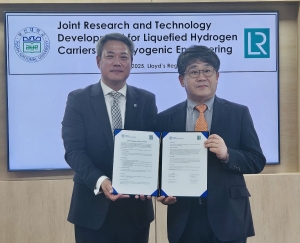
The partnership aims to advance liquefied hydrogen carrier technology, promoting sustainable and zero-emission maritime transport.
Lloyd’s Register (LR) has signed an agreement with the Hydrogen Ship Technology Center at Pusan National University (PNU) in Korea, forming an international partnership aimed at advancing liquefied hydrogen carrier technology and cryogenic engineering.
The Memorandum of Understanding (MoU), signed on 16 April at LR’s Busan Office, establishes a strategic collaboration focused on developing liquefied hydrogen as a clean and scalable energy source.
Through this new partnership, LR and PNU will collaborate across a wide range of activities, including joint research and technology development, the exchange of technical expertise, international academic cooperation, and shared policy development. The agreement represents a significant step forward in accelerating the commercialisation of liquefied hydrogen carriers and ensuring that they are designed, built and operated to the highest international safety and performance standards.
PNU, home to Korea’s first university-based institute specialising in eco-friendly ships, is helping to address the challenge. As the lead organisation behind the ‘Hydro Ocean K’ project, the world’s largest liquefied hydrogen carrier currently in development, the university is contributing to the future of zero-emission maritime transport.
Sung-Gu Park, President – North East Asia, Lloyd's Register, said: “We have taken an important first step towards the development of liquefied hydrogen carriers and cryogenic engineering technology. This agreement will serve as a significant turning point, allowing us to advance in the key areas of the future hydrogen economy through differentiated international exchange activities based on world-class cryogenic technology.”
Dr Jae-Myung Lee, Director of the Hydrogen Ship Technology Center, said: “The collaboration between our university and Lloyd's Register is a differentiated international exchange activity based on world-class ultra-low temperature technology. It will be an important turning point for further advancement in the utilisation of liquid hydrogen, a key field in the future hydrogen economy.
“We will make joint efforts to create synergies in the development of ultra-low temperature research, an unexplored field for human society.”
Picture caption: (left) Sung-Gu Park, President – North East Asia, Lloyd's Register); and (right) Dr Jae-Myung Lee, Director of the Hydrogen Ship Technology Center.
ELNAVI Newsletter
More Information: ELNAVI,
19, Aristidou str., Piraeus 185 31,
Tel.: +30 210 45.22.100, e-mail: This email address is being protected from spambots. You need JavaScript enabled to view it.
To ensure quantifiable numbers on how much CO₂ emissions Jotun coated vessel have avoided thanks to its coatings in 2024, DNV Maritime Advisory has performed a technical evaluation. With 11.1 million tons avoided CO₂ for its customers in 2024, the effect of Jotun’s Hull performance is proven and stands as a testament to Jotun’s Clean shipping commitment.
The avoided emissions for Jotun coated vessels were verified through a technical evaluation using the DNV MASTERv2 emission prediction model combined with AIS data and Jotun provided data on average speed loss over a 5-year drydocking cycle.
“We are happy to showcase the verified effect our efforts within hull performance have for our customers in terms of avoided emissions. This mean that we contribute to the environment with great significance, and we help preserve fuel worth approximately 2 billion USD for our customers,” said Morten Sten Johansen, Global Category Director Hull Performance in Jotun.
“To put it into context, the DNV verified numbers are the same as emitted emissions of more than 2.3 million gasoline-powered passenger vehicles driven for one year, estimated by EPA. And according to SSB (Statistics Norway) Norway’s total CO₂ emissions in 2023 was 38.1 million tons CO₂, so we are definitely making our mark. This says something about the perspectives and the enormous effect it has when prioritizing a clean hull.”
The 11.1 million tons avoided CO₂ emissions in 2024 for Jotun coated vessels is verified with a margin of ±2.1 million tons, and the calculation is based on average speed loss during the 4 last years of a 5-year dry-docking cycle, using the first year as reference and following ISO 19030.
Morten Sten Johansen in Jotun adds: “As a leader in our industry, our mission to preserve fuel, cut carbon emissions and protect biodiversity rests on the idea of ensuring clean hulls for the shipping industry. This evidence is inspiring us to continue our efforts towards a cleaner industry and we hope to inspire other stakeholders in the industry at the same time.”
ELNAVI Newsletter
More Information: ELNAVI,
19, Aristidou str., Piraeus 185 31,
Tel.: +30 210 45.22.100, e-mail: This email address is being protected from spambots. You need JavaScript enabled to view it.
The Signal Ocean Voyages API offers a deep dive into global versus U.S. port calls for both dry bulk and tanker vessels, providing valuable insights into which vessel size segments and commodity types are most exposed to recent policy developments. In light of these shifts, a critical question emerges: Is the U.S. shipbuilding industry truly positioned to play a pivotal role in the freight market at this moment?
The shipbuilding industry is a critical sector for the economic and geopolitical strength of any nation, especially when it intersects with commercial shipping and maritime power. In the age of globalisation and geo-economic competition, the relationship between the United States and China in the shipbuilding domain is marked by growing tensions, particularly regarding trade policies such as the imposition of port tariffs and duties on shipbuilding products.
The recent proposal by the U.S. Trade Representative (USTR) to impose substantial port fees on Chinese-built and Chinese-operated vessels is poised to significantly impact the global freight market. The proposed fees include charges of up to $1.5 million per port call for operators using Chinese-built ships and up to $1 million per port call for Chinese maritime transport operators. Additionally, operators with existing or pending orders from Chinese shipyards may face similar fees. Implementing these fees is expected to lead to increased operational costs for shipping companies, which will likely be passed on to consumers through higher freight rates. The World Shipping Council estimates that these fees could add approximately $600–$800 per container, effectively doubling the cost of shipping U.S. exports. This escalation in shipping costs may reduce the competitiveness of U.S. exports, potentially leading to decreased trade volumes and shifts in global trade patterns.
The U.S. Shipbuilding Industry: Limited in Scope, Strategic in Value
The United States has a rich history in shipbuilding, particularly in the military and domestic commercial sectors. The Jones Act of 1920—which requires that vessels operating between U.S. ports be built in the country, owned by American entities, and crewed by U.S. citizens—has long shielded the domestic industry from foreign competition. Yet despite this protection, America’s commercial shipbuilding capacity has shrunk dramatically. Today, only a handful of shipyards remain active, hampered by high construction costs and limited global competitiveness. Nevertheless, the sector remains strategically vital, deeply intertwined with national security and supply chain resilience.
China’s Commanding Lead in Global Shipbuilding
In contrast, China has emerged as the dominant force in global commercial shipbuilding, accounting for 45% of the dry bulk fleet’s newbuild orders, according to Signal Ocean data. This leadership is supported by substantial state subsidies, low labor costs, and an expansive industrial ecosystem. Chinese yards are renowned for their cost efficiency and rapid delivery times, attracting global demand—including from U.S. shipowners. Beyond hull construction, China also exports a wide array of ship components, from engines to maritime electronics, reinforcing its central role in the maritime supply chain. While Japan remains highly competitive in dry bulk construction (42%), South Korea leads the tanker segment with a 53% share—demonstrating regional specialisation and deliberate industrial policy. As of 2025, the global tanker fleet (VLCC, Suezmax, Aframax, Panamax, MR2, MR1) is approximately 6,000+ vessels. (as depicted in the image below) China accounts for 22% of the global tanker shipbuilding market, meaning roughly 1 in 5 tanker vessels in the current fleet is likely Chinese-built.
Prospects for a U.S. Shipbuilding Revival
Rebuilding the U.S. commercial shipbuilding sector presents formidable challenges. Currently, the United States accounts for just 0.13% of global commercial vessel production, while China, Japan, and South Korea together command more than 90% of the market. Further compounding this disparity, ship construction costs in the U.S. are estimated to be three to four times higher than in East Asia. Revitalising the domestic industry would demand large-scale investments in infrastructure, advanced manufacturing, and skilled labor development.
To bridge these capability gaps, strategic partnerships with established shipbuilding nations like South Korea and Japan have been suggested. However, overcoming the deeply rooted advantages of Asian competitors—bolstered by decades of industrial policy, scale, and specialisation—remains a significant hurdle.
Against this backdrop, the U.S. government is increasingly turning to geoeconomic tools such as port tariffs, signalling a broader departure from traditional free-trade principles toward a more interventionist industrial strategy. Bolstering the domestic shipbuilding base is now framed not just as an economic goal, but as a strategic imperative—central to national defense, supply chain security, and maritime sovereignty. This urgency is magnified by ongoing global instability, including the war in Ukraine and rising tensions in the Indo-Pacific.
Yet, tariffs alone will not restore America’s competitive edge in shipbuilding. Lasting progress will depend on sustained public and private investment, technological innovation, and a coordinated industrial policy that supports long-term capacity-building.
Implications for International Shipping and Global Trade
Increased tariffs on Chinese shipbuilding exports and potential port duties on Chinese-built ships could trigger significant disruptions in the global shipping system. Shipowners operating Chinese-built vessels may face higher costs to access U.S. ports, costs that are likely to be passed along the supply chain, contributing to higher transportation costs and inflationary pressures. Moreover, if China retaliates with reciprocal measures, it could restrict American companies' access to Chinese ports, leading to a realignment of trade flows and a deepening of economic decoupling between the two powers.
The Grain Impact
Increased Transportation Costs: The American Farm Bureau Federation estimates that proposed port fees could add between $372 million and $930 million in annual transportation costs for bulk agricultural exporters. This significant rise would erode the cost advantages that have traditionally helped U.S. farm products stay competitive in global markets. For example, the extra fees could increase the cost of shipping a bushel of soybeans—currently trading at $10.07—by as much as 27.75 cents. In commodities trading, where margins are razor-thin and often decided by just a few pennies per bushel, this would represent a serious blow to exporter profitability.
Reduced Export Competitiveness: As shipping costs climb, U.S. grain exporters may be forced to reduce their sale prices to remain competitive, thereby cutting into already tight profit margins. The financial strain could ultimately lower the volume of U.S. grain exports, especially as buyers shift to countries with lower transportation costs. Reports from exporters indicate that freight costs have surged by as much as 40%, making it increasingly difficult to secure bids for shipments of soybeans, corn, and wheat.
Impact on Farmers: This cost burden trickles down directly to American farmers, many of whom depend on international markets to sell their harvests. Without access to affordable freight, growers face the grim prospect of being priced out of global supply chains. The American Soybean Association has warned that these additional port fees could effectively shut U.S. soybeans out of export markets altogether, threatening the economic viability of farming operations across the Midwest and beyond.
Broader Economic Implications – Including Tanker Sectors: While the grain sector is most directly affected, the proposed port fee hikes could have ripple effects across the broader U.S. economy. The energy sector, for example, has voiced concern that rising transportation costs could undermine U.S. oil and gas exports. Tanker operators warn that increased fees may hamper efforts to solidify energy dominance by making U.S. shipments less competitive in the global marketplace. Likewise, the mining industry—another key user of bulk and tanker shipping—has flagged potential supply chain disruptions and higher export costs that could bring parts of the sector to a standstill.
Based on The Signal Ocean Voyages API data and in connection with the recent U.S. proposal to impose port fees of up to $1.5 million per call on Chinese-built ships, here's a comprehensive market impact analysis of U.S. port fees on Chinese-built vessels.
ELNAVI Newsletter
More Information: ELNAVI,
19, Aristidou str., Piraeus 185 31,
Tel.: +30 210 45.22.100, e-mail: This email address is being protected from spambots. You need JavaScript enabled to view it.
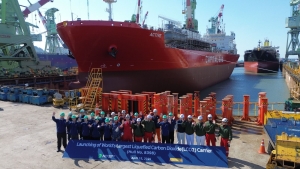
A unique milestone for Capital Clean Energy Carriers Corp. and for the CCUS (Carbon Capture, Utilization and Storage) and the shipping industry: the world's first 22,000cbm liquid CO2 carrier has been launched at HD Hyundai Mipo Co., Ltd. with expected delivery in January 2026!
The next generation of LCO2 carriers as HD Hyundai Mipo Co., Ltd. launches the hull of "Active" the first of its low-pressure vessels for Capital Clean Energy Carriers Corp.
Capital Clean Energy Carriers Corp., is one of the world’s leading platforms of gas carriage solutions with a focus on energy transition. CCEC’s in-the-water fleet includes 16 high specification vessels, including 12 latest generation LNG/Cs and four legacy Neo-Panamax container vessels, one of which we have agreed to sell within the first quarter of 2025. In addition, CCEC’s under construction fleet includes six additional latest generation LNG/Cs, six dual-fuel medium gas carriers and four handy liquid CO2/multi-gas carriers, to be delivered between the first quarter of 2026 and the third quarter of 2027.
ELNAVI Newsletter
More Information: ELNAVI,
19, Aristidou str., Piraeus 185 31,
Tel.: +30 210 45.22.100, e-mail: This email address is being protected from spambots. You need JavaScript enabled to view it.
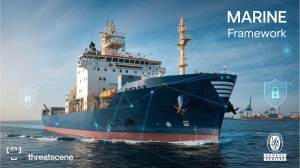
Bureau Veritas Marine & Offshore (BV), a global leader in testing, inspection, and certification services, has endorsed the MARINE framework, a comprehensive cybersecurity approach developed by ThreatScene SA, a leading provider of cybersecurity services.
The MARINE framework, developed by ThreatScene SA in partnership with the Hellenic Chamber of Shipping, was created to help the maritime industry tackle the growing challenge of cybersecurity threats. Designed as a practical, scalable, and easy-to-implement methodology, MARINE provides clear guidelines and best practices tailored specifically to the maritime sector, offering organizations an effective starting point for strengthening their cyber resilience across vessel operations, port infrastructure, and interconnected maritime systems.
The endorsement by Bureau Veritas recognizes MARINE as a valuable foundation for maritime organizations looking to build their cybersecurity capability in alignment with industry standards. To further support IT teams, the framework is available as a handbook, providing an accessible benchmark for maritime stakeholders seeking to implement cybersecurity best practices and navigate evolving threats.
ThreatScene SA also offers a free online self-assessment platform, enabling organizations to evaluate their cybersecurity maturity, compare their scores against industry peers, and receive a tailored gap analysis report. This report highlights key areas for improvement, helping companies prioritize security enhancements and develop a structured path toward cyber resilience.
As part of the endorsement agreement, ThreatScene SA will continue to update the framework, ensuring it remains aligned with the latest technological advancements, regulatory changes, and emerging cyber threats. This process will be overseen by BV, who will also work with ThreatScene to deliver workshops designed to assist in the revision of the framework (Rev2), incorporating IACS cyber regulations. This commitment reflects both organizations' dedication to supporting the maritime industry in addressing the ever-evolving cybersecurity landscape.
Katerina Tasiopoulou, CEO of ThreatScene Greece MAE, said: "We are honoured to receive the endorsement from BV, a globally respected leader in the maritime industry. This recognition underscores our commitment to delivering cutting-edge cybersecurity solutions that help maritime operators protect their critical assets. With our ongoing obligation to update the framework, we will continue to provide the industry with the tools needed to stay ahead of emerging threats."
Matthieu de Tugny, President of Bureau Veritas Marine & Offshore, said: “The MARINE cybersecurity framework is a valuable starting point for the Greek maritime market to address the evolving threat to cybersecurity. The framework provides a practical approach to help owners develop a robust cyber management plan that aligns with relevant industry standards and enhances the overall resilience of their operations”.
The endorsed framework is available for maritime operators, shipowners, and port authorities, offering
tailored guidance to address the unique cybersecurity challenges of the sector.
About ThreatScene Greece MAE: ThreatScene is a trusted cybersecurity partner, providing advanced security services to safeguard organisations against modern cyber risks. The company’s expertise spans across public and private sectors, critical infrastructure, maritime, and defense, ensuring compliance, resilience, and security in an ever-changing threat landscape.
About Bureau Veritas: Bureau Veritas is a world leader in inspection, certification, and laboratory testing services with a powerful purpose: to shape a world of trust by ensuring responsible progress. With a vision to be the preferred partner for customers’ excellence and sustainability, the company innovates to help them navigate change. Created in 1828, Bureau Veritas’ 84,000 employees deliver services in 140 countries. The company’s technical experts support customers to address challenges in quality, health and safety, environmental protection, and sustainability.
Bureau Veritas is listed on Euronext Paris and belongs to the CAC 40, CAC 40 ESG, SBF 120 indices and is part of the CAC SBT 1.5° index. Compartment A, ISIN code FR 0006174348, stock symbol.
ELNAVI Newsletter
More Information: ELNAVI,
19, Aristidou str., Piraeus 185 31,
Tel.: +30 210 45.22.100, e-mail: This email address is being protected from spambots. You need JavaScript enabled to view it.
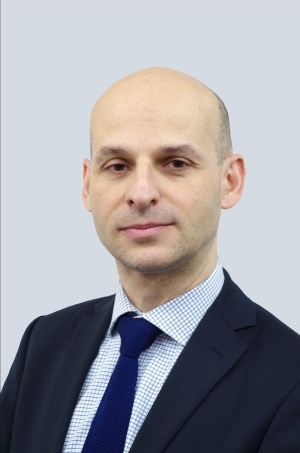
At last landmark MEPC 83 meeting, the International Maritime Organization (IMO) Member States assumed responsibility and agreed on a medium-term greenhouse gas reduction measure that differs from the levy-based approach INTERCARGO and industry partners have advocated for many years.
INTERCARGO Secretary General, Kostas Gkonis commented, “INTERCARGO is concerned about the complexity of the measure taken forward by IMO, disregarding calls for a simple, practical and therefore predictable, enforceable, and effective approach.”
He continued, “Despite these challenges, our Association remains committed to supporting the IMO process and its implementation. We will make every effort to help the industry progress toward the fair and practical transition required for international shipping and the dry bulk sector.”
INTERCARGO will continue providing constructive input to IMO as this work progresses, aligned with IMO's ambition to achieve decarbonisation goals for international shipping as the global regulator. Our industry needs global solutions that are transparent and simple to administer, especially for the small and medium-sized companies that form its backbone, rather than fragmented regional measures.
Nevertheless, INTERCARGO welcomes the progress made by Member States in reaching a decision at IMO. As the voice of the dry bulk shipping sector—the largest by number of vessels and deadweight tonnage, with bulk carriers serving as the backbone of international tramp shipping—INTERCARGO remains committed to supporting the IMO's efforts toward a just and effective energy transition.
About INTERCARGO
International shipping is vital for the global economy and prosperity as it transports approximately 90% of world trade. The dry bulk sector is the largest shipping sector in terms of number of ships and deadweight. Dry bulk carriers account for 43% of the world fleet (in tonnage) and carry an estimated 55% of the global transport work.
The International Association of Dry Cargo Shipowners (INTERCARGO) unites and promotes quality dry bulk shipping, bringing together more than 260 forward thinking companies from 30 countries. INTERCARGO convened for the first time in 1980 in London and has been participating with consultative status at the International Maritime Organization (IMO) since 1993. INTERCARGO provides the forum where dry bulk shipowners, managers and operators are informed about, discuss, and share concerns on key topics and regulatory challenges, especially in relation to safety, security, the environment, and operational excellence. The Association promotes its members’ positions to IMO, as well as to other shipping and international industry fora, having free and fair competition as a principle.
ELNAVI Newsletter
More Information: ELNAVI,
19, Aristidou str., Piraeus 185 31,
Tel.: +30 210 45.22.100, e-mail: This email address is being protected from spambots. You need JavaScript enabled to view it.
Aegean Protective Coatings S.A. and PPG Introduce Cutting-Edge Electrostatic (ESTA) Technology in Greek Shipyards
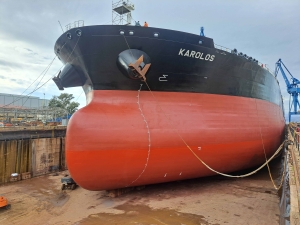
Aegean Protective Coatings S.A., representative of PPG in Greece, has successfully completed a pioneering coating project during the dry docking of the 150K DWT crude oil tanker Karolos of Dynacom Tankers Management Ltd. at Skaramangas Shipyards in December 2024.
During the dry docking, the hull of M/T Karolos was coated with PPG SIGMAGLIDE 2390, a premium high-performance silicon-based fouling release system designed to enhance vessel efficiency by reducing drag and fuel consumption. Notably, this project marked the first-ever application with the use of Electrostatic (ESTA) technology in a Greek shipyard, demonstrating Aegean Protective Coatings’ commitment to bringing innovative solutions to the maritime industry.
The Field Technical Service Team of Aegean and PPG played a critical role in the execution of this project, with eight specialized technicians overseeing and ensuring the optimal application of the coating system. The project was carried out in collaboration with Coral Piraeus Ship Repair, the subcontractor responsible for the coating process.
PPG Sigmaglide 2390 is a durable and extremely long-lasting biocide free, foulin release coating that can help vessels achieve instant power savings of up to 20% with a speed loss performance of less than 1%. It does this whilst also allowing the customer to profit from a considerable reduction in long-term maintenance costs. By lowering vessel emissions by up to 35%, PPG Sigmaglide 2390 can make it significantly easier to meet IMO GHG targets, EEXI and EEDI ratings, and CII compliance.
ESTA technology represents a significant advancement in marine coatings application, allowing for superior paint adhesion, reduced material waste, and improved environmental sustainability. By utilizing an electrostatically charged spray method, the technique ensures a more uniform and efficient coating application compared to traditional methods.
With this pioneering project, Aegean Protective Coatings S.A. reaffirms its dedication to promoting PPG’s revolutionary marine coatings applications in Greece and paving the way for more efficient and environmentally friendly dry docking practices, bringing benefits to owners, operators and shipyards.
About Aegean Protective Coatings
Aegean Protective Coatings S.A. is the long-standing representative of PPG Coatings in Greece, providing innovative and high-performance coating solutions for the maritime industry. Through close collaboration with PPG, Aegean Protective Coatings S.A. delivers cutting-edge technology and technical expertise to shipowners and operators.
About PPG
PPG is a global leader in paints, coatings, and specialty materials. With a strong commitment to innovation, sustainability, and performance, PPG’s Protective and Marine Coatings Business delivers state-of-the-art solutions designed to extend the service life of assets and enhance operational efficiency. www.ppgpmc.com
ELNAVI Newsletter
More Information: ELNAVI,
19, Aristidou str., Piraeus 185 31,
Tel.: +30 210 45.22.100, e-mail: This email address is being protected from spambots. You need JavaScript enabled to view it.
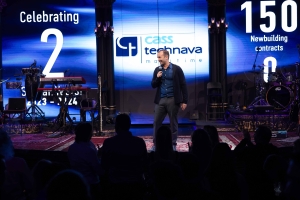
Cass Technava, the prominent Greek-Asian shipbroking company based in Athens, marked an exceptional milestone in its history with a lavish celebration. On Wednesday, March 5th, the company hosted an elegant event to commemorate two remarkable years of success. This milestone included an impressive 150 newbuilding contracts signed over the past two years and 75 second-hand vessel deals. The evening was an embodiment of the company’s achievements, drawing a distinguished crowd of prominent figures from the shipping industry.
The highlight of the event was a stunning live performance by Greek pop icon Anna Vissi, who serenaded the A-list audience of shipowners and industry leaders. Among the guests were some of the most influential figures in the maritime sector who all share a long-term friendship with the Tomazos family.
Among the company’s key achievements are surpassing the 500-newbuilding mark in 2022, and being awarded the prestigious "Shipbroker of the Year" title three times by Lloyd's List (2010, 2015, and 2023). It is remarkable that particularly since 2015 one out of six of all Greek newbuilding’s have been brokered by Cass Technava.
The managing director of Cass Technava, Fedon Tomazos and his team seem to indeed share a unique relationship with the top shipyards of China and Korea and Greek owners recognize that by choosing them for their newbuilding expansions whereas they often package their deals with financing from local lessors.
ELNAVI Newsletter
More Information: ELNAVI,
19, Aristidou str., Piraeus 185 31,
Tel.: +30 210 45.22.100, e-mail: This email address is being protected from spambots. You need JavaScript enabled to view it.
2nd Maritime Security Conference
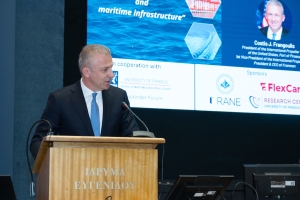
The 2nd Maritime Security Conference, titled “Threats to Maritime Trade and Maritime Infrastructure”, was held with strong attendance on Wednesday, April 2nd, at the Eugenides Foundation.
The conference was a joint initiative of the Propeller Club, Port of Piraeus, the Council for International Relations-Greece and the Foreign Affairs Institute, in cooperation with the School of Maritime and Industrial Studies at the University of Piraeus and the Mackinder Forum.
In 5 focused panel discussions, industry experts explored critical challenges and emerging threats to maritime trade and infrastructure—an issue more relevant than ever.
Among others, addresses were delivered by the Minister of Maritime Affairs & Insular Policy, Mr. Vassilis Kikilias, former European Commissioner and former Minister, Mr. Dimitris Avramopoulos, and the Chief of the Hellenic Navy General Staff, Vice Admiral Dimitrios-Eleftherios Kataras.
ELNAVI Newsletter
More Information: ELNAVI,
19, Aristidou str., Piraeus 185 31,
Tel.: +30 210 45.22.100, e-mail: This email address is being protected from spambots. You need JavaScript enabled to view it.