




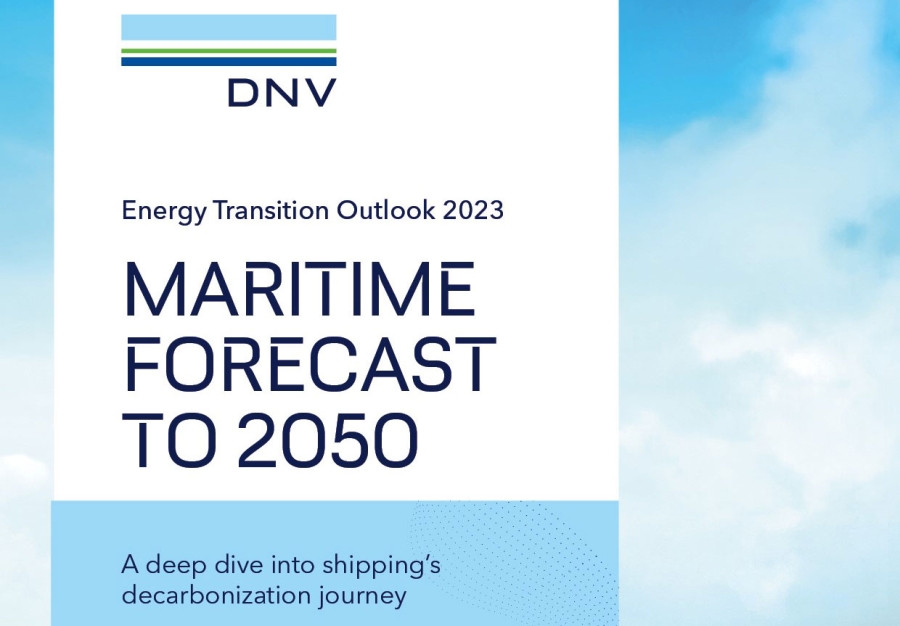
Faced with tough competition for greener fuels from other sectors, new 2030 maritime emission targets hang in the balance. According to the latest edition of DNV‘s Maritime Forecast to 2050 the shipping industry will find it challenging to secure enough supply of carbon-neutral fuels. The report emphasizes the need to consider all alternative approaches to reducing emissions and to take action now to secure future success.
Increasing regulatory pressure to decarbonize, including stricter targets set by the International Maritime Organization (IMO) this July, means the shipping industry now needs to achieve a 20% reduction in emissions by 2030 and net-zero emissions by or around 2050. To meet the anticipated demand of 17 million tonnes of oil equivalent (Mtoe) annually by 2030, the maritime sector needs to access a staggering 30-40% of the projected worldwide carbon-neutral fuel supply. Shipowners must therefore focus beyond fuels, in particular on what can be done now to achieve energy efficiencies and carbon emission reductions.
Knut Ørbeck-Nilssen, CEO DNV Maritime, said: “The 2020s marks the decisive decade for shipping. Securing greener fuel supply is critical. However, focusing on fuels alone can distract us from making an impact this decade and ambitious future declarations are not good enough. What we need is tangible actions that will reduce emissions. Energy efficiency measures can deliver decarbonization results now and towards 2030.”
The Maritime Forecast to 2050 presents an updated look on a range of regulations and drivers for the decarbonization of shipping, the most important being new IMO regulations, the inclusion of shipping in the European Union’s (EU) Emissions Trading Scheme and incoming well-to-wake requirements. These regulations will increase the operational cost of using carbon fuels, incentivising shipowners to put plans in place today to reduce their carbon output.
“Our latest report outlines several energy efficiency measures that can deliver decarbonization results now. It emphasises the need for the maritime sector to adopt a holistic approach to ensure a strong evolution of regulations and technologies, as well as long-term security of fuel supply,” said Eirik Ovrum, Principal Consultant in DNV Maritime, and Lead Author of the Maritime Forecast.
To overcome decarbonization challenges, the sector can adopt operational energy efficiency measures such as air lubrication systems and wind assisted propulsion. The latter has already been installed on 28 large vessels, delivering fuel savings of between 5-9% to date. The potential when retrofitted on existing ships can reach 25%.
In addition, technologies such as onboard carbon capture and storage and nuclear propulsion can address the competition for sustainable biomass and renewable electricity. The report presents an economic analysis of both options through detailed case studies that can help stakeholders make informed decision around these technologies.
Other findings include that a fuel technology transition is already underway, with half the ordered tonnage capable of using liquefied natural gas (LNG), liquefied petroleum gas (LPG), or methanol in dual-fuel engines, compared to one third of the tonnage on order last year. For ships in operation, 6.5% of tonnage can now operate on alternative fuels, compared to 5.5% last year. The uptake of methanol and LPG is also starting to show in the statistics together with the first hydrogen-fuelled newbuilds. There are currently several ongoing demonstration projects for ammonia-fuelled ships, and a growing pipeline of ammonia-fuelled ships soon to hit the order book.
About DNV Maritime: DNV is the world’s leading classification society and a recognized advisor for the maritime industry. We enhance safety, quality, energy efficiency and environmental performance of the global shipping industry – across all vessel types and offshore structures.
We invest heavily in research and development to find solutions, together with the industry, that address strategic, operational or regulatory challenges.
For more information visit: www.dnv.com/maritime
About DNV: DNV is the independent expert in risk management and assurance, operating in more than 100 countries. Through its broad experience and deep expertise DNV advances safety and sustainable performance, sets industry benchmarks, and inspires and invents solutions.
Whether assessing a new ship design, optimizing the performance of a wind farm, analyzing sensor data from a gas pipeline or certifying a food company’s supply chain, DNV enables its customers and their stakeholders to make critical decisions with confidence.
Driven by its purpose, to safeguard life, property, and the environment, DNV helps tackle the challenges and global transformations facing its customers and the world today and is a trusted voice for many of the world’s most successful and forward-thinking companies.
For more information visit: www.dnv.com
ELNAVI Newsletter
More Information: ELNAVI,
19, Aristidou str., Piraeus 185 31,
Tel.: +30 210 45.22.100, e-mail: This email address is being protected from spambots. You need JavaScript enabled to view it.