


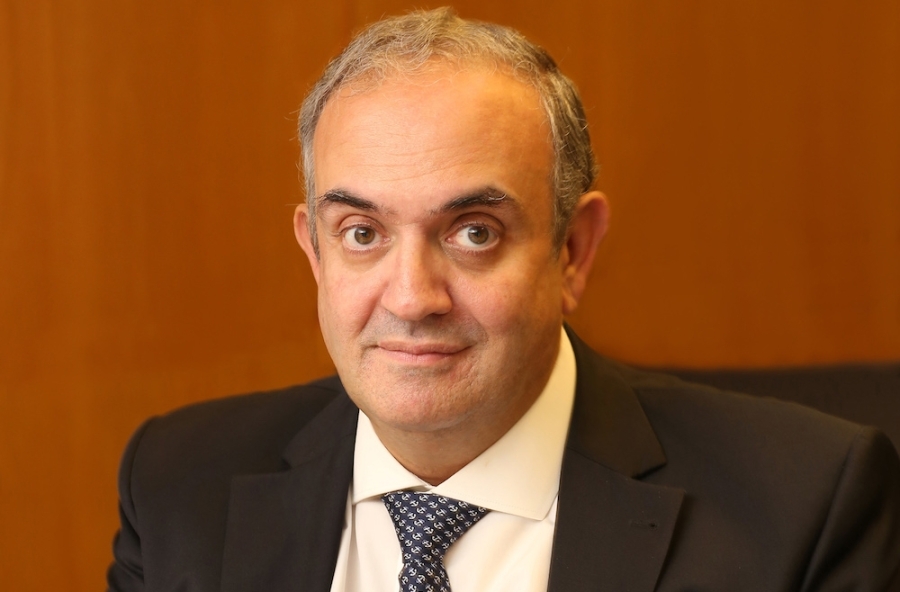
In presenting the latest Greek Shipping Co-operation Committee Annual Report 2023-2024 the chairman of GSCC Mr. Haralambos J. Fafalios referred to the following critical issues: “Whilst the War in Ukraine seems no nearer to conclusion, the Gaza conflict and its effect on the Red Sea have made a very significant change to world trade as shipping avoids that area thus shunning the Suez Canal.
The increase in tonne-miles is very significant especially for the container, bulk and tanker sector.
Whilst it was felt that the Chinese economy was moving uncertainly, the imports of cargo into China have been larger than ever and demand has held up appropriately.
This year, being a time when over 60% of the world is having elections, we have had varying unusual results around the globe. Russia remained the same, South Africa realized that change was necessary, Europe has moved significantly to the right, the U.K. will move to the left and America has a choice of candidates whose policies are well known and are unlikely to change much.
However, this does not mean that a growing world population does not need to engage further in world trade in order to house, feed and equip all these people. Climatically the Panama Canal seems to be slowly recovering but world shipping is still doing its best to compensate from disruption caused by longer port stays and less efficient infrastructure systems.
Whilst global economic prospects seem more stable, interest rates are not subsiding and remaining at relative high levels.
Looking at the specific markets, the Tanker sector had a very acceptable and lucrative year.
The Container market, which started the year in a bit of a subdued state is now doing very well with little overcapacity, significant port delays and much higher freight rates.
Whilst the L.N.G. sector remained stable, the L.P.G. market enjoyed its best ever year over the last 12 months.
The Car Carrier market is still very active, even with an ever-growing orderbook.
Whilst the Dry Bulk market has improved from last year, it is not doing as well as the orderbook would suggest. It is still at the mercy of a volatile FFA market and this suffers large fluctuations on an irregular basis.
Within this environment, the Greek Merchant fleet has been significantly selling older tanker and bulk carriers and ordering large numbers of newbuildings.
The orders are mainly for tankers large and small, larger bulk carriers and a fair number of gas carriers, both L.P.G. and L.N.G.
Since the global container orderbook is already at very high levels, the Greek orderbook has not substantially increased this year.
The Greek Fleet, being among the two largest in the world, is being renewed with a combination of high technology newbuildings as well as a fair number of dual-fuel ready ships.
Yet again, the fleet average age is falling and its GHG efficiency is rising. By virtue of its predominant position in the tramp shipping market, the Greek merchant fleet is always the first to adapt to changing global requirements and takes heed of all new regulations, whether global or regional. It is very important to stress that the Greek fleet represents over 60% of the total EU tonnage and that it is strategically vital to meet the EU’s needs.
With this in mind, we stress the importance of supporting the global marine regulator, the IMO, which has to take a practical and balanced attitude to all legalisation, as opposed to some of the more political elements of some regional legislators which do not have the knowledge to see the bigger picture.
The G.S.C.C. itself is always at the forefront of keeping its members closely informed of all these developments and lobbying at the highest levels in order to bring about a coherent legislative program.
The increase in tonne-miles is very significant especially for the container, bulk and tanker sector.
Whilst it was felt that the Chinese economy was moving uncertainly, the imports of cargo into China have been larger than ever and demand has held up appropriately.
This year, being a time when over 60% of the world is having elections, we have had varying unusual results around the globe. Russia remained the same, South Africa realized that change was necessary, Europe has moved significantly to the right, the U.K. will move to the left and America has a choice of candidates whose policies are well known and are unlikely to change much.
However, this does not mean that a growing world population does not need to engage further in world trade in order to house, feed and equip all these people. Climatically the Panama Canal seems to be slowly recovering but world shipping is still doing its best to compensate from disruption caused by longer port stays and less efficient infrastructure systems.
Whilst global economic prospects seem more stable, interest rates are not subsiding and remaining at relative high levels.
Looking at the specific markets, the Tanker sector had a very acceptable and lucrative year.
The Container market, which started the year in a bit of a subdued state is now doing very well with little overcapacity, significant port delays and much higher freight rates.
Whilst the L.N.G. sector remained stable, the L.P.G. market enjoyed its best ever year over the last 12 months.
The Car Carrier market is still very active, even with an ever-growing orderbook.
Whilst the Dry Bulk market has improved from last year, it is not doing as well as the orderbook would suggest. It is still at the mercy of a volatile FFA market and this suffers large fluctuations on an irregular basis.
Within this environment, the Greek Merchant fleet has been significantly selling older tanker and bulk carriers and ordering large numbers of newbuildings.
The orders are mainly for tankers large and small, larger bulk carriers and a fair number of gas carriers, both L.P.G. and L.N.G.
Since the global container orderbook is already at very high levels, the Greek orderbook has not substantially increased this year.
The Greek Fleet, being among the two largest in the world, is being renewed with a combination of high technology newbuildings as well as a fair number of dual-fuel ready ships.
Yet again, the fleet average age is falling and its GHG efficiency is rising. By virtue of its predominant position in the tramp shipping market, the Greek merchant fleet is always the first to adapt to changing global requirements and takes heed of all new regulations, whether global or regional. It is very important to stress that the Greek fleet represents over 60% of the total EU tonnage and that it is strategically vital to meet the EU’s needs.
With this in mind, we stress the importance of supporting the global marine regulator, the IMO, which has to take a practical and balanced attitude to all legalisation, as opposed to some of the more political elements of some regional legislators which do not have the knowledge to see the bigger picture.
The G.S.C.C. itself is always at the forefront of keeping its members closely informed of all these developments and lobbying at the highest levels in order to bring about a coherent legislative program.
Decarbonization
The frustration felt by the tramp shipping sector which makes up the majority of the world fleet, is very visible as no global, definitive solutions are found to the decarbonization goal.
A multitude of different fuels with no global bunkering network and a still high well to wake carbon footprint makes the decision of which way to jump nigh on impossible.
However, in the meantime, technically sophisticated Owners are adopting all the latest hull and machinery innovations to make the world fleet’s footprint even greener.
Whilst ETS and CII have been shown to be unfit as incentives, a straight forward Fuel Levy, albeit re-named so as to be mutually acceptable, will still be the best way to bring about our 2040 and 2050 goals.
ESG
Apart from quantifying the carbon emissions and discussing a company’s program for decarbonization, most, if not all, well-run shipping companies have carried out these tasks on their own in an efficient, well-organized manner for many years. They have quietly carried out their ESG obligations without fanfare!
Rightship
This organization will not move forward if it does not increase its transparency and accountability. Otherwise, it just adds a layer of bureaucracy without significantly improving the safety of seafarers and ships. Flag, Class, and Port State already carry out all of these tasks in a professional and maritime manner with decades, not to say centuries, of experience.
Maritime Education in Greece
We continue to stress the importance of a vibrant public and privately funded maritime education sector in Greece. It is a crucial element in the Greek Maritime cluster, and without it, Greece will not remain the epicentre of global ship management.
As the Greek fleet itself continues to become more sophisticated, and Greek companies invest in more and more ship types, it is imperative to be able to man them with Greek officers and crew.
The government must legislate for the creation of privately run schools to flourish and more investment in state-funded schools. Particular problems to be addressed are the low numbers and pay of the teaching staff in the Greek maritime academies. These are stifling the number of entrants annually.
G.S.C.C. Role and Liaisons
One of the greatest strengths of the Greek shipping industry over the last half-century has been the close relationship between the Greek Shipping industry and the Ministry of Maritime Affairs and Island Policy, the Hellenic Coast Guard, and, of course, the Government itself.
Not undermining the progress already made towards the digitalization and the reduction of bureaucracy, we urge the Greek Ministry of Maritime Affairs and Island Policy to drastically reduce the bureaucratic burden involved with vessels flying the Greek Flag or it will lose its significance for Greek Managed Shipping. Actions are needed and not just promises.
Without the appreciation of how strong this link is, the Greek maritime cluster would not be as prominent as it is, and shipping would not hold the position of Greece’s second most important export industry. The link must be maintained going forward to guarantee a vibrant maritime sector.
Apart from its close and warm links with the Union of Greek Ship Owners in Greece, the G.S.C.C. prides itself on maintaining a close dialogue with all major international maritime organizations, such as the I.M.O., I.C.S., INTERCARGO, INTERTANKO, BIMCO, the EU, national governments, MEPs and the International Group of P&I Clubs. We have P&I Club Chairmen and Directors on our Council.
Our relationship with senior IACS members is also very close, not least due to our presence as individual members on the boards of many National and International Committees of leading Classification Societies. We also work together with them to press for ever higher vessel standards in construction and operation.
Being based in London gives us the opportunity to keep close contact with the IMO, the Baltic Exchange (the world’s leading shipping indices provider), the UK Chamber of Shipping, Maritime London, and other London-based organizations.
We look forward again to LISW 2025.
Finally, I would like to thank our Member Offices for their support, the Council, and the Secretariat for their hard work. Their efforts allow us to continue keeping our membership well-informed and lobby on a global basis in favour of positive practical legislation. When legislation is negative, we make our opinion very well-known, backing it up with well-reasoned arguments.
I am particularly grateful to our Vice-Chairmen, Constantinos Caroussis, John M. Lyras and Nikolas P. Tsakos, our Honorary Chairman Epaminondas Embiricos, our Honorary Vice Chairman Spyros Polemis our Treasurer Diamantis Lemos and Deputy Treasurer Dimitri Frank Saracakis.
Sadly, this year we lost one of our most distinguished colleagues and friend, Stathes Kulukundis. Stathes served the G.S.C.C. with great distinction for over 40 years and in that time represented Greek Shipping at the highest levels. We will miss his presence immensely.
My special thanks go to John Hadjipateras, George Embiricos, Filippos Lemos, Alex Hadjipateras and Basil Mavroleon, without whom our monthly reports and other documents would not be as professionally prepared as they are.
Our technical subcommittee headed by Dimitri Monioudis has proven extremely popular and effective, with active participation by senior technical officers of member companies in the U.K. and Greece, as well as achieving wider input from our extensive contact network within the global maritime community (e.g., classification societies, consultants, shipbuilders and propulsion manufacturers).
Our Director, Konstantinos Amarantidis, assisted by Maria Syllignaki and Vasso Giadikiaroglou continues to run the Committee smoothly and very professionally and I thank them for their sterling efforts.
As always, I wish to thank all the seafarers in the world, whose perseverance and sacrifice during these difficult times has been legendary. Without them, world seaborne trade would not be able to take place in the efficient and seamless way that exists today”.
ELNAVI Newsletter
More Information: ELNAVI,
19, Aristidou str., Piraeus 185 31,
Tel.: +30 210 45.22.100, e-mail: This email address is being protected from spambots. You need JavaScript enabled to view it.