



.jpg)
.jpg)
.jpg)
.jpg)
.jpg)
 (1).jpg)
 (1).jpg)
.jpg)
.jpg)
.jpg)
.jpg)
 (1).jpg)
.jpg)
.jpg)
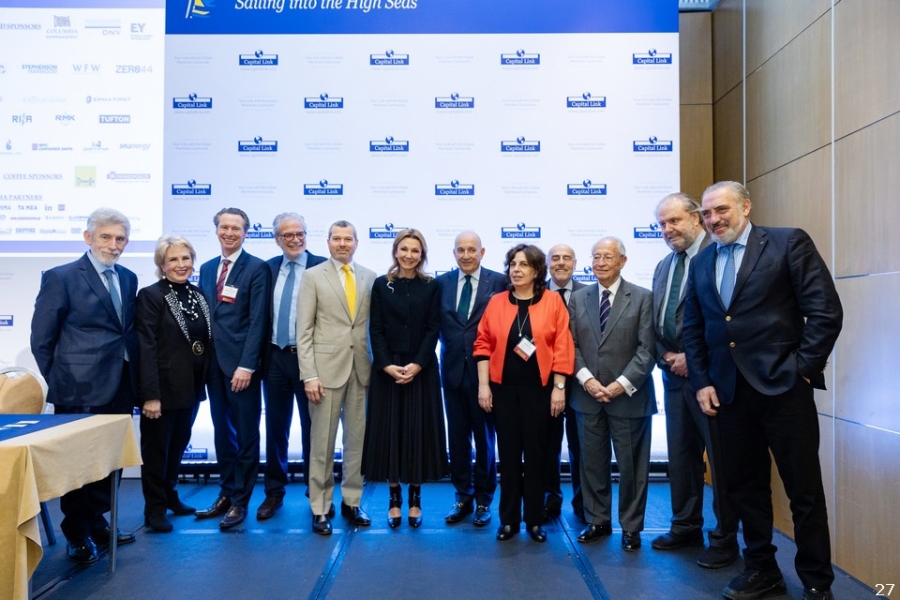
The 14th Annual Capital Link Greek Shipping Forum titled “Sailing into the high seas” was held with great success in Athens on Thursday, February, 8, 2024, at the Athenaum Intercontinental Hotel. The event was organized in cooperation with New York Stock Exchange and Nasdaq. Tsakos Energy Navigation – TEN Ltd. was the Lead Sponsor.
With attendance exceeding 1,000, the event featured the institutional and industry leadership of global and Greek shipping, and it has thus been rightly labeled as an unofficial Summit of Global Shipping. The significant topics and pressing issues discussed at the forum included the current trends and outlook of the global economy and the main commodity, energy and shipping markets, the opportunities that lie ahead and strategies to compete in an increasingly complex and demanding world, geopolitical and regulatory developments, compliance with decarbonization targets, trade sanctions geopolitical tensions, the transformational impact of technology, and Maritime Finance and overall access to capital sources.
The Forum was attended by prominent figures including Mr. Arsenio Dominguez, Secretary General - International Maritime Organization (IMO), H.E. Christos Stylianides, Minister of Insular Policy & Shipping - Hellenic Republic, Mrs. Melina Travlos, President of the Union of Greek Shipowners (UGS); Chair of the Board of Neptune Lines, Mrs. Fotini Ioannidou, Head of Unit, Directorate-General for Mobility and Transport – European Commission, Mr. Nikolaus Schües, President & Chairperson of the Board – BIMCO ; CEO - Reederei F. Laeisz, Mr. Dimitris Fafalios, Chairman – INTERCARGO; President/Director - Fafalios Shipping S.A., Mr. Emanuele Grimaldi, Chairman – INTERNATIONAL CHAMBER OF SHIPPING; President & MD - Grimaldi Euromed SpA; Managing Director – Grimaldi Group, Mr. Paolo d’Amico, Chairman – INTERTANKO; Chairman & CEO - d'Amico International Shipping SA, the CEOs of major classification societies, Mr. Knut Orbeck Nilssen - DNV Maritime, Mr. Nick Brown - Lloyds Register and Mr. Ugo Salerno – RINA.
Mr. Nicolas Bornozis, President – Capital Link, Inc., welcomed and thanked all participants for joining, and all of the forum’s sponsors for their contribution to organization of the conference, as well as all the Supporting Organizations and Media Partners for their participation and support. Mr. Bornozis emphasized that the conference provides a unique opportunity for the discussion of the most critical issues concerning both the Greek and international shipping industry. He stressed that the 14th Annual Greek Shipping Forum is taking place during a prosperous period for both shipping and the markets despite significant challenges. The forum has been called an informal summit of the institutional and industry leadership of Greek and Global Shipping, and we are honored to have prominent decision makers with us here today. I would like to welcome the Greek Minister of Maritime Affairs & Insular Policy, Mr. Christos Stylianides, the Secretary General of IMO, Mr. Arsenio Dominguez, the President of Union of Greek Shipowners (UGS) and Chair of the Board of Neptune Lines, Ms. Melina Travlos, and Ms. Fotini Ioannidou, Acting Director - EUROPEAN COMMISSION, DG for Mobility & Transport, as well as the heads of the four industry organizations – BIMCO, ICS, INTERCARGO & INTERTANKO, the heads of major classifications societies – DNV, Lloyds Register, RINA, the global heads of shipping of major international banks, and many more prominent speakers.
THE EFFECT OF REGULATIONS ON SHIP SUPPLY – Presentation
Dr. John Kokarakis, Technical Director, SEEBA Zone - Bureau Veritas stated: “Ships are as old as humanity itself. Over four fifths of the trade of the world is flowing through the high seas. As maritime trade expanded so did maritime regulations. Their historical evolution serves as a testament to the industry’s adaptability in the face of a multitude of challenges. Regulations increase risk, as complexity imposes uncertainty, and any changes may devalue one’s fleet. Consequently, compliance is time-consuming and resource-intensive, progressively increasing the cost of production. Fuel selection will be critical, as we transition to zero-carbon, in an effort to reduce shipping’s environmental impact.
In 2023, the global shipbuilding industry witnessed a dynamic year, with IMO’s regulations, which are well-intended but not perfect, being a major driver. Ship owners need to invest in new technologies and processes to meet the new standards. Thankfully, the EU has committed to updating the requirements if the IMO measures, when introduced, are in line with its objectives.”
EU EMISSIONS TRADING SYSTEM (ETS) – THE CARBON EMISSIONS PRICE TAG FOR SHIPPING
Moderator: Ms. Alexia Hatzimichalis, Partner, Athens Office Head – Watson Farley & Williams
Panelists: Mr. Stamatis Fradelos, Vice President, Regulatory Affairs – ABS, Mr. Vasileios Tsiamis, Associate Partner – EY, Dr. Arlie Sterling, Co-Founder & President – Marsoft, Ms. Friederike Hesse, CoFounder and MD - ZERO44
Ms. Alexia Hatzimichalis, Partner, Athens Office Head – Watson Farley & Williams, stated: “Thank you Capital Link for inviting me. Each of the panelists will tell us how they are helping clients reach their goals in the new landscape of the EU emissions trading system in order to ensure accurate reporting and compliance.”
Mr. Stamatis Fradelos, Vice President, Regulatory Affairs – ABS, stated: “When looking at data it is important for us to make our own calculations to make sure they are indeed correct. A few years ago, we looked at the regulations and studied them, to better inform clients on the preparations that will be need from their side. We used data to create digital tools that come up with calculations in only a few minutes. Our website provides the option for owners to enter the details of their ships and get an estimate of the cost. We engage with additional partners and collaborators to achieve maximum transparency.”
Mr. Vasileios Tsiamis, Associate Partner – EY, stated: “Innovation is the answer. I have experienced, in Brussels, the integration of different sectors at the European level. Regulations and directives are not meant to be kept the same for life, but rather to be improved. ETS for the shipping sector is not just a regulation. It is difficult to follow but also an opportunity to access funds and make fleets greener. 800 million euros are dedicated for that purpose.”
I’ve seen two types of shipping companies: those that still resist reality and others that are well-prepared and ready to initiate innovation. As a whole, the sector isn’t that well prepared mentally. My advice is to try to assess a roadmap for greening the fleets, whether it be alternative fuels, electrification, zero emission engines and so on. I encourage you to dare to change.”
Dr. Arlie Sterling, Co-Founder & President – Marsoft, stated: “Gathering so many shipowners at nine in the morning is an extraordinary achievement, congratulations everyone. How do we prepare reports? How do we ensure accurate data? That’s where the focus should be. Then, once you figure out how to do the reporting, it becomes about how to use the mechanism to become more competitive and differentiate from other fleets. One good way to become a winner right away is to retrofit ships and take advantage of low-hanging fruit solutions.”
I would encourage owners to have a conversation with providers and servicers to ensure that no days are lost due to a lack of compliance from their part. We’ve also seen the reputational impact and the fact that quality control and full transparency is becoming critical to achieve premium pricing.”
Ms. Friederike Hesse, CoFounder and MD - ZERO44, stated: “Our company helps you comply with EU ETS and better understand the cost that comes along with it. We work for owners, charterers, and ship managers. Our software is in essence an accounting system that helps you keep track and follow the money, as well as understand potential benefits.
It is a step-by-step process. The first thing is making sure the data is ready, so we can understand the exposure’s extent. The second step would be to get the contracts straight and agree on who’s doing what: who’s paying, who’s invoicing, who’s trading. EU companies need to be a frontrunner in this transition, betting on a long-term strategic perspective.”
TARGETING NET ZERO - Alternative Fuels & Technology
Moderator: Mr. Nick Brown, CEO - Lloyd’s Register
Panelists: Mr. Stelios Troulis, Director, Green Ship, Energy Transition & Sustainability - Angelicoussis Group, Mr. John Lycouris, CEO – Dorian LPG (USA) LLC (LPG), Mr. Konstantinos Stampedakis, Co-Founder & Managing Director - ERMA FIRST, Mr. Bud Darr, EVP, Maritime Policy and Government Affairs – MSC Group, Mr. Dor Raviv, Co- Founder & CTO – Orca AI.
Mr. Nick Brown, CEO - Lloyd’s Register, stated: “I’m delighted to be joined by a wonderful panel today. We’ve got every sector in shipping represented here, from cruisers to liners. Reaching the net zero targets by 2050 represents a huge challenge. Huge investments are required in the production of new fuels, hundreds of thousands of people must be trained, and market-based measures will have to be introduced.”
Mr. Stelios Troulis, Director, Green Ship, Energy Transition & Sustainability - Angelicoussis Group, stated: “We’re fuel agnostic for both our near- and long-term needs. We act on what’s available and safe to operate today, and that’s LNG. We see a potential to reach net zero through the use of biomethane. Furthermore, we only invest in vessels that use alternative fuels if there’s enough supply. With LNG we’re just now getting to that point. We also applaud initiatives such as green corridors. In the future, optionality will have to be safeguarded and we need to have as much precision as possible, allowing us to avoid situations where regulations would be mandating the use of a specific fuel that may be unavailable or extremely expensive due to competition with other business sectors.”
Mr. John Lycouris, CEO – Dorian LPG (USA) LLC (LPG), stated: “The gas and LPG business is what we know well and we believe that these are the transition fuels which are taking us from the carbon age to the hydrogen/ammonia age. Our ships are easily upgradable, reducing the need to build new ships. In the 2030s we’ll see better and greener fuels start to take over. There’s a lot more to be done and the way to do it will probably include some kind of carbon capture technology.”
Training on how to properly handle new fuels is necessary for achieving the transition. We’ve had a good retention record and quality training programs, as well as conferences which take place at least four times a year. Our seafarers need to be aware of the risks and particularities of the upcoming fuels.”
Mr. Konstantinos Stampedakis, Co-Founder & Managing Director - ERMA FIRST, stated: “We’re definitely in an era during which technology has to play a significant role. Achieving the 2030 goals requires changes which are mainly operational. We are transitioning from the promise stage to the efficiency stage. Energy saving devices are already available in the market and allow shipping companies to make important efficiency gains. At ERMA FIRST we strongly advocate for carbon capture and storage technology.”
Mr. Bud Darr, EVP, Maritime Policy and Government Affairs – MSC Group, stated: “Our company has more exposure than most, across different types of ships. We will not achieve our goals unless we remain open-minded, creative and optimistic. Also, it is important to keep the world open to a multi-fuel solution. It’s not going to be simple, as one size does not fit all. We need multiple fuels and investments from both the shipping and energy sectors.
We’re looking to move away from LNG in the long-term. Our aim is to have as much flexibility upfront as possible, as the available fuels could be different in 2038 and different in 2042. We’re preparing for ammonia in the future, ensuring our compatibility. Lastly, we’re working on carbon capture and methanol projects as well, while simultaneously retrofitting existing ships.”
Mr. Dor Raviv, Co- Founder & CTO – Orca AI, stated: “It seems that most of the industry players are ready to invest billions of dollars in new energies, but we must not forget seafarers and the consequences emission deduction is having on them. In naval academies today, this is not being discussed enough. We have to find economic incentives for crews to understand the impact their actions on board are having. Only with combined efforts between the office and crews will we be able to meet our sustainability goals.”
COMMERCIAL BANKING SUMMIT – Adapting to New Commercial & Industry Realities
Moderator: Mr. Jasel Chauhan, Partner Head of International Finance - Hill Dickinson LLP
Panelists: Ms. Anastassia Tcherneva, Global Head of Shipping - ABN AMRO, Mr. Vasilios Maroulis, Managing Director, Global Industry Head, Shipping, Logistics & Offshore – Citi, Mr. Christos Tsakonas, Head of Global Shipping – DNB, Mr. Evan Cohen, Managing Director & Group Head of Maritime Finance – First-Citizens Bank & Trust Company.
Mr. Jasel Chauhan, Partner Head of International Finance - Hill Dickinson LLP, stated: “Thank you to Nicolas and the entire Capital Link team for a great event as always. According to the panel’s title our industry should be adapting to new commercial realities, and with the number of things that are changing, it seems right. Our panelists will give us an overview and what banks are doing to anticipate decarbonization, the energy crisis, and geopolitics, such as the war that is still affecting shipping routes.”
Ms. Anastassia Tcherneva, Global Head of Shipping - ABN AMRO, stated: “It’s been a good year for shipping, although not free of challenges. From ABN AMRO’s perspective we’re optimistic about shipping’s ability to keep generating good returns. Of course, we’d rather have assets that at least have a decarbonization possibility in the future.
It seems like we’re turning a corner. In more and more meetings with client prospects, decarbonization is the dominating discussion topic. Our shareholders, as well as societies and NGOs, especially in Europe, are pushing for change. This is an industry that’s rich on data, and we’re not yet taking advantage of it to the extent that we could, especially with the advent of artificial intelligence.”
Mr. Vasilios Maroulis, Managing Director, Global Industry Head, Shipping, Logistics & Offshore – Citi, stated: “All segments have been performing strongly this past year. All portfolios have offered significant repayments, but we need to keep in mind that there’s a multitude of things play, including fleet regeneration, ESG criteria, and consolidations. There’s a significant demand for capital banks have to deploy, which all makes for a very interesting mix. An important factor for us is working with people with a strategy and the willingness to go down the path of what needs to be done in terms of regulation compliance and the energy transition. Lots of things are happening as we speak which will necessitate groundbreaking transactions and increased capital.”
Mr. Christos Tsakonas, Head of Global Shipping – DNB, stated: “We prefer to select clients with a spotless track record that have shown they know how to deal with adversity. After all, we’re living in a very uncertain time with very high asset prices. Greek companies have managed to preserve their liquidity, maybe through alternative finance providers. There’s plenty of capital available, probably more capital than there are projects. In the western world, US and Europe banks tend to focus on decarbonization, meanwhile we see less of that in the East. What counterbalances that is higher uncertainty and even bigger geopolitical risks, like in Taiwan and China.”
KEYNOTE SPEECH
Ms. Melina Travlos, President - Union of Greek Shipowners (UGS); Chair of the Board - Neptune Lines stated: “Geopolitical crises, economic volatility, financial risk, and a changing regulatory environment create a puzzle for strong players. Players with foresight, who can see the bigger picture and think strategically. Shipping, however, is interconnected with other sectors: shipyards, refineries, legislators, and ports work hand in hand with us. International trade depends on the adoption of pragmatic solutions. In that context we can provide input based on our hands-on experience managing risks. The time has come to work together for a greener, sustainable future for the shipping industry.
It is crucial to ensure proper, fit for purpose implementation. Our practical know-how is therefore necessary in order to assist regulators. We strongly embrace the IMO’s greenhouse gas strategy. But it is important to note that the IMO cannot regulate other business sectors, whose contribution will be fundamental to achieve our global objectives. Let’s face reality: shipping offers the best way to transport essential goods and is indispensable to preserve our way of life and keep transport costs low. This journey will be a collective endeavor. Let’s work on expanding our legacy and create a bright future for the generations to come.”
REGULATORY LEADERSHIP ROUNDTABLE – Setting the Framework for the Industry to Move Forward
Moderator: Mr. Knut Ørbeck-Nilssen, CEO - DNV Maritime
Panelists: Mr. Arsenio Dominguez, Secretary-General –IMO, Mrs. Fotini Ioannidou, Acting Director - EUROPEAN COMMISSION, DG for Mobility & Transport, Mr. Knut Ørbeck-Nilssen, CEO - DNV Maritime, stated: “We’re very pleased to have Mr. Dominguez and Ms. Ioannidou on this stage. I would like to thank Nicolas for hosting and express our gratitude to all seafarers, who face many challenges today, including in the Red and Black Sea.”
Mr. Arsenio Dominguez, Secretary-General -IMO, stated: “You were right to highlight the human element of defending freedom of navigation, so everyone thinks to put safety first in these challenging times. We need global regulations, given the fact that we are a global industry. We have a role to play in highlighting the importance of our sector in all member states, in environmental institutions, even in foreign affairs ministries. At the IMO we focus in bridging gaps, embracing the knowledge and experience that all stakeholders have to offer. We need to move as one, as a big family.
Cooperation with the European Commission has been great, as both parties are becoming more aware of the situation. The decision we made last July as a major steppingstone for the future. There will be compromises, but our teams are working together to end up with a global, harmonized mechanism that’s applied everywhere.”
Mrs. Fotini Ioannidou, Acting Director - EUROPEAN COMMISSION, DG for Mobility & Transport, stated: “The EU is putting into place the most ambitious regulatory framework in the world. Making its implementation a success is our first priority. We’re working closely with all stakeholders to be able to adjust properly. We’re ready to work with all partners to reach an agreement on economic measures and a carbon levy that’s applied worldwide. We need to analyze whether the financial tools at our disposal are fit for purpose and ready to support this transition.
Upskilling and reskilling of seafarers, as well as increasing the attractiveness of the profession are very important to us. Furthermore, climate change is also impacting shipping directly. The targets that have been set to mitigate the environmental crisis are not negotiable.
The maritime industry will benefit a lot from the money collected through EU ETS. Member states have the obligation to use these funds in climate-related projects, including R&D and innovation projects within the maritime industry.”
KEYNOTE ADDRESS
H.E. Christos Stylianides, Minister of Maritime Affairs & Insular Policy - Hellenic Republic stated: “This forum has become an emblematic event in the shipping industry, so I ‘d like to thank the organizers for including me. Maritime security is becoming a major challenge. One of the most vital shipping lanes is being threatened, putting in danger the lives of innocent seafarers. The Greek government has strongly condemned the attacks and took immediate action. Greece has a fundamental interest in protecting freedom of navigation and it is our responsibility and duty to do so.
Greece lives by the sea, for the sea, because of the sea. Shipping is one the most robust sectors in the country and the Greek fleet is essential for the world economy to keep moving. However, times are challenging, in a competitive international environment. Shipping’s transition to the carbon-free era represents a radical change, but we believe this can become an opportunity that ensures the sustainable growth of the sector. We need to create a predictable environment which will clear the path for the future in collaboration with scientists and research institutions.
Last but not least, no sailing in the high seas can be possible without seafarers. The ministry of maritime affairs has decided that 2024 will be the year of maritime education, taking initiatives in order to attract more young people and increase the available manpower.”
INSTITUTIONAL LEADERSHIP SUMMIT – Leading the Industry Through Transformation, Innovation & Geopolitical Challenges
Moderator: Mr. Ugo Salerno, Executive Chairman - RINA
Panelists: Mr. Nikolaus Schües, President & Chairperson of the Board - BIMCO; CEO - Reederei F. Laeisz, Mr. Dimitrios Fafalios, Chairman - INTERCARGO; President/Director - Fafalios Shipping S.A., Mr. Paolo d’Amico, Chairman - INTERTANKO; Chairman & CEO - d'Amico International Shipping SA, Mr. Emanuele Grimaldi, Chairman – ICS ; President & MD, Managing Director - Grimaldi Euromed SpA - Grimaldi Group.
Mr. Ugo Salerno, Executive Chairman – RINA, stated: “No introduction of mine could be more interesting for you than to listen to our panelists speak their mind on regulations, the energy transition, which by the way is more difficult to achieve on ships than it is on shore, and fuel availability.”
Mr. Nikolaus Schües, President & Chairperson of the Board - BIMCO; CEO - Reederei F. Laeisz, stated: “In my view there are three reasons to be optimistic: First, the industry is already extremely efficient. Secondly, we’ve come a long way already. In 2008, the maritime industry produced 1,1 billion tons C02. Today much it is less, thanks to slow steaming and the measures already in place. The third reason is that the attitude within our industry has changed. It’s much better to start a process with optimism, instead of complaining about the obstacles and hurdles along the way. 2030 will be done, I truly believe so.
Mr. Dimitrios Fafalios, Chairman - INTERCARGO; President/Director - Fafalios Shipping S.A., stated: “There is no lack of willingness from shipowners to decarbonize, but collaboration is necessary. Right now, shipping is the only sector that is being heavily regulated, which may cause disruptions. Thankfully, the IMO as a regulatory body is doing a good job in defending the industry’s interests. We need to use the available technology to the maximum. If shipping is poorly regulated, this will be a disaster; the inherent efficiency of our current models must be safeguarded. For the future, sustainable biofuels and carbon capture technologies do provide hope as long as they’re supported by good regulations.
Mr. Paolo d’Amico, Chairman - INTERTANKO; Chairman & CEO - d'Amico International Shipping SA, stated: “We do not have an alternative fuel that is green and available everywhere in the world. Therefore, it is impossible to invest capital at the moment, due to lack of information. C02 and ammonia are the commodities of the future. I also think that there will be more gas and less transportation of liquids. Lastly, I’m quite optimistic about tankers, there will always be more to do in the sector.
Mr. Emanuele Grimaldi, Chairman – ICS ; President & MD, Managing Director - Grimaldi Euromed SpA - Grimaldi Group, stated: “It will not be an easy ride, decarbonization is complicated, but as Ms. Travlos explained, it is something that needs to be done. We need a big revolution, and the climate for that is becoming more and more positive. Starting from the short-term, existing vessels can and must become more efficient. That alone will save an important amount of fuel and reduce emissions. No solutions should be discarded or discouraged because different solutions may apply to different ships. People are worried about using ammonia, which can be poisonous, aboard passenger ships. I’m sure that carbon capture will have a major role to play. The skepticism that was prevalent a few years ago doesn’t exist anymore, even though regulators have been much harder on our industry in comparison to others.
ALTERNATIVE FINANCE – WHAT IS THE VALUE PROPOSITION
Moderator: Ms. Dora Mace-Kokota, Partner - Stephenson Harwood
Panelists: Mr. Elias Sakellis, Chief Investment Officer - Borealis Maritime Ltd.; Chief Executive Officer - Australis Maritime Ltd., Mr. Omer Donnerstein, Managing Director - Entrust Global, Mr. Martin Hugger, Managing Director - Meerbaum Capital Solutions Inc, Mr. Harris Antoniou, Founder & Managing Director - Neptune Maritime Leasing Ltd.
Ms. Dora Mace-Kokota, Partner - Stephenson Harwood, stated: “We’ve got a fantastic panel on alternative finance. I think what we’ll try to show is that the focus now is on the value proposition. This is a different animal than mainstream banking, but it’s all about the value and the deal on the table.”
Mr. Elias Sakellis, Chief Investment Officer - Borealis Maritime Ltd.; Chief Executive Officer - Australis Maritime Ltd., stated: “Flexibility and speed of execution is what we offer. We go where typical banks won’t go: smaller owners, financing older vessels, going to regions where banks are not active, segments where traditional players don’t operate. Scale is important for us on the credit side. A perfect deal for us is the second, or third deal that we manage to make with the same client.
Everyone already knows what the other party brings to the table, and if everyone does their job, the process becomes smoother and smoother. Repeat business is what we’re after.”
Mr. Omer Donnerstein, Managing Director - Entrust Global, stated: “We’re all here because of banking dislocation and its absence from shipping, but we’re all very different in terms of the approach we have adopted. We set up our fund in 2015, to create a maritime investment platform. Our wide investment in different sectors and products allowed us to grow the business, and in the last three years we’ve made a billion dollars every year, being active mostly in Greece. Our portfolio has grown organically, following the most sufficient way to do business, which is to acquire assets and talents that have a strong position in their respective region. There are no good and bad sectors, there are good and bad deals.”
Mr. Martin Hugger, Managing Director - Meerbaum Capital Solutions Inc, stated: “What has happened recently is banks is that they’ve become more heavily regulated and have to carry a heavy bureaucratic burden. We bring people in contact with agents that understand the industry and its needs well. We can act in the timeframe that is required, provided we know who’re dealing with. Regarding the age of the vessels, we operate in the bracket of ships that are 12-15 years old. A deal that’s good for our client, is ultimately good for us too.”
Mr. Harris Antoniou, Founder & Managing Director - Neptune Maritime Leasing Ltd., stated: “Financing is not just banking, it’s more than that. Three and a half years ago, we decided to venture in the world of leasing. We don’t do lending, nor do we own vessels. We opted for that because the product is developing in the same path that the aircraft industry has done in the past decades. We have had a great run, last year we quintupled our exposure in terms of the number of vessels, covering different sectors such as dry bulk and containerships. We want to stay on that course during 2024.”
SHIPPING AT CAPITAL & STRATEGY CROSSROADS – Optimizing Corporate Strategy, Capital Sourcing & Allocation – Maximizing Returns
Moderator: Mr. Holt Goddard, Counsel - Seward & Kissel
Panelists: Mr. Mark O’Neil, President & CEO - Columbia Group; President – InterManager, Ms. Christa Volpicelli, Managing Director & Head of Maritime Investment Banking – Citi, Mr. Felix Nölke, Managing Director – Maritime Investments - MPC Capital, Mr. Michael Kirk, Managing Director - RMK Maritime
Mr. Holt Goddard, Counsel - Seward & Kissel, stated: “It’s good to see everyone. Today’s discussion will be on the topic of shipping being at a capital and strategy crossroads. There are many strategic decisions that shipping is called to make.”
Mr. Mark O’Neil, President & CEO - Columbia Group; President - InterManager, stated: “A crossroads suggests an easy choice: we’re more at a junction with no markings and no traffic lights. There’s geopolitical uncertainty, with a number of wars that could escalate at any moment. Alliances and allegiances are changing, and the upcoming elections in many countries, including the US, could change the course of things.
Shipping has never been weaponized and targeted and this level. Many shipping companies are expanding, buying terminals and logistics centers and this influences capital allocation. We lack a single, strong, strategic voice in the sector. We have the capital, because uncertainty works in favor of shipping, but are still looking for a strategy.”
Ms. Christa Volpicelli, Managing Director & Head of Maritime Investment Banking - Citi, stated: “In the midst of everything taking place geopolitically and the current economic megatrends, such as inflation and high interest rates, it comes down to investing in the right assets and cost of capital. Shipping finance has gone from being bank and relationship-driven, to turning to alternative sources. We feel good about 2024, as most experts agree that interest rates will start to come down this year.”
Mr. Felix Nölke, Managing Director – Maritime Investments - MPC Capital, stated: “Capital and strategy are two concepts that are intertwined. If you are a maritime investor, flexibility is going to be key. When you facilitate deals that can happen in two or three weeks, flexibility and versatility are definitely becoming major growth drivers. Differentiation is difficult to achieve in this market, it depends on creating a strategy and sticking to it from day one. This creates credibility with all the different stakeholders, including lenders and clients.”
Mr. Michael Kirk, Managing Director - RMK Maritime, stated: “I’m curious to see what happens as things normalize. Is this more like 2005 or 2008? For me there’s many opportunities still. 2024 in particular will be a year of decisions and we’ll be paying attention to respond accordingly to the choices shipping companies are going to make.
In terms of size, in my opinion it is very idiosyncratic, since although raising capital is easier for larger companies, there is no straight line; some smaller owners are in a better position than some of their larger competitors.”
IMPACT OF MIDDLE EAST DISRUPTIONS ON SHIPPING – Presentation
Ms. Alexandra Alatari, Senior Shipping Analyst – Braemar stated: “This is an industry that’s well-known for its innate volatility. Recently, increased security risks have led to expensive ship diversions. It takes ships two more weeks to reach their destination after the first attacks took place on commercial ships. This leads to supply chain disruptions and inflated freight rates. 30% of containers pass through the Suez Canal. Disruption is causing severe delays, driving up costs, all while the world still recovering from high inflation. The key will be the duration of this turmoil, which is impossible to estimate. A potential ceasefire could ease things up, but a fully-fledged resolution is required for ships to return safely to the Red Sea.”
INVESTING IN SHIPPING – WHERE ARE THE OPPORTUNTIES TODAY?
Do investors and shipowners look at shipping the same way?
Moderator: Mr. Panos Katsambas, Global Co-Lead Financial Industry Group, Partner - Reed Smith LLP
Panelists: Mr. Christian Synetos, Investment Professional, Global Energy & Power Infrastructure – FundBlackRock, Mr. Vagelis Chatzigiannis, Senior Trader – GMS, Mr. Darren Maupin, Founder & Director - Pilgrim Global, Mr. Peter Weernink, Founder – SwissMarine, Mr. Nicolas Tirogalas, Chief Investment Officer (CIO) - Tufton Investment Management., Mr. Panos Katsambas, Global Co-Lead Financial Industry Group, Partner - Reed Smith LLP, stated: “I’m pleased to be closing this well-attended conference. I remember the days we were talking about distress and NPLs. Now, in the last few years we’re in a different market with far greater returns and opportunities for shipping investors. Of course, the current environment presents many challenges due to geopolitical and regulatory changes.”
Mr. Christian Synetos, Investment Professional, Global Energy & Power Infrastructure – FundBlackRock, stated: “Our investment strategy has a very long-term horizon. When making decisions we look at the long-term trends, more than being income driven. We believe that the energy transition should be on top of everyone’s agenda. In terms of opportunities, those would be centered around hydrogen, it could mean ships that transport it, including in forms like ammonia. The emergence of carbon capture will also create opportunities in maritime space. We’re interested in the whole value chain, as energy security becomes a major issue.”
Mr. Vagelis Chatzigiannis, Senior Trader – GMS, stated: “We are looking to improve older assets in terms of their efficiency. The policy we’ve followed has been counter-cyclical and we’ve been successful at that. The recycling business is something that interests us, even though sometimes it requires asking ship owners to look 25 to 30 years ahead. Today, lenders’ confidence in shipping is good thanks to the recent results and turnovers.
From a sanctions perspective, we try very hard to be in line with regulations. Recycling will remain our main business, and I think there will be busy times up ahead.”
Mr. Darren Maupin, Founder & Director - Pilgrim Global, stated: “In a super cyclical business, the only path to success is being counter cyclical. We’ve really pivoted to offshore; that’s where we still see limited risk and very interesting dynamics. We’ve moved on from traditional shipping, because it is the opportunity that drives us: we deal with the market gives us. Our model historically has been to look for opportunities and partnering with good people; across the various segments there’s always something promising to invest in.”
Mr. Peter Weernink, Founder – SwissMarine, stated: “At the beginning our approach looked 12 months into the future, whereas now we’re into more long-term exposure. Raising capital and finding someone willing to finance shipping is not difficult at the moment, it is just about finding the right opportunity.”
Mr. Nicolas Tirogalas, Chief Investment Officer (CIO) - Tufton Investment Management, stated: “Few people spend the time to go through the compliance requirements, but for publicly listed companies it is our fiduciary duty to do so and even more so when regulatory bodies are pushing for it.
If you want to make sure your business is operating efficiently, you need to spend the time. Especially as an investment manager it is crucial not to be caught off guard, to educate ourselves. We’re specifically trained to learn what we can and cannot do.”
ELNAVI Newsletter
More Information: ELNAVI,
19, Aristidou str., Piraeus 185 31,
Tel.: +30 210 45.22.100, e-mail: This email address is being protected from spambots. You need JavaScript enabled to view it.