




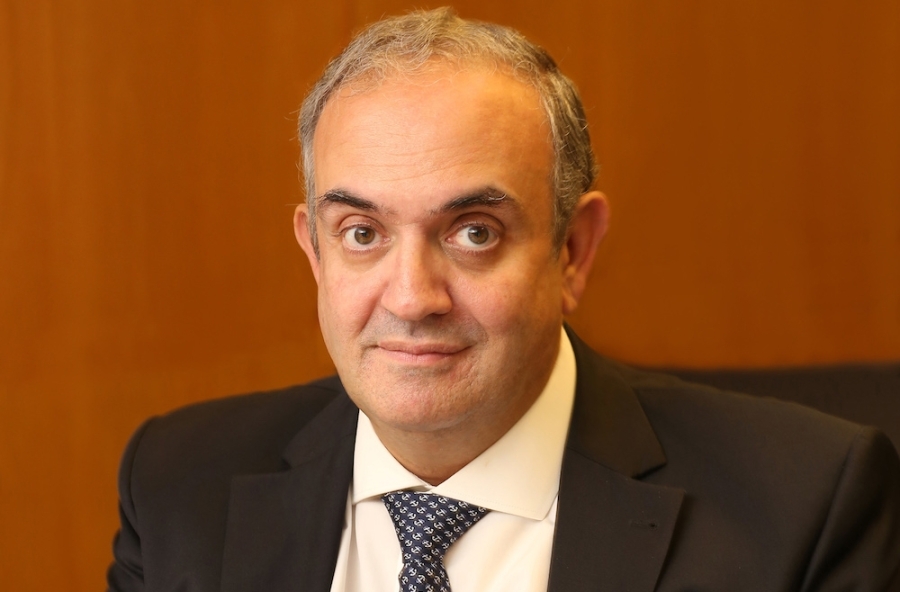
On the occasion of GSCC (Greek Shipping Cooperation Committee) New Year pitta cutting, Mr. Haralambos Fafalios in his speech described the latest geopolitical events and climate crisis incidents that affect the world shipping industry.
He said: “The world has moved significantly on from the pandemic into an era of several significant wars going on, namely the Ukraine and Gaza.
To add to that we have a regional conflict in Yemen, which very significantly affects our business.
Primarily from the perspective of crew safety as well as potentially severing one of the most significant arteries of world trade i.e. the Red Sea and Suez Canal.
In fact, as this problem has been spreading, it might even affect the access to the Persian Gulf.
Against this backdrop, the low water levels in the Panama Canal seems a bit less worrisome but the effects to world maritime trade are all there.
As usual, the world shipping industry has been doing its best to counteract these issues and see to it that all nations are still receiving their wet and dry commodities as well as manufactured goods on time and on schedule.
Inflation is slightly abating itself but still the world’s most significant economic zones are coping in different ways.
Europe itself is just short of recession and has many elections to decide on its future direction.
The Far East, except for China, is still progressing forward as is India. China will have to take some very difficult economic decisions if it is to resuscitate various ailing parts of its economy.
Whilst the U.S. economy is moving strongly, an election in the autumn will leave voters with two relatively stark choices so far.
The world has learnt to live with sanctions and its effects on maritime trade has been significant as it has created a parallel universe of a fleet with few controls, which is involved in the transport of sanctioned commodities.
In the last twelve months all these factors have helped some sectors of the shipping markets and hindered others.
The tanker sector, both dirty and clean, enjoyed a fruitful and positive twelve months.
The gas carrier fleet, especially the LPG sector, reached new record highs in their freight rates.
The container sector has cooled down a lot and a very substantial orderbook does not bode well for the future. Interestingly, the car carrier market has been more fortunate with a record demand for vehicle transportation.
Dry bulk went through an unexceptional year, occasionally brought up by the odd FFA induced rally.
Apart from all these challenges, world shipping has been trying to adjust to a low carbon environment. Few realistic solutions at all have been provided by the technology suppliers such as ship and engine builders and the energy suppliers who have still not given us a real low carbon fuel on a well-to-wake basis. This is especially the case for tramp / bulk shipping.
The fuels that are being offered do not, at present, have a global bunkering network and in some cases are not proven to be safe, especially for seafarers.
So, it does the industry no good to add to its headaches with instruments such as ETS, CII, EEXI, which do not in any way encourage a path towards green shipping.
The fact that world shipping transports more than 90 per cent of world trade, in a manner which is more carbon efficient than any other mode of transport, speaks highly of shipping’s continuous aim of lowering its carbon footprint.
The Greek shipping industry itself, one of two largest in the world, is engaged in a very substantial newbuilding programme in all sectors in order to provide vessels suitable for the future.
As the Greek fleet itself carries most of the world’s tramp trade, i.e. dry bulk, gas and tanker, it has to be more versatile than any other fleet and adhere to the requirements of every nation and its legislative conditions.
In order to reach a net zero situation sooner rather than later, we urge all those who supply us with ships and fuels to increase their efforts to reach real solutions, to efficiently serve the tramp model.
We also think that legislators ought to supply more carrot and less stick in order to encourage progress as opposed to filling up their fiscal shortfalls.
The G.S.C.C. itself, being based in London, has the advantage of being close to all the major shipping bodies and has a close dialogue with all these organizations as well as non UK-based institutions. We are always working towards improving the global understanding of what Greek and world shipping does and how it goes about this in a seamless and low carbon manner.
We still urge the Greek government to upgrade the maritime education system and allow more private education establishments.
If the Greek flag is to survive the surrounding bureaucracy, it must improve itself significantly.
We cannot stress enough the need for Greece to have more permanent representation at the E.U. and the I.M.O. in order to increase the understanding of the maritime industry.
The Hellenic Coast Guard must remain an important backbone to the Greek maritime system with its global representation.
Most importantly, of all our gratitude goes to all our seafarers, who endure so many challenges every day and are rarely appreciated for their hard work.
World trade would not function without their selfless efforts every day of the year keeping ships trading from one port to the other whilst encountering rough seas and challenging port environments.
Those working in shipping offices ashore must also not be forgotten for all their hard work in keeping this vital industry functioning smoothly”.
Concluding Mr. Fafalios thanked G.S.C.C. colleagues for their dedication and hard work and in particular to Kostas Amarantidis and his team for running this organization so efficiently in these difficult times.
Image: Mr. Haralambos Fafalios, President of the Greek Shipping Co-operation Committee
ELNAVI Newsletter
More Information: ELNAVI,
19, Aristidou str., Piraeus 185 31,
Tel.: +30 210 45.22.100, e-mail: This email address is being protected from spambots. You need JavaScript enabled to view it.